SendTech Times
Funding
CAPACITY TEST:

Daifuku ties factory expansion and M&A to a bigger bet on semiconductor and logistics automation demand

Article summary

Daifuku used a May 28, 2026 briefing in Tokyo to outline how heavier capital spending and selective acquisitions are meant to support its fiscal 2030 sales target of ¥1 trillion. The plan includes ¥1.6 trillion in investment across fiscal 2024-2027, added capacity in Shiga and Komaki, and the planned acquisition of Germany’s Eisenmann to strengthen its automotive business in Europe. The move matters beyond one company because it signals confidence that chip fabs, cleanroom production and large-scale intralogistics projects will keep demanding more complex material-handling systems and software.
Daifuku ties factory expansion and M&A to a bigger bet on semiconductor and logistics automation demand
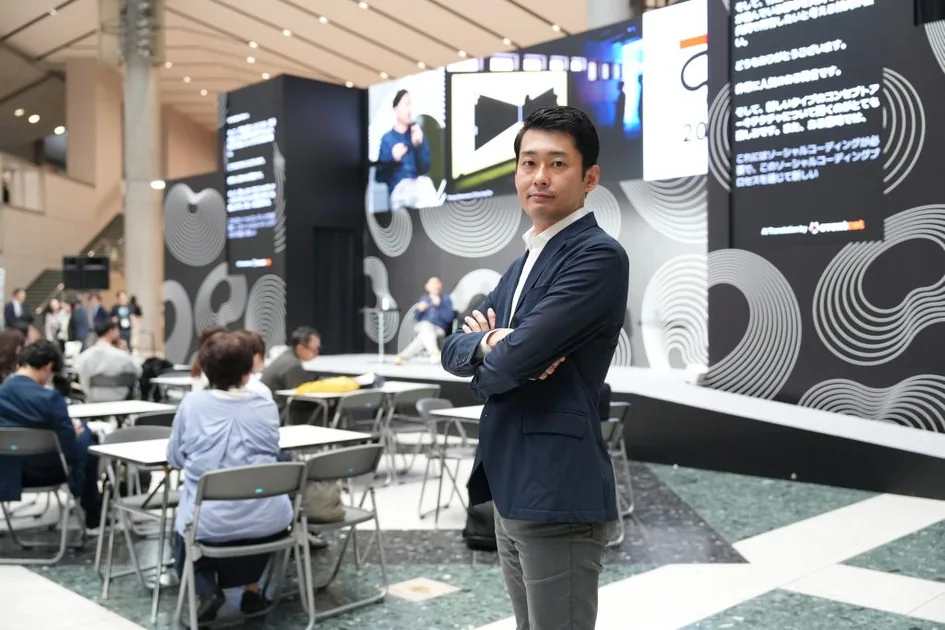
Image source: MONOist

What Happened

Daifuku on May 28, 2026, detailed growth investments tied to its long-term vision, “Driving Innovative Impact 2030,” under which it is targeting sales of ¥1 trillion by fiscal 2030.

The company said it will invest about ¥52 billion during 2026-2029 in areas including M&A and production capacity reinforcement to improve competitiveness.

It also laid out a broader capital plan of ¥160 billion over fiscal 2024-2027: ¥80 billion already planned for regular equipment renewal and R&D over three years, plus an additional ¥80 billion strategic investment allocation.

The spending is intended for next-generation R&D and production equipment.

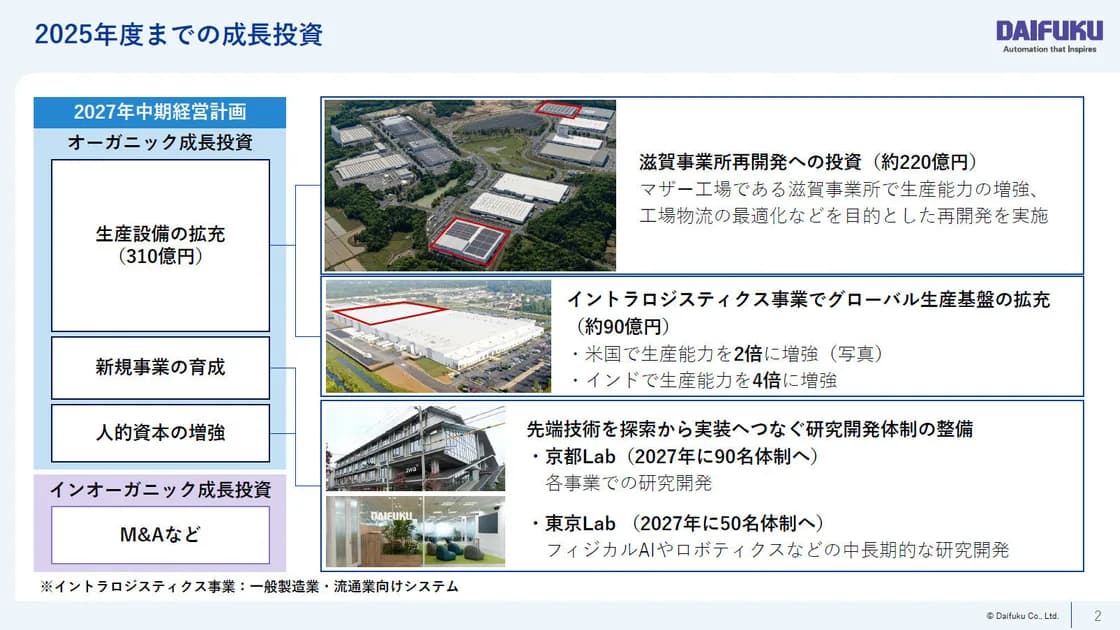
At its Shiga site in Hino, Shiga Prefecture, Daifuku has been redeveloping the mother factory since 2024 to raise production capacity and optimize factory logistics.

New buildings for general manufacturing and distribution systems began operating in July 2025, and a new building for semiconductor production-line systems began operating in April 2026.

Those projects involved about ¥22 billion.

Daifuku is now planning roughly ¥30 billion more for two additional Shiga buildings: one for intralogistics production capacity and warehouse use, and another warehouse building for the cleanroom and automotive businesses.

The Shiga site would then total 17 buildings.

The company is also investing about ¥10 billion to fully renovate an existing building at its Komaki site in Aichi Prefecture, which produces components including non-contact power supply devices, power panels and control panels for overhead hoist transport systems used in cleanrooms.

Construction and renovation are scheduled for completion during 2029-2030.

Daifuku said production space versus 2023 will expand to about 1.3 times in intralogistics and about 2 times in cleanroom operations.

Outside Japan, Daifuku said it is building a new factory in India to quadruple production capacity for its global intralogistics manufacturing base and renovating an existing US plant to double capacity.

In automotive, it announced in April 2026 that it would acquire Germany-based Eisenmann, which handles conveyor systems for auto production lines and industrial painting equipment.

The expected acquisition price is about ¥12 billion, with closing planned for July 2026.

The company said it will continue exploring M&A without setting constraints by industry or region.

R&D is also being expanded.

Daifuku set up Kyoto Lab in 2025 for advanced technologies needed by business divisions and established Tokyo Lab in 2026 to pursue mid- to long-term development in areas including physical AI and robotics.

By 2027, Kyoto Lab is planned to have 90 staff and Tokyo Lab 50.

Why It Matters

The immediate significance is that Daifuku is investing not only in floor space but in the ability to serve much larger and more software-intensive automation projects.

President Tomoaki Terai said projects that once involved 100 transport vehicles are now reaching 1,000 vehicles in a single large factory, and 10 connected factories could imply about 10,000 vehicles and total transport routes of 300 kilometers.

He also emphasized the importance of software reliability in running those systems.

That matters because the company is positioning for demand where material handling is becoming a system-level bottleneck rather than a peripheral equipment purchase.

In semiconductor and cleanroom environments, delivery timing, uptime and integration quality could matter as much as hardware output.

If fab and advanced manufacturing investments stay elevated, suppliers able to scale both equipment production and control software may be better placed to win larger packages.

Global Context

This fits a wider industrial pattern in which automation suppliers are expanding near major manufacturing hubs and trying to deepen their role inside production workflows.

Broadly, semiconductor capacity build-outs, warehouse modernization and more automated automotive plants have increased demand for conveyors, hoist transport, controls and orchestration software.

Daifuku’s India and US capacity moves suggest a hedging strategy across regions, while the Eisenmann acquisition points to a push for stronger local relevance in Europe.

More generally, the competitive field is shifting from standalone machinery toward integrated platforms that combine equipment, power systems, controls, robotics and software.

The company’s use of the term physical AI in its Tokyo Lab plans suggests it sees future differentiation coming from smarter autonomous or semi-autonomous factory operations, though the commercial pace of that transition remains uncertain.

Industry Impact

For semiconductor and cleanroom customers, Daifuku’s expansion could improve supply assurance if demand remains strong, especially for overhead transport-related systems and adjacent controls.

For automotive manufacturers, the Eisenmann deal could broaden Daifuku’s process coverage in Europe beyond conveying into paint-related stages.

For rivals, the message is that scale, regional manufacturing footprint and software credibility are increasingly linked.

The announcement is also notable for showing that M&A is being treated as a capability tool, not only a market-share tool.

That could encourage further consolidation across specialist automation, controls and production-line engineering segments if customers continue favoring larger, end-to-end suppliers.

What To Watch Next

Key near-term markers are whether the Eisenmann acquisition closes in July 2026 as planned, whether the added Shiga and Komaki projects stay on schedule for 2029-2030 completion, and how quickly the labs scale to their planned 2027 headcounts.

Investors and customers will also likely watch whether cleanroom and intralogistics demand remains strong enough to justify the new capacity.

Another open question is how much of Daifuku’s future edge comes from software and AI-enabled control rather than purely from hardware output.

The article does not provide deployment-scale metrics beyond examples cited by management, nor does it disclose future revenue contribution by segment, so the commercial payoff from these investments will need to be tracked over time.


Share this article
inXf

Related articles

More
Bluesky Warns Teen Social Media Bans Could Tighten Big Tech's Grip
Science & Tech

Bluesky Warns Teen Social Media Bans Could Tighten Big Tech's Grip

Bluesky COO Rose Wang warned that teen social media bans could strengthen large technology platforms if compliance costs fall harder on smaller rivals. Australia's ban for under-16s requires age-verification steps and can carry fines of up to 49.5 million Australian dollars, or $35 million, for non-compliance. The practical test is whether online-safety rules can protect young users without making scale and compliance teams the main market advantage.

Ciena's $50 Billion AI Network Target Puts Optical Capacity on the Hyperscaler Clock
Chips & Semiconductors

Ciena's $50 Billion AI Network Target Puts Optical Capacity on the Hyperscaler Clock

Ciena says AI demand could roughly double its addressable market to about $50 billion by 2029 as hyperscalers and service providers invest in optical networking. It cited RLS Hyper Rail, DCOM, coherent modules and 400G/800G pluggable optics as demand areas while planning $250 million to $275 million in capex this year. The practical test is whether AI compute buildouts convert into durable network orders.

Warren Hearing Request Puts Nvidia China Chip Sales Under Export-Control Scrutiny
Chips & Semiconductors

Warren Hearing Request Puts Nvidia China Chip Sales Under Export-Control Scrutiny

Sen. Elizabeth Warren invited Nvidia CEO Jensen Huang to testify before the Senate Banking Committee on June 11 over China chip sales and export controls. The request focuses on Nvidia's views on U.S. export control laws and its business in China as lawmakers scrutinize advanced AI chip flows. The next signal is whether Huang appears and gives senators enough detail on Nvidia's China strategy and national-security posture.

AMD Server CPU Share Hits 33.2% as AI Server Demand Lifts the Segment
Chips & Semiconductors

AMD Server CPU Share Hits 33.2% as AI Server Demand Lifts the Segment

AMD reached 33.2 percent of the server CPU market in the first quarter of 2026 as overall x86 processor shipments fell by more than six percent. Server CPU unit shipments rose by more than 10 percent from a year earlier, while Intel still held roughly two-thirds of the server CPU market. The next signal is whether AI server demand keeps server processors stronger than the wider PC and client CPU cycle.

Keep Reading

More Stories

Latest
Apple AI Architecture Puts Google And Nvidia Inside Its Privacy TestAIJun 9, 2026Apple AI Architecture Puts Google And Nvidia Inside Its Privacy TestApple is using Google and Nvidia to support its most advanced cloud AI model while trying to keep Apple Intelligence centered on private orchestration, proprietary models and on-device context.Amazon-Corning Fiber Deal Puts Optics Inside The AI Data Center BottleneckCloud & Data CentersJun 9, 2026Amazon-Corning Fiber Deal Puts Optics Inside The AI Data Center BottleneckAmazon has reached a multi-year optical fiber and networking agreement with Corning, adding North Carolina manufacturing jobs and highlighting fiber capacity as a practical constraint in AI data center expansion.Check Point VPN Exploitation Puts Legacy IKEv1 Access In The Ransomware SpotlightCybersecurityJun 8, 2026Check Point VPN Exploitation Puts Legacy IKEv1 Access In The Ransomware SpotlightA critical Check Point VPN flaw, CVE-2026-50751, is being exploited against legacy IKEv1 remote-access configurations, with activity tied in one case to a Qilin ransomware affiliate and a second related VPN issue also disclosed.Silent Ransom Group Uses Fake IT Support Calls to Pressure Law FirmsCybersecurityJun 8, 2026Silent Ransom Group Uses Fake IT Support Calls to Pressure Law FirmsSilent Ransom Group is targeting U.S. law firms and professional services organizations with fake IT support calls, remote access tools and rapid data-theft extortion. Mandiant links the activity to UNC3753, Luna Moth and Chatty Spider, while the FBI has warned of related social engineering and in-person theft attempts.Alphabet’s $85 Billion AI Financing Push Tests Data Center Investor AppetiteCloud & Data CentersJun 8, 2026Alphabet’s $85 Billion AI Financing Push Tests Data Center Investor AppetiteAlphabet is seeking $85 billion in equity financing after raising its capex outlook to as high as $190 billion. The company is presenting Google Cloud growth, AI adoption and lower Gemini serving costs as evidence that its data center spending can support long-term AI demand.Apple WWDC 2026 Turns Siri Into the Test of Its AI CredibilityAIJun 8, 2026Apple WWDC 2026 Turns Siri Into the Test of Its AI CredibilityApple is expected to put Siri back at the center of WWDC 2026 after delays to its promised Apple Intelligence assistant. The event is likely to test whether Apple can turn contextual awareness, chatbot-style interaction and agentic voice tasks into reliable platform features.ChatGPT Lockdown Mode Narrows AI Data Exfiltration PathsCybersecurityJun 8, 2026ChatGPT Lockdown Mode Narrows AI Data Exfiltration PathsOpenAI is rolling out Lockdown Mode for eligible ChatGPT users to reduce data exfiltration risk from prompt injection. The optional setting limits outbound web and tool capabilities, trading some product flexibility for stronger containment around sensitive workflows.Smart TV Proxy SDKs Turn Free Apps Into a Hidden AI Scraping Supply ChainCybersecurityJun 7, 2026Smart TV Proxy SDKs Turn Free Apps Into a Hidden AI Scraping Supply ChainBright Data's SDK has been reverse-engineered in research showing how free apps can turn consumer devices, including smart TVs, into residential proxy nodes for web-scraping traffic. The issue matters because AI data harvesting is increasing demand for residential IPs, while consent screens and background network behavior may not be clear to users or IT teams.Stratos Data Center Cuts Utah Plan as Water Backlash Tests AI Infrastructure GrowthAIJun 7, 2026Stratos Data Center Cuts Utah Plan as Water Backlash Tests AI Infrastructure GrowthA Kevin O'Leary-backed Utah data center plan has been cut back after water and transparency objections, showing how local resistance can reshape AI infrastructure projects.Dubai Hotels Turn to Residents as Tourism Shock Tests Luxury DemandEconomyJun 7, 2026Dubai Hotels Turn to Residents as Tourism Shock Tests Luxury DemandDubai luxury hotels are using resident staycation discounts to offset weaker international tourism, but the source shows weekend demand cannot fully replace longer foreign stays.liko.ai Funding Turns Edge AI Into a Smart-Home Hardware TestAIJun 7, 2026liko.ai Funding Turns Edge AI Into a Smart-Home Hardware Testliko.ai completed its first-round financing to fund edge-side vision-language models, AI-native hardware and multi-modal home terminals. The investor group includes Shangtang Guoxiang Capital, Orient Fortune Capital, iFlytek Venture Capital, Hongtai Fund, Zhengxuan Investment and Mianbi Intelligence. The practical test is whether the startup can turn camera-based edge AI into a consumer smart-home hub without relying on cloud processing.Impact Circle Turns Impact Finance Into a Japan Fintech Measurement TestFintech & Digital PaymentsJun 7, 2026Impact Circle Turns Impact Finance Into a Japan Fintech Measurement TestTokyo-based Impact Circle is building a fintech model that measures social impact through its own lending and visualization businesses. The company won the Tokyo Financial Award 2025 financial innovation category and raised 335 million yen in a November 2024 Series A round. The next signal is whether Impact Cloud IC can turn impact measurement into a repeatable workflow for investors and Japanese corporations.