SendTech Times
Guide
AI SHIFT:

Japan’s AI Suitcase Turns Assistive Mobility Into a Robotics Test Case

Article summary

CAAMP, a consortium that includes university research institutes and IBM Japan, has developed the AI Suitcase to guide visually impaired users with sensors, cameras, motors and AI. The suitcase is being tested at locations including Miraikan, New Chitose Airport and Tokyo’s Nihonbashi district, where 39 visually impaired participants completed a monthlong indoor trial without collisions. An updated indoor-and-outdoor model is planned for Expo 2025 in Osaka, with CAAMP aiming to collect feedback from 2,000 to 3,000 people without visual disabilities.
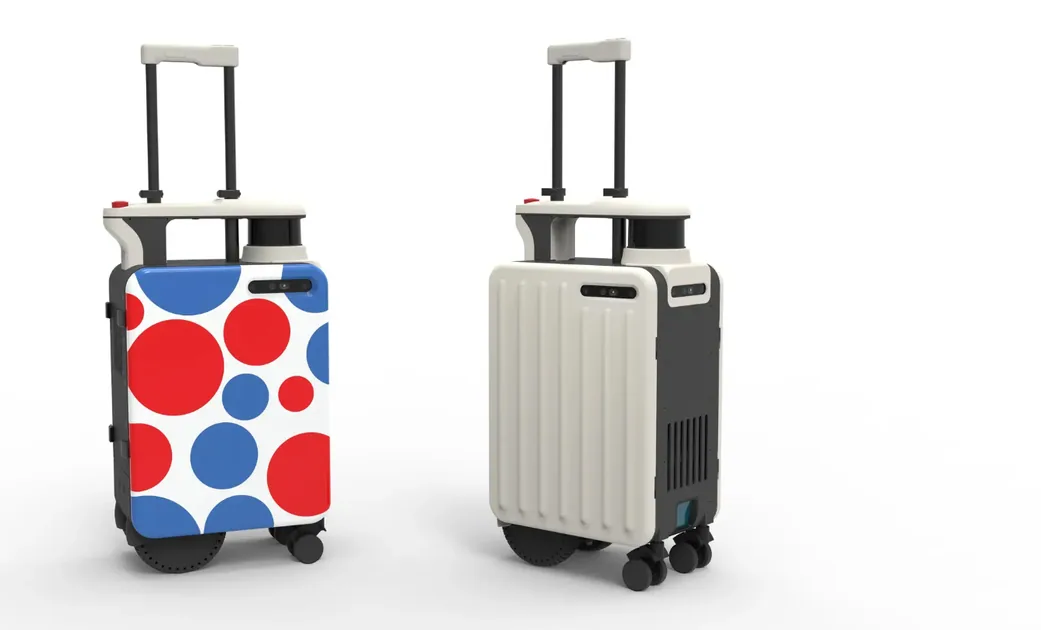
Japan’s AI Suitcase Turns Assistive Mobility Into a Robotics Test Case
Image source: JStories / Consortium for Advanced Assistive Mobility Platform (CAAMP)

What happened

A Japanese assistive-technology consortium has pushed the AI Suitcase from research concept toward public demonstration, positioning a suitcase-shaped robot as a potential mobility aid for people with visual disabilities.

The Consortium for Advanced Assistive Mobility Platform, or CAAMP, includes university research institutes and major companies such as IBM Japan.

The device combines a computer, image-recognition sensors, cameras and motors to guide a user toward a selected destination.

Users choose where they want to go through a smartphone app, grip the handle and receive directional cues through handle vibration.

Releasing the handle stops the suitcase.

The system also uses LiDAR to judge distance from obstacles and real-time kinematics technology based on satellite signals and ground-station data.

The onboard computer processes that information so the robot can estimate its location in more complex outdoor settings.

CAAMP is also exploring functions that use cloud data and image recognition to describe nearby shops, people and products.

Why it matters

The project is a market signal for robotics beyond factory automation.

Japan is testing whether AI navigation, sensor fusion and human-machine interaction can become practical infrastructure for accessibility in public spaces.

If the system proves reliable, it could affect airports, museums, shopping centers and transport hubs that need safer ways to support independent mobility.

The work also shows how assistive robotics may depend less on a single breakthrough than on the integration of several mature technologies: smartphone interfaces, computer vision, LiDAR, localization and edge computing.

The commercial question is whether those parts can operate smoothly in crowded indoor and outdoor environments.

Who is affected

The primary users are people with visual disabilities who may need navigation support in places where guide dogs are restricted or where route guidance requires more precise destination control.

Public-venue operators could also be affected if assistive robots become part of accessibility planning.

The project was initiated by Chieko Asakawa, chief executive director of the National Museum of Emerging Science and Innovation, known as Miraikan, and a fellow at the University of Tokyo’s Research Center for Advanced Science and Technology.

Demonstration testing has taken place at large shopping malls, New Chitose Airport in Hokkaido, Miraikan in Tokyo and the outdoor route between Miraikan and the nearest train station.

In a monthlong Nihonbashi district test in September 2022, 39 visually impaired participants used the AI Suitcase to reach multiple destinations on the same floor of a building.

The test ended with all users arriving safely and without collisions or other reported problems.

What to watch next

The next proving ground is Expo 2025 in Osaka, where the AI Suitcase has been selected for a Robot Experience exhibit.

A special model designed for both indoor and outdoor use is planned, with improvements including wheels intended to handle steps more easily and a sensor designed to detect low obstacles.

Masashi Oikawa of CAAMP said the group wants to improve technical performance for indoor and outdoor use and check non-functional requirements such as social acceptability and legal compliance.

CAAMP hopes 2,000 to 3,000 people without visual disabilities will test or experience the suitcase during the expo.

Readers should watch whether the expo tests show that the system can handle crowds, uneven surfaces and public-space rules.

Those results may determine whether AI mobility assistance remains a demonstration project or moves closer to real deployment.


Share this article
inXf

Related articles

More
liko.ai Funding Turns Edge AI Into a Smart-Home Hardware Test
AI

liko.ai Funding Turns Edge AI Into a Smart-Home Hardware Test

liko.ai completed its first-round financing to fund edge-side vision-language models, AI-native hardware and multi-modal home terminals. The investor group includes Shangtang Guoxiang Capital, Orient Fortune Capital, iFlytek Venture Capital, Hongtai Fund, Zhengxuan Investment and Mianbi Intelligence. The practical test is whether the startup can turn camera-based edge AI into a consumer smart-home hub without relying on cloud processing.

Airbnb’s Chesky Tests Whether AI Needs Its Own Interface Lab
AI

Airbnb’s Chesky Tests Whether AI Needs Its Own Interface Lab

Brian Chesky is preparing to support a separate AI research effort centered on interface design while keeping his Airbnb CEO role. Airbnb’s AI markers include 40% customer-support automation, conversational search built around a large language model, and a planned voice assistant later this year. The central question is whether a founder-led lab can turn interface research into useful consumer AI without a disclosed team, funding amount or timeline.

Japan’s Gennai AI Push Tests Public-Sector Guardrails For Diet Answers
AI

Japan’s Gennai AI Push Tests Public-Sector Guardrails For Diet Answers

Japan’s government is using its in-house generative AI system Gennai to help prepare Diet answer documents as officials defend the workflow against criticism. Digital Minister Matsumoto said Gennai can identify related systems and past answers, while staff still revise outputs and check facts before material reaches the minister. The practical test is whether the tool reduces late-night bureaucratic work without turning parliamentary answers into unchecked AI output.

Perplexity Makes AI Efficiency the Next Test for Agentic Platforms
AI

Perplexity Makes AI Efficiency the Next Test for Agentic Platforms

Perplexity CEO Aravind Srinivas is positioning AI efficiency around the metric of token value per watt per user. The company's Personal Computer product is an orchestration layer that decides which model to use, how agents cooperate and where AI processing should happen. The market test is whether Perplexity can convert its neutral, cross-model approach into durable value while larger platform companies build their own AI agents.

Keep Reading

More Stories

Latest
Nvidia 6G Radio Chip Plan Moves AI-RAN Into Telecom EdgeChips & SemiconductorsJun 9, 2026Nvidia 6G Radio Chip Plan Moves AI-RAN Into Telecom EdgeNvidia is working on a GPU-based chip for 6G radio units, extending AI-RAN into low-PHY radio processing while power, supplier integration and RAN spending remain the key tests.Apple AI Architecture Puts Google And Nvidia Inside Its Privacy TestAIJun 9, 2026Apple AI Architecture Puts Google And Nvidia Inside Its Privacy TestApple is using Google and Nvidia to support its most advanced cloud AI model while trying to keep Apple Intelligence centered on private orchestration, proprietary models and on-device context.Amazon-Corning Fiber Deal Puts Optics Inside The AI Data Center BottleneckCloud & Data CentersJun 9, 2026Amazon-Corning Fiber Deal Puts Optics Inside The AI Data Center BottleneckAmazon has reached a multi-year optical fiber and networking agreement with Corning, adding North Carolina manufacturing jobs and highlighting fiber capacity as a practical constraint in AI data center expansion.Check Point VPN Exploitation Puts Legacy IKEv1 Access In The Ransomware SpotlightCybersecurityJun 8, 2026Check Point VPN Exploitation Puts Legacy IKEv1 Access In The Ransomware SpotlightA critical Check Point VPN flaw, CVE-2026-50751, is being exploited against legacy IKEv1 remote-access configurations, with activity tied in one case to a Qilin ransomware affiliate and a second related VPN issue also disclosed.Silent Ransom Group Uses Fake IT Support Calls to Pressure Law FirmsCybersecurityJun 8, 2026Silent Ransom Group Uses Fake IT Support Calls to Pressure Law FirmsSilent Ransom Group is targeting U.S. law firms and professional services organizations with fake IT support calls, remote access tools and rapid data-theft extortion. Mandiant links the activity to UNC3753, Luna Moth and Chatty Spider, while the FBI has warned of related social engineering and in-person theft attempts.Alphabet’s $85 Billion AI Financing Push Tests Data Center Investor AppetiteCloud & Data CentersJun 8, 2026Alphabet’s $85 Billion AI Financing Push Tests Data Center Investor AppetiteAlphabet is seeking $85 billion in equity financing after raising its capex outlook to as high as $190 billion. The company is presenting Google Cloud growth, AI adoption and lower Gemini serving costs as evidence that its data center spending can support long-term AI demand.Apple WWDC 2026 Turns Siri Into the Test of Its AI CredibilityAIJun 8, 2026Apple WWDC 2026 Turns Siri Into the Test of Its AI CredibilityApple is expected to put Siri back at the center of WWDC 2026 after delays to its promised Apple Intelligence assistant. The event is likely to test whether Apple can turn contextual awareness, chatbot-style interaction and agentic voice tasks into reliable platform features.ChatGPT Lockdown Mode Narrows AI Data Exfiltration PathsCybersecurityJun 8, 2026ChatGPT Lockdown Mode Narrows AI Data Exfiltration PathsOpenAI is rolling out Lockdown Mode for eligible ChatGPT users to reduce data exfiltration risk from prompt injection. The optional setting limits outbound web and tool capabilities, trading some product flexibility for stronger containment around sensitive workflows.Smart TV Proxy SDKs Turn Free Apps Into a Hidden AI Scraping Supply ChainCybersecurityJun 7, 2026Smart TV Proxy SDKs Turn Free Apps Into a Hidden AI Scraping Supply ChainBright Data's SDK has been reverse-engineered in research showing how free apps can turn consumer devices, including smart TVs, into residential proxy nodes for web-scraping traffic. The issue matters because AI data harvesting is increasing demand for residential IPs, while consent screens and background network behavior may not be clear to users or IT teams.Stratos Data Center Cuts Utah Plan as Water Backlash Tests AI Infrastructure GrowthAIJun 7, 2026Stratos Data Center Cuts Utah Plan as Water Backlash Tests AI Infrastructure GrowthA Kevin O'Leary-backed Utah data center plan has been cut back after water and transparency objections, showing how local resistance can reshape AI infrastructure projects.Dubai Hotels Turn to Residents as Tourism Shock Tests Luxury DemandEconomyJun 7, 2026Dubai Hotels Turn to Residents as Tourism Shock Tests Luxury DemandDubai luxury hotels are using resident staycation discounts to offset weaker international tourism, but the source shows weekend demand cannot fully replace longer foreign stays.Ciena's $50 Billion AI Network Target Puts Optical Capacity on the Hyperscaler ClockChips & SemiconductorsJun 7, 2026Ciena's $50 Billion AI Network Target Puts Optical Capacity on the Hyperscaler ClockCiena says AI demand could roughly double its addressable market to about $50 billion by 2029 as hyperscalers and service providers invest in optical networking. It cited RLS Hyper Rail, DCOM, coherent modules and 400G/800G pluggable optics as demand areas while planning $250 million to $275 million in capex this year. The practical test is whether AI compute buildouts convert into durable network orders.