SendTech Times
Funding
REGULATION WATCH:

Korea’s Weak Won Is Exposing a Policy Credibility Problem

Article summary

South Korea’s won is trading near crisis-era lows even as AI-driven semiconductor demand has produced a record external surplus and a historic rally in chip stocks. The pressure reflects a capital-flow puzzle: exporters are earning dollars, foreign investors are selling Korean equities, and chipmakers may be keeping more revenue offshore. The political risk is that Seoul treats the currency slide as a temporary market anomaly rather than a warning about policy credibility, asset inflation and dependence on a semiconductor cycle.
Korea’s Weak Won Is Exposing a Policy Credibility Problem
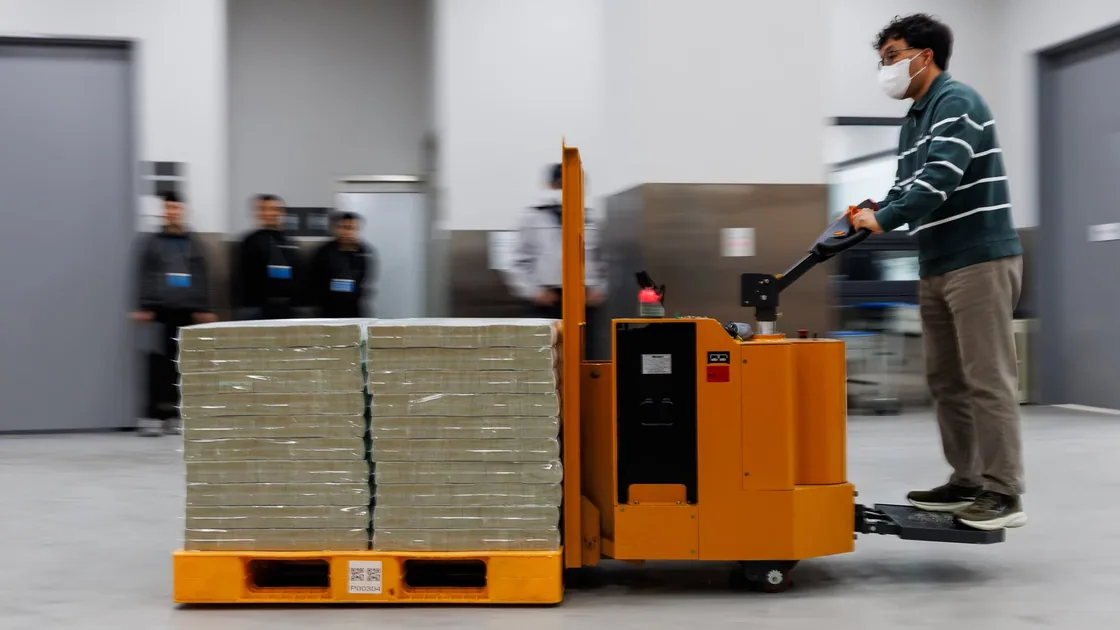
Image source: SeongJoon Cho/Bloomberg via Financial Times

Korea’s Currency Puzzle Is Bigger Than Semiconductors

South Korea should, on paper, have the conditions for a stronger currency.

AI demand has lifted the country’s semiconductor exports, chipmakers are reporting record profits, and the equity market has surged.

Yet the won remains weak.

It has fallen 4 percent against the dollar this year and is trading around levels associated with the 2008-09 financial crisis.

The Financial Times article notes that the currency has been one of Asia’s worst performers, despite a first-quarter current account surplus of USD 73.8 billion and large profits at Samsung Electronics and SK Hynix.

That contradiction is the core issue.

Korea is earning dollars through semiconductors, but the currency is not behaving like the market believes those earnings will fully support the domestic economy.

The Bank of Korea has described the won as “excessively weak relative to economic fundamentals” and said authorities could take “decisive action” if necessary.

That statement acknowledges the problem, but it does not yet amount to a convincing policy framework.

Dollar Earnings Are Not the Same as Won Support

The semiconductor boom does not automatically strengthen the won if exporters do not convert their overseas earnings back into local currency.

Analysts in the article pointed to that possibility.

Large Korean companies such as Samsung and SK Hynix are holding a significant portion of revenue in foreign currencies to fund global operations, according to Patrick Han of SK Securities.

Brad Setser of the Council on Foreign Relations called the phenomenon “DRam dollars,” comparing Korea’s chip-generated current account surplus to the way oil-exporting economies recycle dollar earnings into US assets.

That means Korea can run a large external surplus and still see currency weakness if those dollars do not return to the domestic financial system.

The won’s weakness is therefore not just a trade story.

It is a capital-flow story.

Foreign equity flows add another pressure point.

Foreign investors have sold a record USD 79 billion of South Korean equities this year, based on Financial Supervisory Service data .

RBC Capital Markets’ Abbas Keshvani said Korea’s equity market had “absolutely ripped,” with the Kospi doubling from October.

Portfolio managers may be selling to avoid becoming too concentrated in Korean equities or specific chip stocks.

This creates a strange market structure: Korea’s chip winners are rising sharply, but the capital-flow response may still weaken the currency.

A Political Double Standard

The currency move also creates a political credibility problem.

Critics of Lee Jae-myung argue that his side used exchange-rate anxiety around the 1,300-won level as an attack on the previous government.

With the exchange rate now far weaker, they argue that the same urgency is less visible.

That criticism matters because exchange-rate politics should not change depending on who holds power.

If 1,300 was framed as a national crisis before, then levels near 1,500 cannot be dismissed as a routine market move now.

If the earlier alarm was exaggerated, then Korea’s political class should admit that exchange-rate fear has been used selectively.

The won is not just a partisan talking point.

It affects import costs, inflation expectations, household purchasing power, capital flows and foreign investor confidence.

A government that once treated currency weakness as proof of national mismanagement should be held to the same standard when the currency weakens under its own watch.

Asset Prices Can Hide the Stress

The boom in semiconductor shares may also be masking the severity of the problem.

The FT article notes that Samsung shares have risen more than 400 percent over the past year and SK Hynix shares have climbed 970 percent, pushing both companies to USD 1 trillion market capitalisation.

Those are extraordinary market moves.

They show the scale of investor enthusiasm around AI-linked chip demand.

But rising asset prices do not automatically mean the broader economy is stronger.

In a weak-currency environment, money can move into equities and property as investors search for protection against declining purchasing power.

That can make markets look healthy even while the currency sends a warning signal.

This is where the policy concern becomes sharper.

Korea cannot assume that semiconductor profits are permanent.

The AI chip cycle may remain strong, but memory demand, pricing, export flows and global capital spending can change.

If the government and central bank rely too heavily on semiconductor earnings, they risk ignoring the need for a broader currency and financial-stability strategy.

The absence of a clear response is therefore dangerous.

If policymakers do not explain how they intend to manage currency weakness, imported inflation, asset-price pressure and capital outflows, the market will supply its own interpretation.

That interpretation may be that Korea is benefiting from a temporary semiconductor windfall while failing to address deeper financial vulnerabilities.

The Real Warning From the Won

The won’s weakness is not only a foreign-exchange issue.

It is a warning about confidence.

Korea still has world-class exporters, deep capital markets and major companies positioned at the centre of the AI supply chain.

But those strengths do not remove the need for credible policy.

A country can have a chip export boom and still face currency pressure if investors believe the gains are being recycled offshore, if foreign funds are reducing equity exposure, or if domestic policy looks passive.

The political culture makes the problem harder to discuss.

Korea’s public debate is often shaped by partisan loyalty, and economic warnings are too easily accepted or dismissed depending on which side they hurt.

That is a dangerous habit for a country facing a weakening currency, expensive imports, asset inflation and dependence on a semiconductor cycle.

Some analysts expect appreciation if repatriation begins or if market positioning changes.

RBC’s Keshvani said a rush of repatriation could trigger a sharp upward move if the won starts strengthening.

Sam Konrad of Jupiter Asset Management said he expected both the won and Taiwan dollar to appreciate, though he did not know the catalyst or timing.

The larger question is whether Korea’s political and monetary authorities understand the warning already visible in the currency.

A weak won during a semiconductor export boom is not a normal success story.

It is a signal that dollar earnings, domestic confidence and policy credibility are no longer moving together.

If Seoul keeps treating the issue as temporary while asset prices keep rising and the public looks away, the risk is not just a weaker currency.

The risk is that Korea mistakes a chip-cycle windfall for national resilience.

Share this article
inXf

Related articles

More
Oman's Energy Security Pitch Puts Ports, Private Capital and AI Demand in Focus
Economy

Oman's Energy Security Pitch Puts Ports, Private Capital and AI Demand in Focus

Oman was presented as a stronger energy and infrastructure hub as global markets put more weight on supply security and diversified trade routes. The Global Energy Debate at the 2nd Oman Capital Market Conference included Shell Oman, Oman LNG, OQ, BlackRock and Vision Invest. The next signal is whether private capital and infrastructure planning turn Oman's location, ports and energy assets into financed projects.

Dubai RTA Digital Revenue Shows Smart Mobility Moving Into Daily Use
Economy

Dubai RTA Digital Revenue Shows Smart Mobility Moving Into Daily Use

RTA said digital-channel revenue reached AED5.3 billion in 2025, up 20.6 percent from 2024. The authority reported more than 628 million digital transactions and 96 percent digital adoption. The next test is whether AI, WhatsApp and government-platform integrations make mobility services simpler.

Tokyo Uses Record-Scale SusHi Tech 2026 To Push Startup And Urban Innovation Agenda
Economy

Tokyo Uses Record-Scale SusHi Tech 2026 To Push Startup And Urban Innovation Agenda

SusHi Tech Tokyo 2026 opened at its largest scale, with projected attendance of more than 60,000 and around 10,000 expected business meetings. Tokyo Governor Yuriko Koike and Prime Minister Sanae Takaichi used the opening to frame startups as a shared national and metropolitan economic priority. The key test is whether new support programs, corporate partnerships and overseas participation translate into repeatable funding, pilots and market access.

Dubai RTA Turns AI Mobility Services Into A Dh5.3 Billion Digital Revenue Engine
Economy

Dubai RTA Turns AI Mobility Services Into A Dh5.3 Billion Digital Revenue Engine

Dubai RTA reported Dh5.3 billion in 2025 revenue from digital channels, up 20.6% year on year. The authority recorded more than 628 million digital transactions, with 96% digital adoption and 98% customer happiness. AI, apps, kiosks, WhatsApp services and shared government platforms are becoming the operating layer for Dubai mobility services.

Keep Reading

More Stories

Latest
Apple AI Architecture Puts Google And Nvidia Inside Its Privacy TestAIJun 9, 2026Apple AI Architecture Puts Google And Nvidia Inside Its Privacy TestApple is using Google and Nvidia to support its most advanced cloud AI model while trying to keep Apple Intelligence centered on private orchestration, proprietary models and on-device context.Amazon-Corning Fiber Deal Puts Optics Inside The AI Data Center BottleneckCloud & Data CentersJun 9, 2026Amazon-Corning Fiber Deal Puts Optics Inside The AI Data Center BottleneckAmazon has reached a multi-year optical fiber and networking agreement with Corning, adding North Carolina manufacturing jobs and highlighting fiber capacity as a practical constraint in AI data center expansion.Check Point VPN Exploitation Puts Legacy IKEv1 Access In The Ransomware SpotlightCybersecurityJun 8, 2026Check Point VPN Exploitation Puts Legacy IKEv1 Access In The Ransomware SpotlightA critical Check Point VPN flaw, CVE-2026-50751, is being exploited against legacy IKEv1 remote-access configurations, with activity tied in one case to a Qilin ransomware affiliate and a second related VPN issue also disclosed.Silent Ransom Group Uses Fake IT Support Calls to Pressure Law FirmsCybersecurityJun 8, 2026Silent Ransom Group Uses Fake IT Support Calls to Pressure Law FirmsSilent Ransom Group is targeting U.S. law firms and professional services organizations with fake IT support calls, remote access tools and rapid data-theft extortion. Mandiant links the activity to UNC3753, Luna Moth and Chatty Spider, while the FBI has warned of related social engineering and in-person theft attempts.Alphabet’s $85 Billion AI Financing Push Tests Data Center Investor AppetiteCloud & Data CentersJun 8, 2026Alphabet’s $85 Billion AI Financing Push Tests Data Center Investor AppetiteAlphabet is seeking $85 billion in equity financing after raising its capex outlook to as high as $190 billion. The company is presenting Google Cloud growth, AI adoption and lower Gemini serving costs as evidence that its data center spending can support long-term AI demand.Apple WWDC 2026 Turns Siri Into the Test of Its AI CredibilityAIJun 8, 2026Apple WWDC 2026 Turns Siri Into the Test of Its AI CredibilityApple is expected to put Siri back at the center of WWDC 2026 after delays to its promised Apple Intelligence assistant. The event is likely to test whether Apple can turn contextual awareness, chatbot-style interaction and agentic voice tasks into reliable platform features.ChatGPT Lockdown Mode Narrows AI Data Exfiltration PathsCybersecurityJun 8, 2026ChatGPT Lockdown Mode Narrows AI Data Exfiltration PathsOpenAI is rolling out Lockdown Mode for eligible ChatGPT users to reduce data exfiltration risk from prompt injection. The optional setting limits outbound web and tool capabilities, trading some product flexibility for stronger containment around sensitive workflows.Smart TV Proxy SDKs Turn Free Apps Into a Hidden AI Scraping Supply ChainCybersecurityJun 7, 2026Smart TV Proxy SDKs Turn Free Apps Into a Hidden AI Scraping Supply ChainBright Data's SDK has been reverse-engineered in research showing how free apps can turn consumer devices, including smart TVs, into residential proxy nodes for web-scraping traffic. The issue matters because AI data harvesting is increasing demand for residential IPs, while consent screens and background network behavior may not be clear to users or IT teams.Stratos Data Center Cuts Utah Plan as Water Backlash Tests AI Infrastructure GrowthAIJun 7, 2026Stratos Data Center Cuts Utah Plan as Water Backlash Tests AI Infrastructure GrowthA Kevin O'Leary-backed Utah data center plan has been cut back after water and transparency objections, showing how local resistance can reshape AI infrastructure projects.Dubai Hotels Turn to Residents as Tourism Shock Tests Luxury DemandEconomyJun 7, 2026Dubai Hotels Turn to Residents as Tourism Shock Tests Luxury DemandDubai luxury hotels are using resident staycation discounts to offset weaker international tourism, but the source shows weekend demand cannot fully replace longer foreign stays.Ciena's $50 Billion AI Network Target Puts Optical Capacity on the Hyperscaler ClockChips & SemiconductorsJun 7, 2026Ciena's $50 Billion AI Network Target Puts Optical Capacity on the Hyperscaler ClockCiena says AI demand could roughly double its addressable market to about $50 billion by 2029 as hyperscalers and service providers invest in optical networking. It cited RLS Hyper Rail, DCOM, coherent modules and 400G/800G pluggable optics as demand areas while planning $250 million to $275 million in capex this year. The practical test is whether AI compute buildouts convert into durable network orders.liko.ai Funding Turns Edge AI Into a Smart-Home Hardware TestAIJun 7, 2026liko.ai Funding Turns Edge AI Into a Smart-Home Hardware Testliko.ai completed its first-round financing to fund edge-side vision-language models, AI-native hardware and multi-modal home terminals. The investor group includes Shangtang Guoxiang Capital, Orient Fortune Capital, iFlytek Venture Capital, Hongtai Fund, Zhengxuan Investment and Mianbi Intelligence. The practical test is whether the startup can turn camera-based edge AI into a consumer smart-home hub without relying on cloud processing.