SendTech Times
News
AI SHIFT:

Satellite service growth draws more component makers into LEO supply chains

Article summary

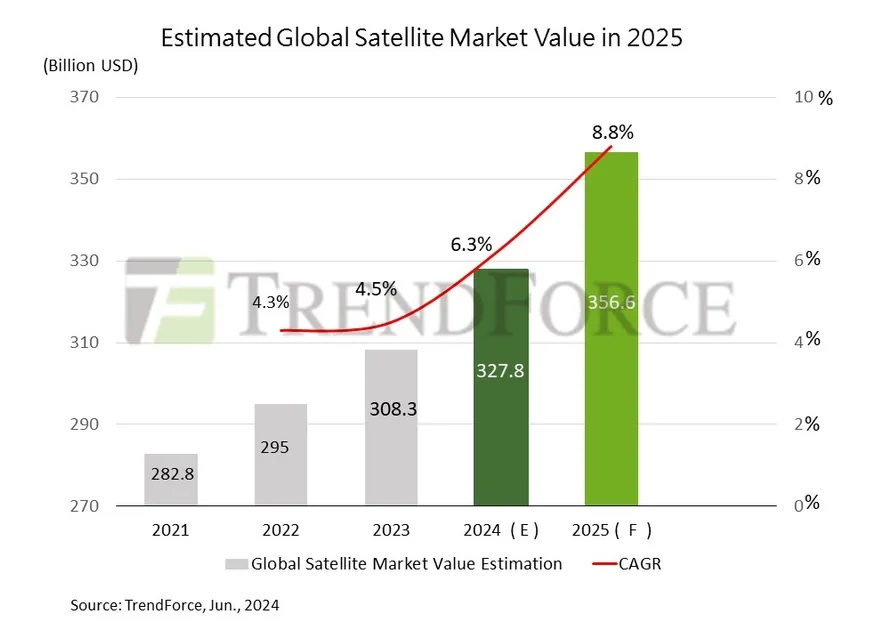
TrendForce said wider adoption of LEO satellite services is pushing component makers toward the supply chains of Starlink and OneWeb. The global satellite market is projected to rise from US$283 billion in 2021 to US$357 billion by 2025, a CAGR of 2.6% (about AED 1,309.69 billion). Starlink relies on vertical integration, while OneWeb uses an outsourced model that broadens participation across suppliers.
Satellite service growth draws more component makers into LEO supply chains
Image source: TrendForce

Market growth and supply-chain pull

TrendForce said growing use of LEO satellite services is encouraging component manufacturers around the world to join the supply chains of Starlink and OneWeb.

The firm projected that the global satellite market would increase from US$283 billion in 2021 to US$357 billion by 2025, representing a CAGR of 2.6%.

That outlook places the 2025 market at about AED 1,309.69 billion.

The report described how demand growth is affecting the structure of the satellite industry.

Rather than following a single manufacturing template, major LEO suppliers are building their systems with very different sourcing models.

TrendForce highlighted this contrast through Starlink and OneWeb, showing how one company keeps more production in-house while the other depends more heavily on external partners.

Starlink's vertically integrated approach

TrendForce said Starlink currently uses a vertical integration strategy for its supply chain.

It produces and assembles key satellite components at its own factory in Washington, USA.

The components named in the report include payload channel elements, Ka-band antenna elements, filters, and separators.

According to TrendForce, making these parts internally helps Starlink manage production conditions more directly and lowers supply-chain management complexity.

This model gives the company tighter control over critical manufacturing steps and assembly work.

TrendForce also said larger Taiwanese manufacturers that enter Starlink's supply chain usually have the resources and organizational systems needed to satisfy strict space testing requirements.

Examples include random vibration tests and separation shock tests.

Smaller Taiwanese satellite component makers, by contrast, face greater difficulty joining Starlink's supplier network because their resources are more limited.

OneWeb's outsourced supplier network

TrendForce described OneWeb as taking a highly outsourced approach to its supply chain.

The company assigns production of key satellite components to regional Tier 2 parts manufacturers.

After that, subsystem factories complete part of the assembly process before the components are delivered to OneWeb Satellite for final assembly.

This structure creates a more accessible path for outside suppliers than a tightly controlled in-house model.

TrendForce said the approach enables a wider range of component makers to work with OneWeb and supports their move into the LEO satellite sector.

The report presented this as an important distinction between the two companies' supply systems.

TrendForce added that small and medium-sized Taiwanese satellite component manufacturers are expected to seek partnerships with satellite companies that use open supply-chain arrangements such as OneWeb.

This route may offer a more practical entry point for firms that cannot easily meet the demands of a vertically integrated supplier system.

Taiwan-related collaboration efforts

TrendForce said opportunities for cooperation between OneWeb and Taiwanese key component manufacturers are being promoted through government project plans and field verification models.

The report said support from LEO satellite projects can help Taiwanese satellite component makers reduce some of the risks tied to entering an emerging market.

It also said these projects can give manufacturers an initial view of how target markets are accepting LEO satellite services and help them judge how much they may want to invest in the future.

In that context, the spread of satellite services is not only expanding the market's size, but also reshaping who can participate in the supply chain and under what conditions.

Across the market, TrendForce's comparison of Starlink and OneWeb points to two different ways suppliers are being drawn into LEO production: a vertically integrated model centered on internal manufacturing control, and an outsourced model built around regional component and subsystem partners.


Share this article
inXf

Related articles

More
VodafoneThree Job Cuts Signal Faster, Vendor-Led 5G Integration
Telco & Connectivity

VodafoneThree Job Cuts Signal Faster, Vendor-Led 5G Integration

Vodafone’s annual report shows the UK workforce averaging 12,416 employees after the Vodafone-Three merger, about 12% below the simple pre-merger combined total. The merged operator is leaning more heavily on Ericsson and Nokia as it works toward CMA-linked 4G and 5G spectrum activation obligations. The shift raises a watchpoint for UK telecom consolidation: faster network integration may come with deeper dependence on a narrow group of RAN suppliers.

EchoStar's $183 Million Payment Delay Raises the Clock on Its AT&T Spectrum Sale
Telco & Connectivity

EchoStar's $183 Million Payment Delay Raises the Clock on Its AT&T Spectrum Sale

EchoStar delayed a $183 million interest payment while waiting for proceeds from its pending $23 billion spectrum sale to AT&T. The company said the missed payment is a default but noted a 30-day grace period and expected net closing proceeds of roughly $20.25 billion. The FCC has approved spectrum sales to AT&T and SpaceX but required a $2.4 billion escrow tied to potential Dish Wireless infrastructure claims.

AI Traffic Tests Telecom’s Network Spending Story
Telco & Connectivity

AI Traffic Tests Telecom’s Network Spending Story

Cisco forecast that AI could help push network traffic to 6.6 times current levels by 2035, but analysts and operator capex plans suggest many developed-market networks still have substantial unused capacity. Analysys Mason research cited busy-hour downlink loading of just 12% on older GPON broadband networks, while Omdia said annual RAN spending has stabilized at $35 billion after a $10 billion fall between 2022 and 2024. The key watchpoint is whether AI creates new supplementary traffic from vehicles, IoT and physical AI, or mostly substitutes for existing consumer data use without forcing a broad telecom spending cycle.

Community Fibre Turns UK Altnet Pressure Into a London Fiber Test Case
Telco & Connectivity

Community Fibre Turns UK Altnet Pressure Into a London Fiber Test Case

Community Fibre plans to expand its London fiber footprint to about 2 million premises and launch an unlimited 5G mobile offer next month. The operator says it has around 450,000 customers on a 1.4 million-premise footprint, giving it a take-up rate of roughly 33% in a difficult UK altnet market. The next test is whether its concentrated London model and VodafoneThree mobile partnership can withstand pricing pressure and consolidation.

Keep Reading

More Stories

Latest
Nvidia 6G Radio Chip Plan Moves AI-RAN Into Telecom EdgeChips & SemiconductorsJun 9, 2026Nvidia 6G Radio Chip Plan Moves AI-RAN Into Telecom EdgeNvidia is working on a GPU-based chip for 6G radio units, extending AI-RAN into low-PHY radio processing while power, supplier integration and RAN spending remain the key tests.Apple AI Architecture Puts Google And Nvidia Inside Its Privacy TestAIJun 9, 2026Apple AI Architecture Puts Google And Nvidia Inside Its Privacy TestApple is using Google and Nvidia to support its most advanced cloud AI model while trying to keep Apple Intelligence centered on private orchestration, proprietary models and on-device context.Amazon-Corning Fiber Deal Puts Optics Inside The AI Data Center BottleneckCloud & Data CentersJun 9, 2026Amazon-Corning Fiber Deal Puts Optics Inside The AI Data Center BottleneckAmazon has reached a multi-year optical fiber and networking agreement with Corning, adding North Carolina manufacturing jobs and highlighting fiber capacity as a practical constraint in AI data center expansion.Check Point VPN Exploitation Puts Legacy IKEv1 Access In The Ransomware SpotlightCybersecurityJun 8, 2026Check Point VPN Exploitation Puts Legacy IKEv1 Access In The Ransomware SpotlightA critical Check Point VPN flaw, CVE-2026-50751, is being exploited against legacy IKEv1 remote-access configurations, with activity tied in one case to a Qilin ransomware affiliate and a second related VPN issue also disclosed.Silent Ransom Group Uses Fake IT Support Calls to Pressure Law FirmsCybersecurityJun 8, 2026Silent Ransom Group Uses Fake IT Support Calls to Pressure Law FirmsSilent Ransom Group is targeting U.S. law firms and professional services organizations with fake IT support calls, remote access tools and rapid data-theft extortion. Mandiant links the activity to UNC3753, Luna Moth and Chatty Spider, while the FBI has warned of related social engineering and in-person theft attempts.Alphabet’s $85 Billion AI Financing Push Tests Data Center Investor AppetiteCloud & Data CentersJun 8, 2026Alphabet’s $85 Billion AI Financing Push Tests Data Center Investor AppetiteAlphabet is seeking $85 billion in equity financing after raising its capex outlook to as high as $190 billion. The company is presenting Google Cloud growth, AI adoption and lower Gemini serving costs as evidence that its data center spending can support long-term AI demand.Apple WWDC 2026 Turns Siri Into the Test of Its AI CredibilityAIJun 8, 2026Apple WWDC 2026 Turns Siri Into the Test of Its AI CredibilityApple is expected to put Siri back at the center of WWDC 2026 after delays to its promised Apple Intelligence assistant. The event is likely to test whether Apple can turn contextual awareness, chatbot-style interaction and agentic voice tasks into reliable platform features.ChatGPT Lockdown Mode Narrows AI Data Exfiltration PathsCybersecurityJun 8, 2026ChatGPT Lockdown Mode Narrows AI Data Exfiltration PathsOpenAI is rolling out Lockdown Mode for eligible ChatGPT users to reduce data exfiltration risk from prompt injection. The optional setting limits outbound web and tool capabilities, trading some product flexibility for stronger containment around sensitive workflows.Smart TV Proxy SDKs Turn Free Apps Into a Hidden AI Scraping Supply ChainCybersecurityJun 7, 2026Smart TV Proxy SDKs Turn Free Apps Into a Hidden AI Scraping Supply ChainBright Data's SDK has been reverse-engineered in research showing how free apps can turn consumer devices, including smart TVs, into residential proxy nodes for web-scraping traffic. The issue matters because AI data harvesting is increasing demand for residential IPs, while consent screens and background network behavior may not be clear to users or IT teams.Stratos Data Center Cuts Utah Plan as Water Backlash Tests AI Infrastructure GrowthAIJun 7, 2026Stratos Data Center Cuts Utah Plan as Water Backlash Tests AI Infrastructure GrowthA Kevin O'Leary-backed Utah data center plan has been cut back after water and transparency objections, showing how local resistance can reshape AI infrastructure projects.Dubai Hotels Turn to Residents as Tourism Shock Tests Luxury DemandEconomyJun 7, 2026Dubai Hotels Turn to Residents as Tourism Shock Tests Luxury DemandDubai luxury hotels are using resident staycation discounts to offset weaker international tourism, but the source shows weekend demand cannot fully replace longer foreign stays.Ciena's $50 Billion AI Network Target Puts Optical Capacity on the Hyperscaler ClockChips & SemiconductorsJun 7, 2026Ciena's $50 Billion AI Network Target Puts Optical Capacity on the Hyperscaler ClockCiena says AI demand could roughly double its addressable market to about $50 billion by 2029 as hyperscalers and service providers invest in optical networking. It cited RLS Hyper Rail, DCOM, coherent modules and 400G/800G pluggable optics as demand areas while planning $250 million to $275 million in capex this year. The practical test is whether AI compute buildouts convert into durable network orders.