SendTech Times
News
CAPACITY TEST:

Tencent Takes WorkBuddy AI Agent Global In Enterprise Productivity Push

Article summary

Tencent Cloud launched WorkBuddy for overseas users after an earlier China rollout. The agent can run tasks through messaging apps and connect with GitHub, Jira, Google Drive, Gmail, Notion, and Slack. Miora and TokenHub show Tencent building a wider enterprise AI stack around agents, creative work, and model access.
Tencent Takes WorkBuddy AI Agent Global In Enterprise Productivity Push
Image source: Pandaily

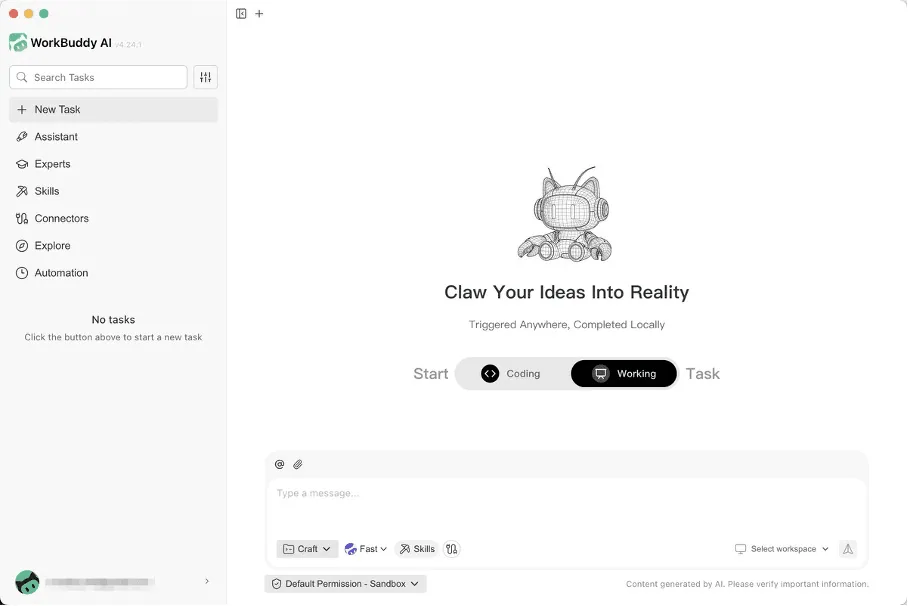
Tencent Cloud has moved WorkBuddy, its office-focused AI agent, into overseas markets after an earlier China launch.

The release is a useful signal because Chinese cloud and internet groups are trying to turn large-model work into products inside daily enterprise workflows.

The Product Move

WorkBuddy is designed for users who want an agent to execute work rather than only respond in a chat window.

Tencent says a user can write a natural-language request and the system can read resources, break the request into tasks, call outside tools, and return project files.

The source describes use cases across coding, analysis, productivity, presentations, spreadsheets, and research briefs.

That places WorkBuddy in the same competitive category as other enterprise AI agents that promise to reduce manual coordination across documents, code repositories, and collaboration systems.

Workflow Integrations

The important detail is where Tencent wants the agent to live.

WorkBuddy can be triggered through Slack, Telegram, Discord, and WeChat, so it is meant to operate inside messaging channels rather than as a separate destination app.

Tencent also says the product connects through MCP with GitHub, GitLab, Jira, Confluence, Google Drive, Gmail, Notion, and Slack.

Those integrations are central to the pitch: the agent becomes more valuable if it can work across files, tickets, email, and repositories with clear user permission.

Ecosystem Impact

The launch was not isolated.

Tencent also introduced Miora, an AI-native creative studio for brand and campaign assets, and TokenHub, a model-as-a-service platform that provides access to Tencent Hunyuan models and third-party models through a unified gateway.

Together, the products show Tencent building a workplace AI stack: agent execution, creative production, and model access.

The company is trying to convert its cloud and AI capabilities into tools that enterprises can test without heavy infrastructure setup.

Adoption Barrier

The main test is trust.

WorkBuddy's value depends on access to sensitive workplace systems, including code platforms, documents, email, and project-management tools.

Tencent says tasks run in a sandboxed environment by default and that local folder access needs explicit permission, but enterprise buyers will still examine security controls carefully.

The second test is whether the output is reliable enough for repeated use.

More than 100 built-in expert roles and support for user-selected large language models may lower adoption friction, but users will judge the product by whether it produces usable files and saves time.

What To Watch

WorkBuddy gives Tencent a clearer international position in AI agents.

The next indicators are adoption outside China, the depth of third-party tool support, and whether companies treat the agent as a daily productivity layer rather than an experimental assistant.


Share this article
inXf

Related articles

More
Microsoft Uses Build 2026 to Push Agents Beyond Copilot
AI

Microsoft Uses Build 2026 to Push Agents Beyond Copilot

Microsoft used its Build 2026 keynote to introduce MAI models, Project Soltera and Microsoft Scout as part of a broader agent strategy. MAI-Thinking-1 is described as a 35-billion-parameter reasoning model with a 128,000-context window for multi-step instructions, long-context reasoning and code generation. The announcement gives Microsoft a clearer agent roadmap, but the source does not provide customer rollout data, pricing or enterprise adoption evidence.

Salesforce opens Headless 360 as AI agents push enterprise software beyond the browser
AI

Salesforce opens Headless 360 as AI agents push enterprise software beyond the browser

Salesforce Japan described Headless 360 as a way for external interfaces and AI agents to directly access Salesforce assets through APIs, MCP and CLI tools. The briefing connected Headless 360 with prior Agentforce 360 customer uptake. In Japan, the key test may be whether IT service vendors and partners treat the platform as a preferred toolkit.

MiniMax M3 turns long-context AI into an agent platform test
AI

MiniMax M3 turns long-context AI into an agent platform test

MiniMax launched M3 on June 1, 2026, combining long-context, agentic, coding and native multimodal capabilities in one model line. The API supports up to 1 million tokens of context, with a guaranteed minimum of 512K tokens, and includes M3 and M3-highspeed versions. MiniMax plans to open-source M3 on HuggingFace and GitHub, while early pricing offers a 50% discount for the first seven days.

Poke Gets Apple Approval as AI Agents Move Into iMessage Distribution
AI

Poke Gets Apple Approval as AI Agents Move Into iMessage Distribution

Poke received approval to operate on Apple's Messages for Business platform, adding iMessage to its AI-agent distribution channels. The startup says it has relayed about 100 million messages and will pay Apple on a per-user basis, with exact pricing not disclosed. The immediate test is whether iMessage access increases consumer use enough to justify the new platform cost.

Keep Reading

More Stories

Latest
Apple AI Architecture Puts Google And Nvidia Inside Its Privacy TestAIJun 9, 2026Apple AI Architecture Puts Google And Nvidia Inside Its Privacy TestApple is using Google and Nvidia to support its most advanced cloud AI model while trying to keep Apple Intelligence centered on private orchestration, proprietary models and on-device context.Amazon-Corning Fiber Deal Puts Optics Inside The AI Data Center BottleneckCloud & Data CentersJun 9, 2026Amazon-Corning Fiber Deal Puts Optics Inside The AI Data Center BottleneckAmazon has reached a multi-year optical fiber and networking agreement with Corning, adding North Carolina manufacturing jobs and highlighting fiber capacity as a practical constraint in AI data center expansion.Check Point VPN Exploitation Puts Legacy IKEv1 Access In The Ransomware SpotlightCybersecurityJun 8, 2026Check Point VPN Exploitation Puts Legacy IKEv1 Access In The Ransomware SpotlightA critical Check Point VPN flaw, CVE-2026-50751, is being exploited against legacy IKEv1 remote-access configurations, with activity tied in one case to a Qilin ransomware affiliate and a second related VPN issue also disclosed.Silent Ransom Group Uses Fake IT Support Calls to Pressure Law FirmsCybersecurityJun 8, 2026Silent Ransom Group Uses Fake IT Support Calls to Pressure Law FirmsSilent Ransom Group is targeting U.S. law firms and professional services organizations with fake IT support calls, remote access tools and rapid data-theft extortion. Mandiant links the activity to UNC3753, Luna Moth and Chatty Spider, while the FBI has warned of related social engineering and in-person theft attempts.Alphabet’s $85 Billion AI Financing Push Tests Data Center Investor AppetiteCloud & Data CentersJun 8, 2026Alphabet’s $85 Billion AI Financing Push Tests Data Center Investor AppetiteAlphabet is seeking $85 billion in equity financing after raising its capex outlook to as high as $190 billion. The company is presenting Google Cloud growth, AI adoption and lower Gemini serving costs as evidence that its data center spending can support long-term AI demand.Apple WWDC 2026 Turns Siri Into the Test of Its AI CredibilityAIJun 8, 2026Apple WWDC 2026 Turns Siri Into the Test of Its AI CredibilityApple is expected to put Siri back at the center of WWDC 2026 after delays to its promised Apple Intelligence assistant. The event is likely to test whether Apple can turn contextual awareness, chatbot-style interaction and agentic voice tasks into reliable platform features.ChatGPT Lockdown Mode Narrows AI Data Exfiltration PathsCybersecurityJun 8, 2026ChatGPT Lockdown Mode Narrows AI Data Exfiltration PathsOpenAI is rolling out Lockdown Mode for eligible ChatGPT users to reduce data exfiltration risk from prompt injection. The optional setting limits outbound web and tool capabilities, trading some product flexibility for stronger containment around sensitive workflows.Smart TV Proxy SDKs Turn Free Apps Into a Hidden AI Scraping Supply ChainCybersecurityJun 7, 2026Smart TV Proxy SDKs Turn Free Apps Into a Hidden AI Scraping Supply ChainBright Data's SDK has been reverse-engineered in research showing how free apps can turn consumer devices, including smart TVs, into residential proxy nodes for web-scraping traffic. The issue matters because AI data harvesting is increasing demand for residential IPs, while consent screens and background network behavior may not be clear to users or IT teams.Stratos Data Center Cuts Utah Plan as Water Backlash Tests AI Infrastructure GrowthAIJun 7, 2026Stratos Data Center Cuts Utah Plan as Water Backlash Tests AI Infrastructure GrowthA Kevin O'Leary-backed Utah data center plan has been cut back after water and transparency objections, showing how local resistance can reshape AI infrastructure projects.Dubai Hotels Turn to Residents as Tourism Shock Tests Luxury DemandEconomyJun 7, 2026Dubai Hotels Turn to Residents as Tourism Shock Tests Luxury DemandDubai luxury hotels are using resident staycation discounts to offset weaker international tourism, but the source shows weekend demand cannot fully replace longer foreign stays.Ciena's $50 Billion AI Network Target Puts Optical Capacity on the Hyperscaler ClockChips & SemiconductorsJun 7, 2026Ciena's $50 Billion AI Network Target Puts Optical Capacity on the Hyperscaler ClockCiena says AI demand could roughly double its addressable market to about $50 billion by 2029 as hyperscalers and service providers invest in optical networking. It cited RLS Hyper Rail, DCOM, coherent modules and 400G/800G pluggable optics as demand areas while planning $250 million to $275 million in capex this year. The practical test is whether AI compute buildouts convert into durable network orders.liko.ai Funding Turns Edge AI Into a Smart-Home Hardware TestAIJun 7, 2026liko.ai Funding Turns Edge AI Into a Smart-Home Hardware Testliko.ai completed its first-round financing to fund edge-side vision-language models, AI-native hardware and multi-modal home terminals. The investor group includes Shangtang Guoxiang Capital, Orient Fortune Capital, iFlytek Venture Capital, Hongtai Fund, Zhengxuan Investment and Mianbi Intelligence. The practical test is whether the startup can turn camera-based edge AI into a consumer smart-home hub without relying on cloud processing.