News
CAPACITY TEST:

AWS Lambda MicroVMs Add Stateful Sandboxes For AI-Generated Code

Newsroom brief

AWS has introduced Lambda MicroVMs for isolated, stateful execution environments, giving developers Firecracker-backed sandboxes for user- or AI-generated code with runtime, region and resource limits.

Verified against source materialEdited by SendTech Times Cloud & Infrastructure Desk
AWS Lambda MicroVMs Add Stateful Sandboxes For AI-Generated Code
Image source: Amazon Web Services

Lambda Gets A Stateful Sandbox Layer

AWS has introduced Lambda MicroVMs, a new serverless compute primitive inside AWS Lambda for applications that need isolated execution environments for code generated by users or AI.

The service is aimed at a gap between virtual machines, containers and functions.

AWS says virtual machines provide strong isolation but can take minutes to start, while containers launch faster but share a kernel and require hardening when untrusted code is involved.

Functions are built for request-response workloads and are not designed for long-running interactive sessions that keep state across user interactions.

Lambda MicroVMs gives each end user or session its own isolated environment.

The environment can launch quickly, retain memory and disk state for the session, and pause at a lower idle cost when the user steps away.

The product is powered by Firecracker, the lightweight virtualization technology AWS says already supports more than 15 trillion monthly Lambda function invocations.

For developers building AI coding assistants, interactive code tools, data analytics platforms, vulnerability scanners or game servers with user scripts, the product reduces the need to operate custom virtualization infrastructure.

The service still leaves application teams responsible for packaging code, setting identity roles and deciding where untrusted code belongs in their workflow.

Firecracker Snapshots Replace Cold Starts

The operating model is image-then-launch.

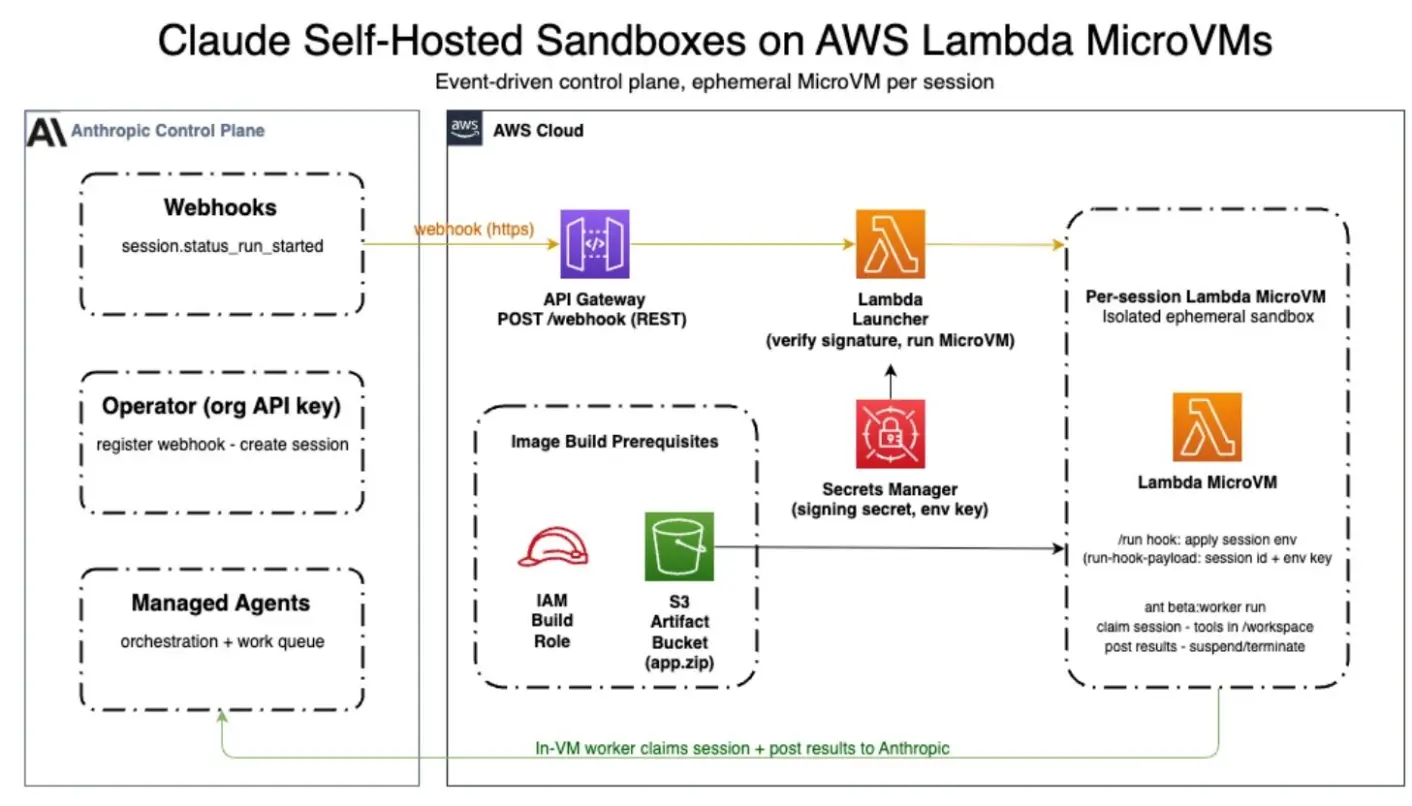
Developers create a MicroVM Image by providing a Dockerfile and code packaged as a zip artifact in Amazon S3.

Lambda runs the Dockerfile, initializes the application and takes a Firecracker snapshot of the running memory and disk state.

Later environments start from the prepared snapshot rather than a cold boot.

AWS says this is intended to provide near-instant launch and resume for interactive sessions, including sessions large enough to involve multi-gigabyte working environments.

The service also has a distinct API surface from Lambda Functions.

AWS says Lambda Functions remain the right fit for event-driven request-response workloads, while Lambda MicroVMs is for multi-tenant applications that need a dedicated environment for each user or session.

That distinction matters for enterprise architecture because the product does not replace conventional functions.

A company could keep Lambda Functions as an event backbone and use Lambda MicroVMs only for steps that execute untrusted code in isolation.

Lifecycle Controls Define The Cost Boundary

AWS describes lifecycle control as one of the product's main differences.

A running MicroVM can retain memory, disk and active processes during a session.

During idle periods, it can be suspended with memory and disk state preserved, then resumed when traffic arrives.

In the example described by AWS, an idle policy auto-suspended the environment after 15 minutes of inactivity and auto-resumed it on the next incoming request.

AWS also gives each MicroVM a maximum total runtime of 8 hours, with automatic suspension available after a configurable idle window.

Those controls are important for applications where users step away but expect their environment to come back with packages, loaded models and working files still available.

The trade-off is that teams need to design around session length, idle policy, authentication and state recovery rather than treating serverless as only stateless execution.

Regions And Limits Set The Rollout Shape

Lambda MicroVMs is available today in US East in N.

Virginia and Ohio, US West in Oregon, Europe in Ireland and Asia Pacific in Tokyo.

The service runs on ARM64 architecture.

Per MicroVM, AWS lists a ceiling of 16 vCPUs, with memory and disk each capped at 32 GB.

The availability list gives developers clear first regions, but it also sets a deployment boundary for global products.

Teams outside those regions will need to decide whether latency, data-location requirements and ARM64 compatibility fit their applications before moving untrusted-code workloads onto the new primitive.

AWS has provided pricing through the Lambda pricing page rather than in the announcement text.

For enterprise teams, the unresolved operating issue is not whether the sandbox exists; it is whether the available regions, ARM64 requirement, 8-hour runtime ceiling and 32 GB memory and disk limits fit the AI coding, analytics or security tools they want to isolate.
Share this article
inXf

Related articles

More
AWS Lambda MicroVMs Extend Serverless Jobs To Eight Hours
Cloud & Data Centers

AWS Lambda MicroVMs Extend Serverless Jobs To Eight Hours

AWS introduced Lambda MicroVMs, a Firecracker-based serverless option that can run isolated Linux containers for up to eight hours instead of the 15-minute Lambda function limit.

Microsoft Linux Push Turns Azure and Windows Into an AI Workload Test
Cloud & Data Centers

Microsoft Linux Push Turns Azure and Windows Into an AI Workload Test

Microsoft used Build 2026 to expand Linux across Azure, Windows development tooling and a new AI workstation. The announcements include Azure Linux 4.0, Azure Container Linux, WSL-backed Windows 11 workflows and the Surface RTX Spark Dev Box. The practical question is whether developers use Microsoft's Linux-centered stack to move AI workloads between local machines and Azure infrastructure.

Runpod Raises $100 Million As AI Developer Cloud Still Needs Capacity Detail
Cloud & Data Centers

Runpod Raises $100 Million As AI Developer Cloud Still Needs Capacity Detail

Runpod says it has raised $100 million and crossed more than one million developers, but the company did not disclose revenue, GPU capacity, regions or customer concentration.

Railway Raises $100 Million For AI-Native Cloud Buildout
Cloud & Data Centers

Railway Raises $100 Million For AI-Native Cloud Buildout

Railway raised $100 million in Series B funding led by TQ Ventures as the developer cloud platform expands its own data-center footprint and pitches faster deployment for AI-generated software.

Keep Reading

More Stories

Latest
Microsoft Puts Agentic Cloud Ops Behind Azure Copilot And FinOps ToolsAIJun 27, 2026Microsoft Puts Agentic Cloud Ops Behind Azure Copilot And FinOps ToolsMicrosoft said Azure Copilot observability agent is generally available and Azure Resource Manager MCP Server is in public preview, tying agentic cloud operations to governance, cost visibility and human approval.Google Cloud Adds Agent-Level Perimeters For Enterprise AI WorkloadsCloud & Data CentersJun 27, 2026Google Cloud Adds Agent-Level Perimeters For Enterprise AI WorkloadsGoogle Cloud has added VPC Service Controls features for agentic AI, including agent identities in perimeter rules, MCP attribute controls and native protection for Gemini Enterprise Agent Platform instances.FCA Links Agentic Finance To Tokenisation And Third-Party RiskFintech & Digital PaymentsJun 27, 2026FCA Links Agentic Finance To Tokenisation And Third-Party RiskFCA chief executive Nikhil Rathi said AI is moving financial markets faster than traditional rulemaking, with agentic systems, tokenisation and third-party model dependence reshaping supervision.Tipalti Targets Future IPO As AI Tools Pressure Finance TeamsFintech & Digital PaymentsJun 27, 2026Tipalti Targets Future IPO As AI Tools Pressure Finance TeamsTipalti president Rob Israch said the finance-automation company expects sustained profitability by early 2027, while customers push for AI tools inside payments, procurement and expense workflows.OpenAI IPO Talk Runs Ahead Of Investor Meetings And TimetableAIJun 27, 2026OpenAI IPO Talk Runs Ahead Of Investor Meetings And TimetableOpenAI has confidentially filed with the SEC, but people familiar with the company say it has not held pre-IPO investor meetings or set an official listing timetable.Apple Seeks US Clearance For CXMT Memory As Chip Prices RiseChips & SemiconductorsJun 27, 2026Apple Seeks US Clearance For CXMT Memory As Chip Prices RiseApple is seeking US clearance to buy memory chips from CXMT, a Chinese supplier on a Pentagon blacklist, after higher memory and storage chip prices pushed up costs for several Macs and iPads.Unconventional AI Tests Oscillator Models Before Power-Efficient Chip ProofChips & SemiconductorsJun 27, 2026Unconventional AI Tests Oscillator Models Before Power-Efficient Chip ProofUnconventional AI has released the Un-0 model series to test oscillator-based image generation, but the work still runs on simulated oscillators rather than a physical AI accelerator.IBM, Red Hat And Deloitte Put Lightwell On Regulated Open-Source Patch WorkCybersecurityJun 27, 2026IBM, Red Hat And Deloitte Put Lightwell On Regulated Open-Source Patch WorkDeloitte is joining IBM and Red Hat’s Lightwell initiative to map open-source components, validate patches and support regulated software supply chains, backed by IBM and Red Hat’s $5 billion commitment.Securitize SPAC Deal Targets $400 Million Before NYSE ListingCrypto/Web3Jun 27, 2026Securitize SPAC Deal Targets $400 Million Before NYSE ListingSecuritize expects about $400 million in gross proceeds from its Cantor Equity Partners II merger, with a July 1, 2026 closing and July 2, 2026 NYSE listing still subject to shareholder approval.Zhipu GLM 5.2 Pressures Frontier AI Labs As Access Limits BiteAIJun 27, 2026Zhipu GLM 5.2 Pressures Frontier AI Labs As Access Limits BiteZhipu’s open-source GLM 5.2 is being pitched as a lower-cost enterprise alternative after landing near Anthropic’s Opus 4.8 on an agentic benchmark while frontier model access faces government limits.Copper ME Gets ADGM Approval Step, But Final FSRA Authorisation Still PendingCrypto/Web3Jun 27, 2026Copper ME Gets ADGM Approval Step, But Final FSRA Authorisation Still PendingCopper ME has received in-principle approval from ADGM’s FSRA to expand regulated digital-asset activities, with custody, settlement, collateral management and tokenised fund brokerage still subject to final authorisation.Oracle AI Buildout Raises Debt Test After 19% Stock DropCloud & Data CentersJun 27, 2026Oracle AI Buildout Raises Debt Test After 19% Stock DropOracle shares fell 19% in a week as investors weighed about $130 billion in debt, nearly $56 billion in fiscal 2026 capital spending and a financing plan tied to AI data-center expansion.