AWS Lambda MicroVMs Extend Serverless Jobs To Eight Hours
AWS introduced Lambda MicroVMs, a Firecracker-based serverless option that can run isolated Linux containers for up to eight hours instead of the 15-minute Lambda function limit.
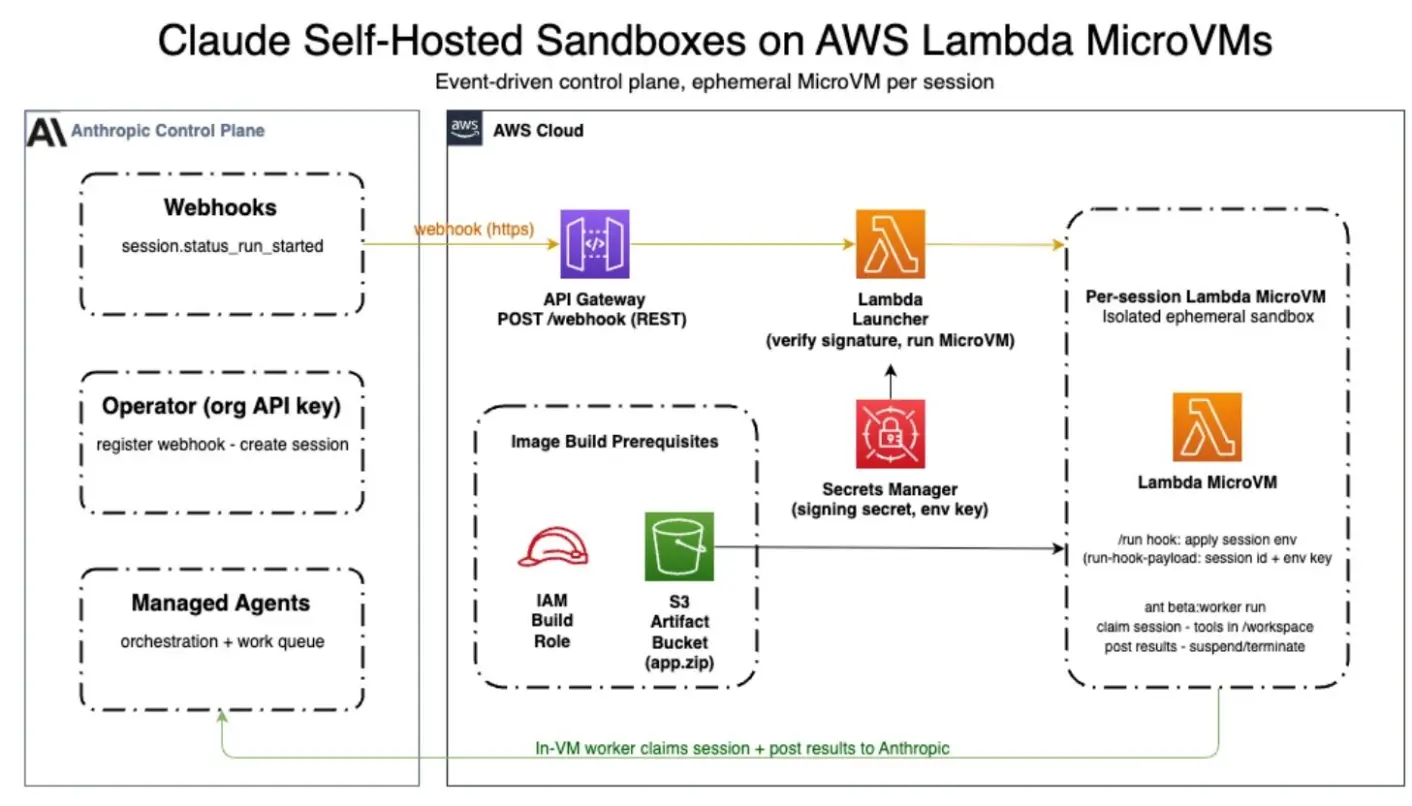
Lambda Gets A Longer-Running Isolation Layer
AWS has introduced Lambda MicroVMs, a Firecracker-based addition to its serverless platform that can run isolated Linux containers for up to eight hours.
The runtime changes the boundary for workloads that did not fit inside Lambda's 15-minute function limit.
Developers provide a Dockerfile and application artifacts, upload them to Amazon S3, and Lambda builds the package into a Firecracker snapshot.
The snapshot can then run as multiple instances when needed, giving teams a way to use containers in a serverless model without keeping a conventional server online.
AWS is positioning the feature around isolation.
The company points to potentially malicious package inspection, vulnerability scanning, AI-generated code execution, prompt-injection risk and insecure output as cases where developers may want code to run inside a more contained environment.
AI Agents Add A Runtime Use Case
AI agents are one obvious fit.
AWS already offers AgentCore Runtime, which also has an eight-hour maximum lifetime, but MicroVMs are more generalized and can be suspended and resumed.
AWS also provides an Agent Toolkit skill that uses MicroVMs and a guide for AI agents managed by Anthropic Claude.
A MicroVM can run, suspend or terminate.
AWS says the environment can expand as far as four times its base specification and pause when there is no traffic.
When network activity resumes, its state is preserved.
Enterprise teams experimenting with agentic workflows get a longer execution window without keeping the workload permanently active.
Long-running coding tasks, CI/CD jobs and untrusted code checks often need more time than a short function window but still benefit from an environment that can disappear when idle.
Pricing And Regions Keep The Rollout Narrow
The commercial model is based on per-second usage of vCPU, RAM, snapshot storage and data transfer.
Compute charges stop when a MicroVM is suspended, leaving snapshot storage costs while the workload is not active.
The launch is still constrained.
At launch, the visible regional list is narrow: US East, US West, Tokyo and Ireland.
Hardware support is also limited to Arm-based AWS Graviton instances.
AWS is extending serverless into longer jobs, but isolation alone does not make AI or untrusted-code workflows secure.
Network access to other resources remains part of the risk design, and the first rollout leaves teams outside the listed regions waiting for broader availability.