Arm And Supermicro Put Agentic AI Servers On A CPU Test
Supermicro introduced new server platforms built around Arm’s AGI CPU for inference-heavy and agentic AI workloads across cloud, enterprise and edge deployments. Arm says the AGI CPU includes up to 136 Arm Neoverse V3 cores, 12 DDR5 memory channels at up to 8800 MT/s and PCIe Gen6 connectivity inside a 300W power envelope. The useful test is not whether the portfolio sounds AI-ready, but whether operators can use these CPU-heavy designs to add inference capacity without creating new power and cooling pressure.
Supermicro has introduced a new server portfolio built around Arm’s AGI CPU, giving AI infrastructure buyers another option for inference-heavy and agentic workloads that need more than GPU acceleration alone.
Supermicro Is Selling A CPU-Heavy AI Rack Story
The announcement focuses on servers for cloud, enterprise and edge deployments.
Arm describes agentic AI workloads as persistent systems that coordinate reasoning, retrieval, memory access, planning and communication across services and models.
In that workflow, the CPU is not just a support chip beside the accelerator.
It handles orchestration, I/O movement and general-purpose compute that can become more visible as inference work spreads across more applications.
Arm introduced the AGI CPU in March 2026.
Its disclosed specification is built around a large general-purpose compute block: 136 Arm Neoverse V3 cores at the top configuration, 12 channels of DDR5 memory, memory speed reaching 8800 MT/s, PCIe Gen6 links and a 300W envelope.
Arm’s rack-level comparison is also explicit; it estimates up to 2x higher performance per rack than comparable x86-based systems.
Those claims make the portfolio relevant to data-center operators facing a practical constraint: inference demand can grow even when facilities cannot keep adding power and cooling at the same pace.
The announcement does not give customer deployments, benchmark logs or production volumes, so the performance claim remains an Arm estimate until buyers show real installation data.
The operational question is workload fit.
A CPU-dense rack can look attractive on paper, but agentic AI systems still have to move data between retrieval tools, models, storage and application services without creating new bottlenecks.
That makes memory bandwidth, I/O capacity and software scheduling as important as the headline core count.
The Rack Figures Are Specific
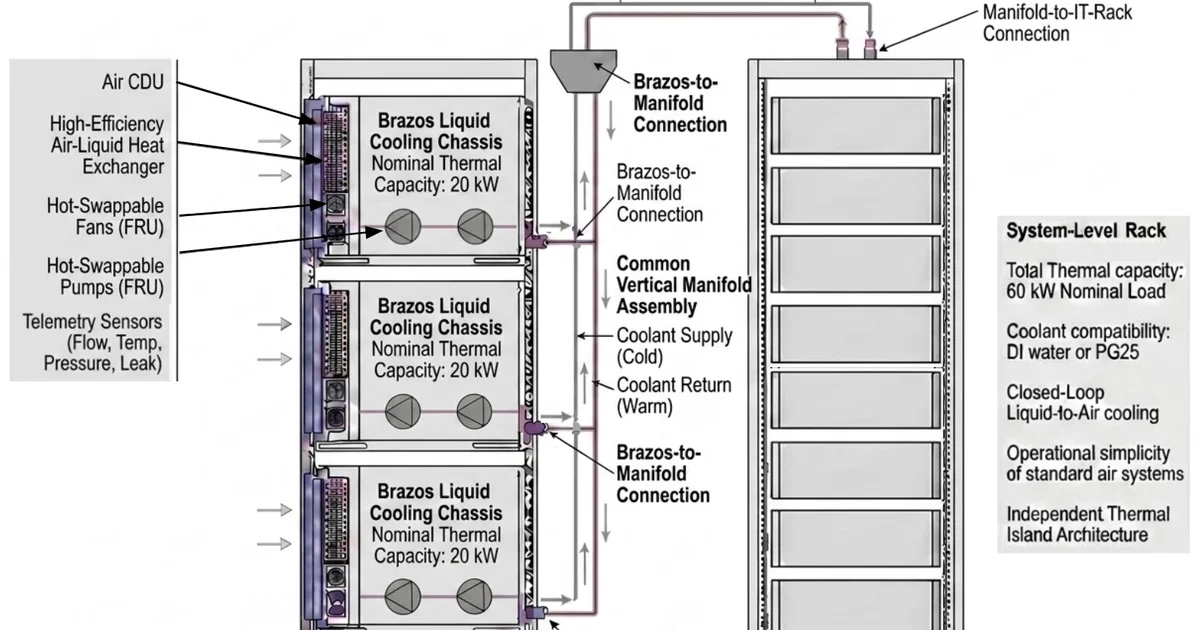
Supermicro’s liquid-cooled Open Rack Wide platform, the ARS-142TP-QNR-LCC, can support up to 336 AGI CPUs in a fully populated rack.
A second liquid-cooled Open Rack V3 system, the 2U4N ORV3 ARS-242TP-QNR-LCC, supports up to 168 AGI CPUs per rack.
Both systems are targeted for sampling in Q1 2027 and production availability in Q2 2027.
The company is also extending the design into air-cooled systems.
The single-socket ARS-212HE-FNR short-depth server is aimed at edge deployments with tighter power and space limits, with sampling targeted for Q4 2026 and production in Q1 2027.
For more conventional data-center work, the dual-socket 2U ARS-222H-NR supports up to 8 NVMe drives and accelerator expansion in a standard 19-inch form factor.
The 5U ARS-522GP-NR targets AI inference deployments with up to eight accelerator cards, dual AGI CPUs and high-density NVMe storage.
The Installation Burden Moves To Power, Cooling And Workload Fit
The pitch is narrower than a general AI boom story.
Supermicro and Arm are arguing that agentic AI will need balanced systems: CPUs, accelerators, memory bandwidth, I/O capacity and efficient rack design working together.
That is a real operating question for enterprises that want inference closer to applications, databases or edge locations.
The next evidence should come from sampling, production availability and buyer deployment details.
Operators will need to see whether these systems can hold the promised density, manage heat in liquid-cooled and air-cooled environments, and improve inference throughput for real agentic workloads rather than only in supplier estimates.