Google’s Brazos Cooling Sidecar Targets The AI Retrofit Problem
Google has introduced Brazos, an open-source liquid-to-air cooling sidecar for existing air-cooled data centers, with a 60kW nominal thermal load per rack and support for OCP ORv3 racks.
Brazos Is Built For Air-Cooled Data Centers
Google has introduced Brazos, an open-source rack-mounted liquid-to-air cooling system aimed at existing air-cooled data centers.
The design matters because many AI retrofit projects need more thermal capacity without rebuilding entire mechanical rooms.
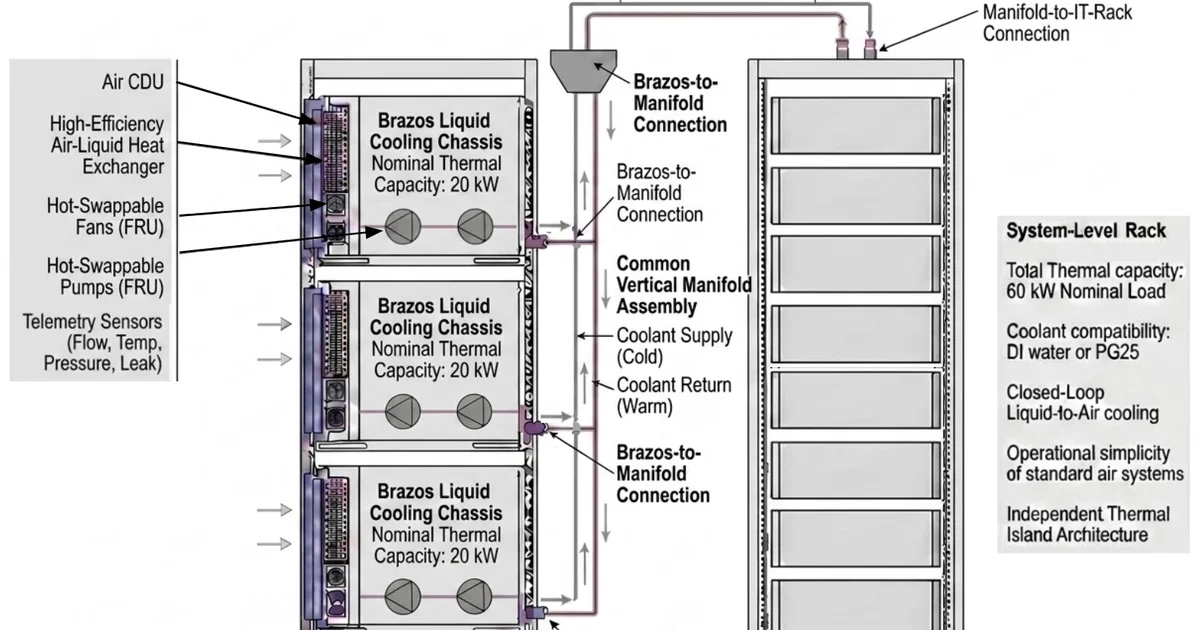
Brazos is a closed-loop sidecar design.
It captures heat through liquid at the component level, then rejects that heat into the hot aisle through liquid-to-air heat exchangers.
That architecture lets operators add high-density liquid cooling one rack at a time instead of converting a whole hall at once.
Google said Brazos is already generally available, and its manufacturing suppliers are ready to engage the broader industry to produce the design.
The company also plans to open-source the technical specifications, design principles and visual assets.
The Useful Numbers Are Rack-Level Numbers
The system uses three cooling units and integrated rack manifolds.
Each chassis takes 11 Open Units of rack height and is built for standard ORv3 racks from the Open Compute Project.
At rack level, Brazos is rated for a 60kW nominal thermal load across its three modules.
Operators can run it with deionized water or a 25 percent propylene glycol mixture, while power comes through a 40-60V DC input connected to standard rack busbars.
The safety and operations details are also practical rather than promotional.
Brazos is certified to UL/CSA/IEC 62368-1 standards, includes leak detection and pressure relief valves, and has a built-in human-machine interface with remote management through Modbus over TCP.
Sidecars Are Becoming AI Infrastructure Tools
Google is not treating the sidecar as a novelty.
Brazos extends work around Open Compute Project rack adaptations, where power and cooling are being separated from the compute rack to handle AI power densities.
In 2024, Microsoft and Meta announced Mount Diablo, an open rack design for AI data centers that separates power and compute into different cabinets.
Google has also worked on Mount Diablo with Meta and Microsoft, including an AC-to-DC sidecar power rack that leaves the main rack space for GPUs, TPUs and CPUs.
AWS has explored a similar path with its In Row Heat Exchanger, a custom liquid cooling design that can be installed without changing air-cooled mechanical designs.
The shared pattern is clear: AI clusters are pushing operators toward modular upgrades that fit into existing facilities.
Adoption Will Decide Its Value
Brazos gives data center operators a defined retrofit option: open specifications, OCP rack compatibility, 60kW rack-level cooling and a supplier path for production.
That is useful for facilities that cannot wait for entirely new AI halls.
The stronger proof will come from deployment.
Operators will need to show that Brazos can be installed with limited disruption, maintained safely, integrated with existing airflow, and produced at a cost that makes one-rack-at-a-time liquid cooling practical for AI infrastructure.