Selfie Video Recovery Gives Google Accounts A New Login Path
Google is adding opt-in selfie video account recovery while keeping Workspace, child and Advanced Protection accounts outside the feature, giving consumer users another login path tied to facial verification controls.
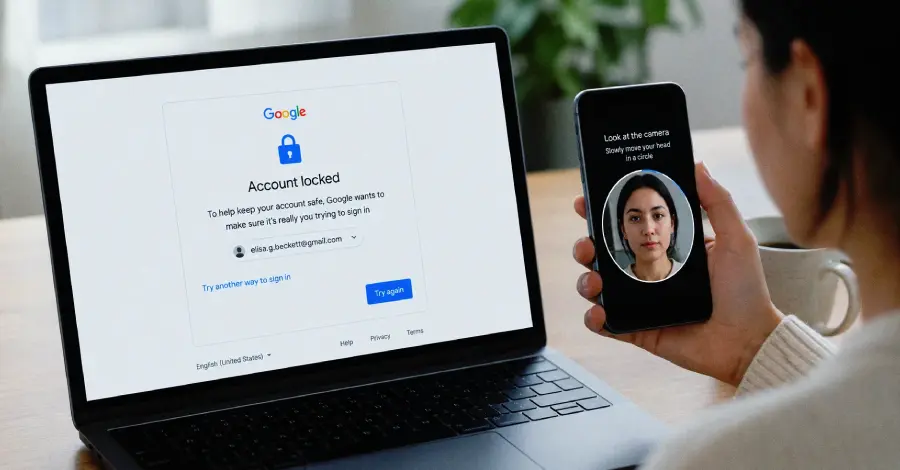
A new selfie video recovery option is giving Google account users another login path when they lose access to the usual device, email address or phone number, drawing on Google material shared through The Hacker News.
Selfie Video Becomes An Account Recovery Option
The sign-in method is an opt-in recovery path on top of existing email-address and phone-number methods.
Users set it up by looking into a device camera and completing a few guided head movements so the account can store a reference video.
When a user later cannot sign in, the recovery flow can ask for a new short video of the same face.
In Google's description, the new clip is compared with the saved selfie video to confirm that the account belongs to the person trying to regain access.
The feature changes the account-recovery surface because it gives users a biometric route when their usual phone or computer is unavailable.
Verification media therefore becomes part of the security control, alongside passwords, devices and secondary contact channels.
The setup sequence also requires the user to look into the device camera before the account stores the reference video.
Workspace And Advanced Protection Accounts Are Excluded
The selfie sign-in option is not available for Google Workspace accounts, child accounts or Google Accounts enrolled in the Advanced Protection Program.
The exclusion keeps the feature aimed at consumer recovery rather than managed enterprise accounts or users already placed under a higher-security programme.
The help document also makes clear that users cannot add a selfie video while they are already locked out or inside the account-recovery process.
That condition means the method has to be configured before the recovery event, not improvised after access is lost.
The same material identifies three purposes for selfie video: helping users get back into an account, unlocking more features or services by verifying that a person is real and has not violated policy, and creating an avatar for AI content that looks and sounds like the user.
Storage Controls Depend On User Choice
The saved selfie video is presented as encrypted at rest and used only to help users log in, unless users choose to share it for other use cases.
Account holders can delete the feature at any time and can change the optional setting that lets the company use the data to improve services.
The optional data use covers work on facial recognition, age estimation and other verification methods that may use physical features or movement.
That makes the consent setting part of the security design, because the same media can support account recovery or broader verification research depending on the user's choice.
Hand Gestures Move ReCAPTCHA Away From Image Challenges
The account-recovery feature arrived alongside a Google Cloud Fraud Defense hand-gesture verification system for reCAPTCHA checks.
That system asks users to perform simple hand gestures through a device camera as a liveness check against automated bot traffic.
Google said the hand-gesture system extracts 21 hand-knuckle coordinates.
For that reCAPTCHA flow, videos are not associated with a user's identity and are deleted after verification, with no image or video retention beyond the check.
Workspace, child and Advanced Protection accounts remain outside the selfie video recovery option, leaving those users on other recovery controls for now.
Summary version for Medium
Selfie Video Recovery Gives Google Accounts A New Login Path
What the announcement means beyond the headline
Quick Summary: Google is adding opt-in selfie video account recovery while keeping Workspace, child and Advanced Protection accounts outside the feature, giving consumer users another login path tied to facial verification controls.
Selfie Video Becomes An Account Recovery Option
The sign-in method is an opt-in recovery path on top of existing email-address and phone-number methods. Users set it up by looking into a device camera and completing a few guided head movements so the account can store a reference video.
Workspace And Advanced Protection Accounts Are Excluded
The selfie sign-in option is not available for Google Workspace accounts, child accounts or Google Accounts enrolled in the Advanced Protection Program.
- Point 1: The central topic is cybersecurity, with the announcement framed around concrete operating detail.
- Point 2: The exclusion keeps the feature aimed at consumer recovery rather than managed enterprise accounts or users already placed under a higher-security programme.
AI deployments now depend on where models, data, approvals and operating teams meet.
Storage Controls Depend On User Choice
The saved selfie video is presented as encrypted at rest and used only to help users log in, unless users choose to share it for other use cases. Account holders can delete the feature at any time and can change the optional setting that lets the company use the data to improve services.
Read the Full Deep Dive
Want to explore the complete technical analysis, enterprise trade-offs, and detailed metrics?
Read the full article originally published at SendTech Times