SendTech Times
News
CAPACITY TEST:

Telecom Operators Test Whether AI Networks Can Move From Opex Cuts To Revenue

Article summary

Communications service providers are using generative and agentic AI to automate network operations, but the next test is whether distributed connectivity, edge sites and secure infrastructure can become paid AI services.
Telecom Operators Test Whether AI Networks Can Move From Opex Cuts To Revenue
Image source: RCR Wireless News

Telecom AI Is Moving Beyond Cost Control

Communications service providers are using generative and agentic AI first to make networks cheaper and more reliable to run.

The operational case is already concrete: automation can handle complex network processes, improve performance indicators and reduce operating expense when operators prepare data, select use cases, integrate systems and validate changes carefully.

The industry benchmark cited for this shift is TM Forum’s Autonomous Networks Project.

Its maturity model has six levels.

Most service providers still place themselves at Level 1 or 2 across the whole network, while some leading operators have validated Level 4 processes in narrower domains.

Those Level 4 examples show why AI operations are becoming more than a lab exercise.

China Mobile has reached Level 4 in network operations centers using agentic and generative AI.

The cited outcomes are a 30% cut to operations-and-maintenance staffing requirements and another 30% improvement in the mean time to repair faults and customer complaints.

Rakuten Mobile has reached Level 4 in RAN energy efficiency, with an expected 20% improvement in radio access network energy efficiency.

Swisscom has also validated Level 4 in IP transport, where the result is cost savings and faster service-extension timelines.

Networks Become Part Of The AI Infrastructure Stack

The next question is whether operators can sell AI-era infrastructure, not just use AI internally.

Service providers control distributed connectivity and compute assets that are relevant to customers looking for data localization, low latency, security and proximity to users, devices and data.

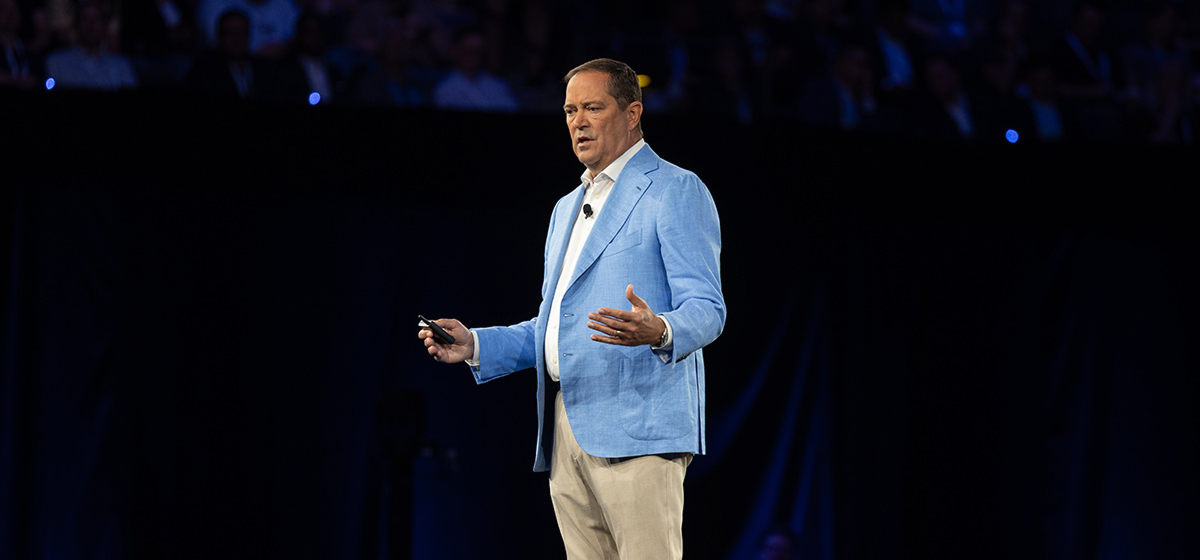
Cisco chair and chief executive Chuck Robbins described the opening as a path for operators to define their role in monetizing AI.

His point was that AI needs bandwidth, distributed infrastructure, secure connectivity and closeness to users and data, all areas where telecom operators already have assets.

That argument also changes how old network sites are viewed.

Robbins pointed to central offices and mini data centers spread across telecom networks as locations that could be reused in the AI era.

Instead of treating those sites only as legacy infrastructure, operators can assess whether they support edge compute, AI inference, sovereign AI services or GPU-as-a-Service.

Enterprise Demand Will Test The Edge Thesis

AT&T’s Andy Forester framed the moment as different from earlier edge-compute cycles.

He said edge compute had been like a use case searching for a market for the last 10 to 15 years.

The difference now is enterprise demand for workload-placement choices: inside company facilities, closer to edge sites, in dedicated AI data centers or through hybrid designs.

That creates a practical test for communications service providers.

Private 5G and multi-access edge computing were often sold with a build-it-first mentality.

AI workloads are less forgiving because architecture depends on the use case, data location, latency profile, security model and business outcome.

The final checkpoint is whether operators can turn autonomous-network progress into customer-facing AI revenue.

The present business case is opex reduction.

The stronger telecom infrastructure story will require paid services around connectivity, edge capacity, security policy and workload placement for enterprises adopting agentic AI.


Share this article
inXf

Related articles

More
AFL’s AI Interconnect Thesis Moves Data Center Networks Into The Bottleneck
Telco & Connectivity

AFL’s AI Interconnect Thesis Moves Data Center Networks Into The Bottleneck

AFL’s Noah Taylor framed data center interconnect as a critical constraint for AI infrastructure, arguing that hyperscale networks now need denser fiber, faster deployment and tighter ecosystem integration as inference shifts more traffic upstream.

AT&T’s OSS/BSS Token Strategy Turns Telco AI Costs Into A Network Test
Telco & Connectivity

AT&T’s OSS/BSS Token Strategy Turns Telco AI Costs Into A Network Test

An AT&T network architect outlined how tokenized OSS/BSS data, edge processing and internal models can reduce telecom AI cost, including 27 billion daily tokens and a 90% generative AI cost reduction claim.

Anterix And Lynk Test Satellite-To-Device Links For Utility Networks
Telco & Connectivity

Anterix And Lynk Test Satellite-To-Device Links For Utility Networks

Anterix and Lynk Global are testing whether 900 MHz private wireless spectrum can extend satellite-to-device connectivity into utilities and other critical infrastructure networks.

US Broadband Operators Reframe Multifamily Buildings As The Next Connectivity Account
Telco & Connectivity

US Broadband Operators Reframe Multifamily Buildings As The Next Connectivity Account

US broadband economics are shifting from raw coverage and speed toward contracted multifamily accounts, where managed Wi-Fi and smart-building services can improve revenue certainty.

Keep Reading

More Stories

Latest
HCLTech-Led Sarvam Round Tests India’s Sovereign AI Scale-UpAIJun 16, 2026HCLTech-Led Sarvam Round Tests India’s Sovereign AI Scale-UpSarvam raised $234 Mn inside a $300 Mn Series B round led by HCLTech, giving the Bengaluru AI startup a $1.5 Bn valuation and more capital for Indian-language models, compute infrastructure and enterprise AI deployments.Anthropic Lawsuit Puts Claude Max Usage Limits Under ScrutinyAIJun 16, 2026Anthropic Lawsuit Puts Claude Max Usage Limits Under ScrutinyA proposed class action lawsuit alleges Anthropic overstated Claude Max usage limits, turning AI subscription transparency into a product and pricing risk for professional users.Edge And Safran Put UAE Defence Tech Push Into European Partnership FrameScience & TechJun 16, 2026Edge And Safran Put UAE Defence Tech Push Into European Partnership FrameAbu Dhabi’s Edge Group and Safran Electronics & Defence signed an agreement in Abu Dhabi to work on air-to-ground weapons systems, with possible expansion into surface-to-air missile work and next-generation smart weapons.AutoVRse Funding Puts India’s Industrial AI Training Stack Under Investor ScrutinyAIJun 15, 2026AutoVRse Funding Puts India’s Industrial AI Training Stack Under Investor ScrutinyAutoVRse raised $2.4 Mn from Singularity AMC and Lumikai, giving the India-based AR/VR training startup fresh capital for North America and Europe while it claims more than 50 enterprise customers.UPI’s Eiffel Tower Rollout Turns India’s Payment Rail Into A Tourist Corridor TestEconomyJun 15, 2026UPI’s Eiffel Tower Rollout Turns India’s Payment Rail Into A Tourist Corridor TestIndia’s UPI is now accepted at the Eiffel Tower and is slated for Paris and Nice airport expansion, giving NPCI International and Lyra a live test of QR-based payments for Indian travellers in France.China’s Open-Source AI Push Tests The Closed-Model PlaybookAIJun 15, 2026China’s Open-Source AI Push Tests The Closed-Model PlaybookFormer Hugging Face Asia-Pacific ecosystem lead Tiezhen Wang said Chinese AI labs are using open releases, licensing changes and cheaper token economics to challenge closed U.S. model strategies without relying only on direct model fees.AI Coding Tools Move From Flat Fees To Usage BudgetsAIJun 15, 2026AI Coding Tools Move From Flat Fees To Usage BudgetsGitHub Copilot, Cursor, Windsurf/Devin and Anthropic pricing moves show AI coding tools becoming metered software, forcing engineering teams to manage agentic development like a cloud cost line.Omniyat Targets Dh200 Billion UAE Property Portfolio By 2030Real EstateJun 15, 2026Omniyat Targets Dh200 Billion UAE Property Portfolio By 2030Omniyat is targeting a portfolio of more than Dh200 billion by 2030 as it expands beyond Dubai and looks for Abu Dhabi projects. The plan is backed by a current Dh100 billion to Dh120 billion portfolio, The Yards launch in City of Arabia and liquidity from recent sukuk issuance, but it will be tested by softer May property-price data.Singapore AI Job Premiums Show Public Sector Demand Moving Faster Than General HiringAIJun 15, 2026Singapore AI Job Premiums Show Public Sector Demand Moving Faster Than General HiringPwC’s Singapore AI jobs data shows government and consumer-market roles paying the largest AI skill premiums, while most new AI listings are for users of AI tools rather than model-building specialists.ASML Warning Pushes Europe’s AI Sovereignty Debate Up The StackChips & SemiconductorsJun 15, 2026ASML Warning Pushes Europe’s AI Sovereignty Debate Up The StackASML chief Christophe Fouquet’s criticism of EU chip-intervention thinking puts the focus on where Europe can still build leverage: trusted compute, data governance, hosting, network interfaces and niche AI supply-chain strengths.Hong Kong Offices Face An AI Infrastructure Test As Tenants Move UpmarketReal EstateJun 15, 2026Hong Kong Offices Face An AI Infrastructure Test As Tenants Move UpmarketKnight Frank says AI adoption is adding energy, connectivity and training-space requirements to Hong Kong offices, putting older buildings under pressure as tenants favour better-equipped central assets.Dubai Municipality Launches Saeed As AI Virtual SpokespersonAIJun 15, 2026Dubai Municipality Launches Saeed As AI Virtual SpokespersonDubai Municipality launched Saeed, an AI-powered virtual spokesperson that will use official municipal data across websites, social media, press conferences, awareness videos, community events and internal employee channels.