AIC Shows 32-Drive PCIe Gen6 JBOF Server For AI Cache Workloads
AIC showed the F2032-01-G6, a 2U JBOF server with 32 PCIe Gen6 E3 drive bays, ServeTheHome reported. The design targets AI cache and flash-tier workloads, but AIC did not disclose pricing, customer deployments, availability or final architecture diagrams.
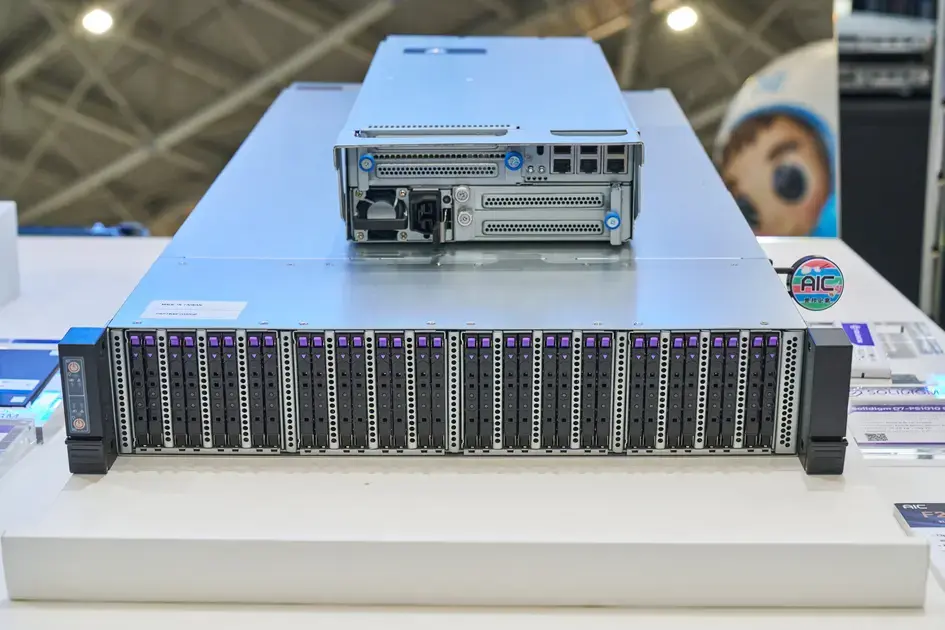
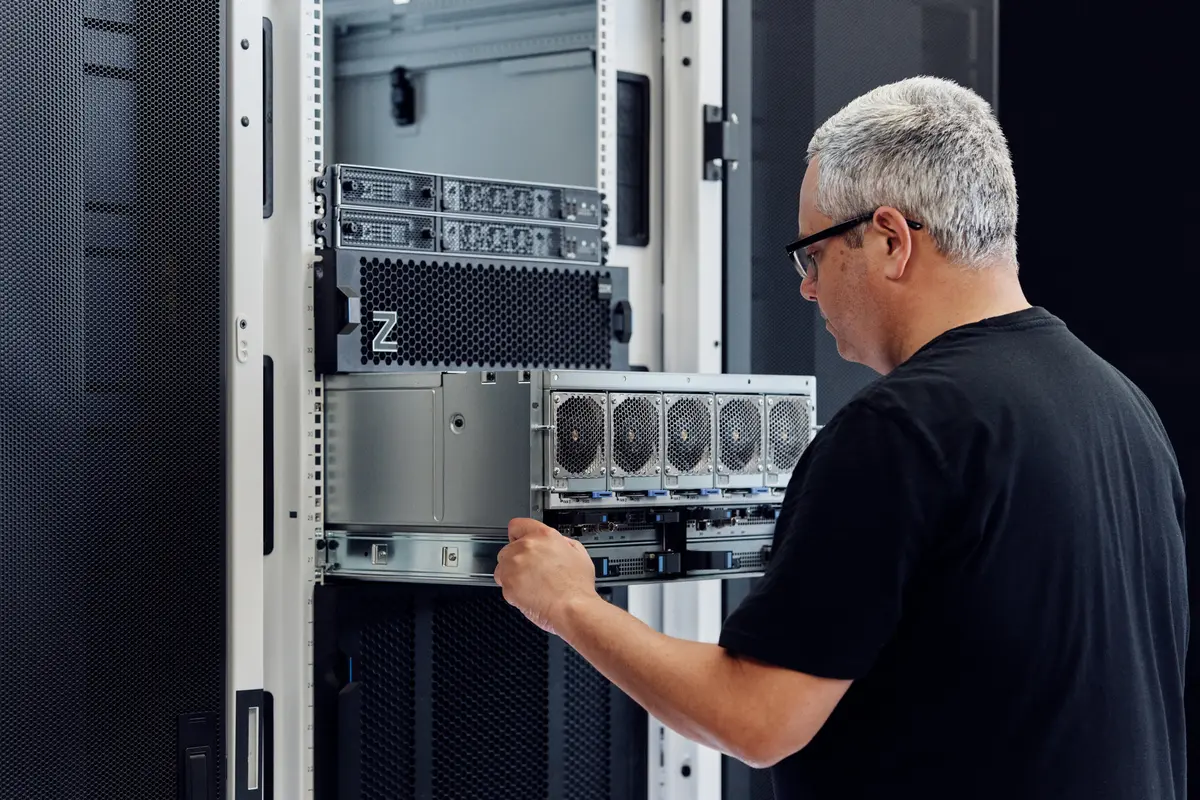
AIC used Computex to show the F2032-01-G6, a 2U just-a-bunch-of-flash server built around PCIe Gen6 storage for AI inference and high-performance data workloads, ServeTheHome reported.
The specialist hardware report described the system as a successor to AIC's PCIe Gen5-era F2026-01-G5.
ServeTheHome reported that the new design moves from 26 2.5-inch U.2 bays to 32 PCIe Gen6 E3 drives, giving AIC a denser storage appliance for key-value caching and other flash-heavy server tasks.
AIC F2032-G6 Holds 32 PCIe Gen6 E3 Drives
ServeTheHome reported that the F2032-01-G6, also referred to as F2032-G6, can hold 32 PCIe Gen6 E3 drives in a 2U chassis.
The report said the appliance supports both E3.L and E3.S versions of 7.5mm-thick SSDs, with hot-swappable trays filling much of the front panel.
AIC positioned the system for storage close to AI accelerators rather than general compute expansion.
ServeTheHome linked the design to the growing need for dynamic storage in AI servers, especially when inference clusters keep key-value cache data near GPUs.
The capacity claim depends on the drive configuration.
ServeTheHome reported that a fully equipped F2032-G6 can store up to 8PB of data when using 256TB SSDs, while TLC NAND configurations sit at about half that capacity.
Broadcom PCIe Gen6 Switch Sits At The Centre Of The Server
ServeTheHome said the internal I/O fabric uses Broadcom's 144-lane PEX90144 PCIe Gen6 switch.
The report noted that AIC did not have the Computex system fully opened, and said the expected lane routing is based on the previous-generation design rather than a published architecture diagram.
That source boundary matters for the storage layout.
ServeTheHome said AIC has not published a detailed architectural diagram for the upcoming server, so the likely two-lane-per-SSD routing remains an interpretation based on the earlier PCIe Gen5 box.
The network side is built for DPUs as much as NICs.
The report said the server uses two nodes, each with its own power supply and space for up to two network expansion devices, and said the design can also house a GPU.
Nvidia BlueField-4 DPUs Control The JBOF For Vera Rubin Racks
ServeTheHome reported that the JBOF appliance is designed to be controlled by at least one Nvidia BlueField-4 DPU.
The Grace CPU and ConnectX-9 NIC-based DPUs support 800Gb Ethernet or InfiniBand networking and PCIe Gen6 I/O connections, according to the report.
AIC is positioning the server as a high-availability system.
ServeTheHome said support for two DPUs and a second node allows redundant operation if a DPU or part of one fails.
The main named use case is Nvidia's Context Memory Storage platform for backing Vera Rubin systems.
ServeTheHome also reported that AIC is pitching the appliance for object storage, scale-out file systems and flash storage tiering.
The report said the CMX role places the appliance in a storage layer for large inference clusters.
It also said key-value cache data needs to sit close to the GPUs doing inference when operators try to scale model-serving performance across AI data-centre racks.
AIC did not disclose pricing, customer deployments, order volumes, a general-availability date, final architecture diagrams or customer benchmark results for the F2032-01-G6 in the ServeTheHome report.
Summary version for Medium
AIC Shows 32-Drive PCIe Gen6 JBOF Server For AI Cache Workloads
Why this hardware shift matters for AI and compute buyers
Quick Summary: AIC showed the F2032-01-G6, a 2U JBOF server with 32 PCIe Gen6 E3 drive bays, ServeTheHome reported. The design targets AI cache and flash-tier workloads, but AIC did not disclose pricing, customer deployments, availability or final architecture diagrams.
AIC F2032-G6 Holds 32 PCIe Gen6 E3 Drives
ServeTheHome reported that the F2032-01-G6, also referred to as F2032-G6, can hold 32 PCIe Gen6 E3 drives in a 2U chassis. The report said the appliance supports both E3.L and E3.S versions of 7.5mm-thick SSDs, with hot-swappable trays filling much of the front panel.
Broadcom PCIe Gen6 Switch Sits At The Centre Of The Server
ServeTheHome said the internal I/O fabric uses Broadcom's 144-lane PEX90144 PCIe Gen6 switch.
- Point 1: The central topic is chips-semiconductors, with the announcement framed around concrete operating detail.
- Point 2: The report noted that AIC did not have the Computex system fully opened, and said the expected lane routing is based on the previous-generation design rather than a published...
The important shift is not the AI label, but the operating boundary it creates for teams.
Nvidia BlueField-4 DPUs Control The JBOF For Vera Rubin Racks
ServeTheHome reported that the JBOF appliance is designed to be controlled by at least one Nvidia BlueField-4 DPU. The Grace CPU and ConnectX-9 NIC-based DPUs support 800Gb Ethernet or InfiniBand networking and PCIe Gen6 I/O connections, according to the report.
Read the Full Deep Dive
Want to explore the complete technical analysis, enterprise trade-offs, and detailed metrics?
Read the full article originally published at SendTech Times