Anthropic Adds Nvidia BioNeMo Toolkit To Claude Science Beta
Anthropic has launched a Claude Science public beta that integrates Nvidia BioNeMo Agent Toolkit. AI News cited 18 of the top 20 drugmakers using BioNeMo, but the companies did not disclose beta-user counts, named Claude Science customers or independent benchmark methodology.

Anthropic has opened a public beta of Claude Science with Nvidia's BioNeMo Agent Toolkit integrated into the research workbench, giving life-sciences users a natural-language route to Nvidia-accelerated scientific tools.
The Nvidia BioNeMo Claude Science integration is aimed at computational biology and drug-discovery workflows.
AI News reported that Claude Science can turn plain-English research requests into agent actions that call BioNeMo tools, Nvidia NIM microservices and accelerated scientific models.
Claude Science Beta Adds Nvidia BioNeMo Agent Toolkit
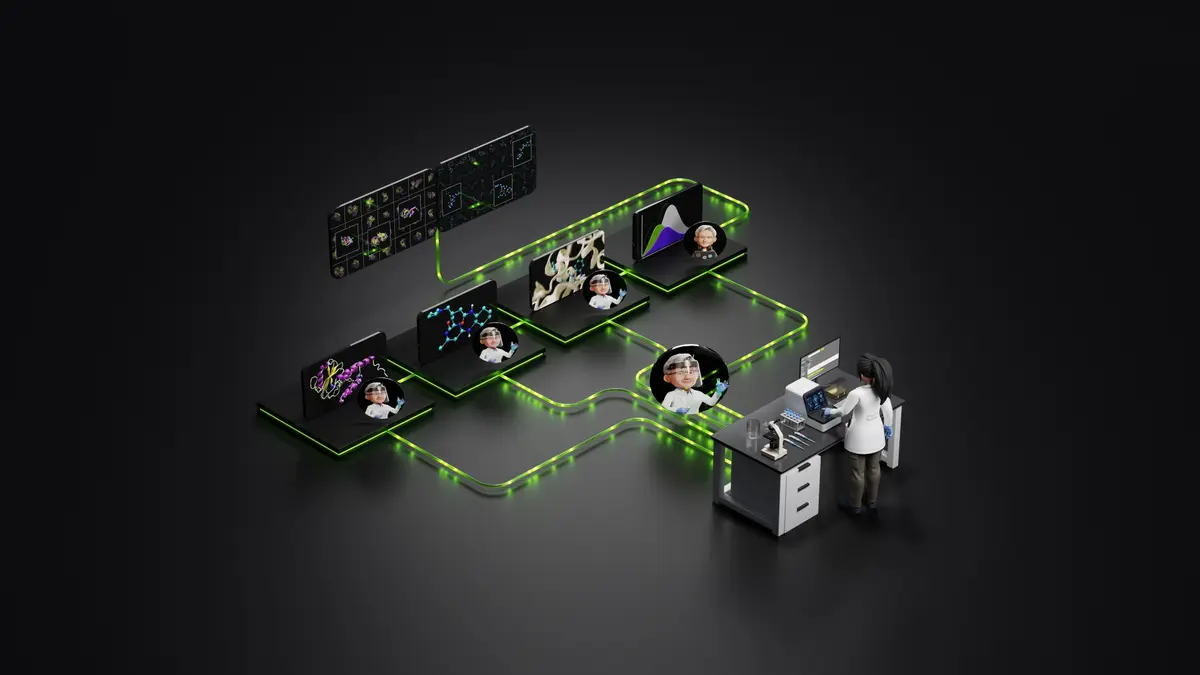
AI News reported that Anthropic's public beta lets scientists talk to digital agents in natural language to run research workflows.
The integration exposes Nvidia BioNeMo Agent Toolkit functions as callable skills inside the Claude environment rather than making researchers manually configure predictive models, network endpoints or separate software stacks.
The beta description included example tasks such as analysing genomic sequences, predicting protein structures and designing possible molecular binders.
Those examples do not prove that the beta has delivered production drug candidates.
Nvidia's toolkit packages accelerated functions as programmatic skills with descriptions of each tool's purpose and required inputs.
AI News said that configuration lets Claude Science select a computational tool, format inputs, run work on deployed Nvidia compute resources and return output to a human reviewer.
AI News Cites 18 Of The Top 20 Drugmakers Using BioNeMo
According to AI News, BioNeMo's production footprint covers 18 companies among the world's top 20 pharmaceutical groups.
Anthropic and Nvidia have not named those companies or identified which ones are using the new Claude Science connection.
AI News also said the integration brings Nvidia-accelerated models, computational libraries and NIM microservices into the environment where scientists conduct research.
It named Evo 2, Boltz-2 and OpenFold3 as open models available through the toolkit.
Those claims remain vendor-platform claims routed through a Tier 2 AI trade source.
Anthropic and Nvidia did not include independent customer case studies, audited productivity results or a list of Claude Science enterprise deployments.
Single-Cell Workflow Falls From 52 Minutes To 25 Seconds
AI News reported a RAPIDS-singlecell example from scverse in which preprocessing and clustering for 1.3-million-cell data fell from 52 minutes to 25 seconds.
AI News also said Nvidia Parabricks can move genomic analysis from hours to minutes, and nvMolKit can accelerate cheminformatics tasks such as similarity search and conformer generation by up to 3,000 times.
AI News presented those figures as tool-level speed claims, while Anthropic and Nvidia did not provide clinical validation, drug-approval evidence or separate trial or customer data tied to faster laboratory outcomes.
AI News described a cancer-target inhibitor workflow in which a scientist asks Claude to design potential inhibitors for a known antigen mutation.
Claude Science and BioNeMo would then coordinate high-throughput inhibitor prediction, optimisation and later validation steps.
Nvidia NIM Microservices Provide Production Endpoints
AI News reported that Nvidia packages BioNeMo models as NIM microservices, which operate as inference endpoints in production environments.
The toolkit is described as open and harness-agnostic, meaning the same scientific skills can work across different agent frameworks and research platforms.
Engineering teams can download the toolkit and related scientific skills through Nvidia developer resources and GitHub repositories.
Anthropic is requesting researcher feedback during the public beta phase on software integrations and additional domain specialists.
The companies have not disclosed beta-user counts, named Claude Science customers, independent benchmark methodology, pricing, availability beyond the public beta, or clinical results tied to the BioNeMo integration.
Summary version for Medium
Anthropic Adds Nvidia BioNeMo Toolkit To Claude Science Beta
What the announcement means beyond the headline
Quick Summary: Anthropic has launched a Claude Science public beta that integrates Nvidia BioNeMo Agent Toolkit. AI News cited 18 of the top 20 drugmakers using BioNeMo, but the companies did not disclose beta-user counts, named Claude Science customers or independent benchmark methodology.
Claude Science Beta Adds Nvidia BioNeMo Agent Toolkit
AI News reported that Anthropic's public beta lets scientists talk to digital agents in natural language to run research workflows. The integration exposes Nvidia BioNeMo Agent Toolkit functions as callable skills inside the Claude environment rather than making researchers manually configure predictive models, network endpoints or separate software stacks.
AI News Cites 18 Of The Top 20 Drugmakers Using BioNeMo
According to AI News, BioNeMo's production footprint covers 18 companies among the world's top 20 pharmaceutical groups.
- Point 1: The central topic is ai, with the announcement framed around concrete operating detail.
- Point 2: Anthropic and Nvidia have not named those companies or identified which ones are using the new Claude Science connection.
The important shift is not the AI label, but the operating boundary it creates for teams.
Single-Cell Workflow Falls From 52 Minutes To 25 Seconds
AI News reported a RAPIDS-singlecell example from scverse in which preprocessing and clustering for 1.3-million-cell data fell from 52 minutes to 25 seconds. AI News also said Nvidia Parabricks can move genomic analysis from hours to minutes, and nvMolKit can accelerate cheminformatics tasks such as similarity search and conformer generation by up to 3,000 times.
Read the Full Deep Dive
Want to explore the complete technical analysis, enterprise trade-offs, and detailed metrics?
Read the full article originally published at SendTech Times