CAICT Token Cloud Plan Turns AI Inference Quality Into A Cloud Benchmark
CAICT launched a Token Cloud Service Quality Enhancement Evaluation Plan with major Chinese cloud and AI partners, aiming to benchmark latency, throughput, reliability and cost efficiency for token-processing infrastructure.
China puts token-cloud quality into a standards track
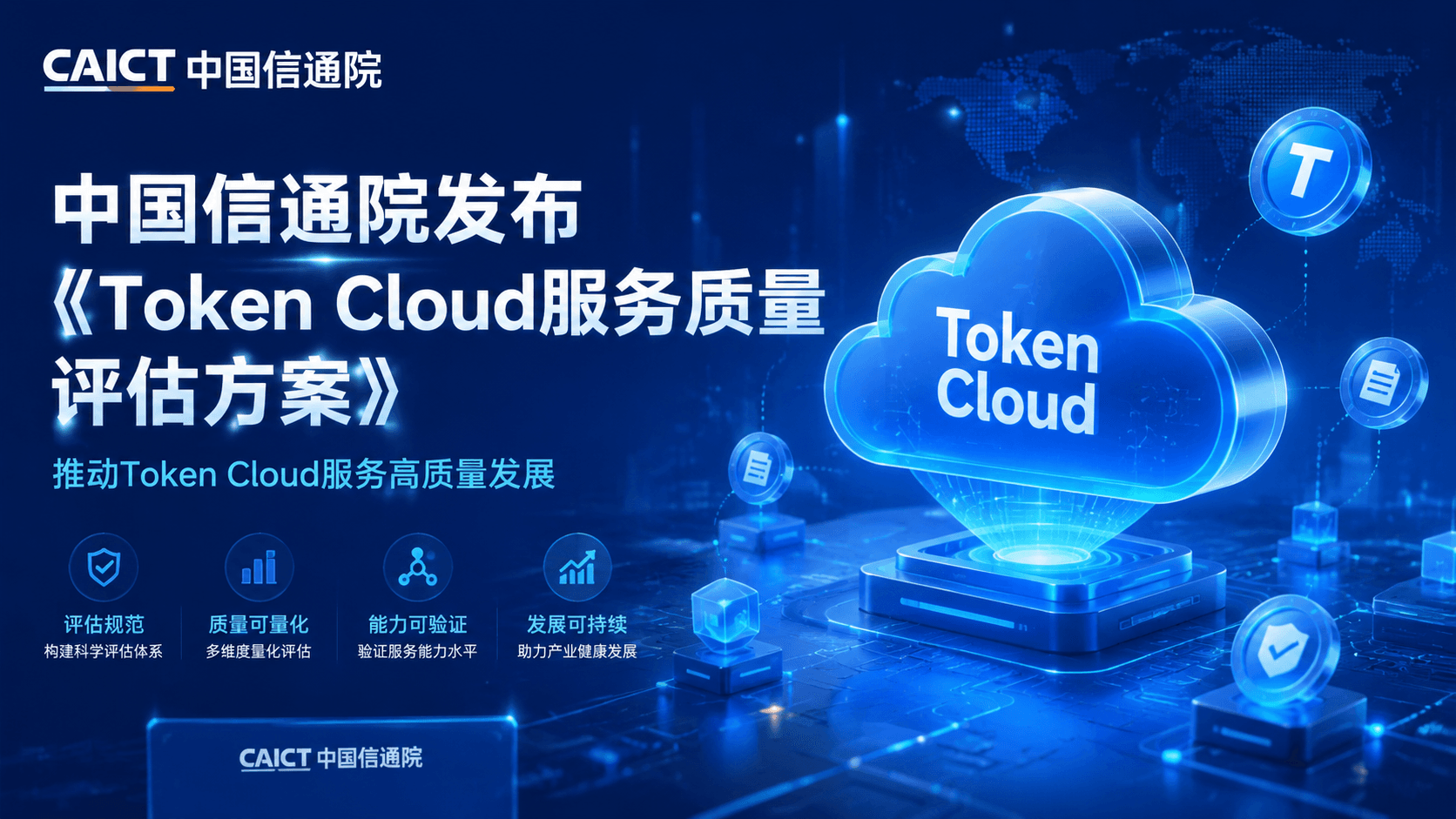
The China Academy of Information and Communications Technology has launched a Token Cloud Service Quality Enhancement Evaluation Plan, moving part of China's AI infrastructure debate from model capability into cloud-service measurement.
The plan was introduced at a June 10, 2026 seminar focused on trusted token cloud services.
The named group spans telecom-backed cloud, e-commerce cloud, device and productivity software ecosystems, including Tianyi Cloud, Huawei Cloud, Alibaba Cloud, JD Cloud, Lenovo, StepFun, Kingsoft Office and Qingcheng Jizhi.
That mix matters because token processing is becoming a shared bottleneck for cloud providers, office software vendors, AI model companies and telecom-backed infrastructure players.
Inference is becoming a procurement question
Token cloud services sit underneath large-language-model applications.
As users send more complex queries, cloud platforms need to process tokens with consistent latency, throughput, reliability and cost efficiency.
CAICT's evaluation plan is meant to create a benchmark layer so enterprise customers can compare token-processing capabilities rather than relying only on vendor claims.
Named speakers gave the plan additional technical weight.
The event included Chinese Academy of Engineering academician Zheng Weimin, He Baohong from CAICT's chief-engineer office and Li Wei from the Cloud Computing and Digital Research Institute.
Their involvement signals that the plan is not just a marketing exercise by cloud vendors.
CAICT operates under China's Ministry of Industry and Information Technology, giving the framework institutional weight in telecom and cloud standard-setting.
The cloud stack becomes part of AI competition
The source frames domestic LLM API call volumes as ranking among the global top tier, which makes infrastructure quality a competitive issue for China's AI sector.
If model providers and application developers cannot rely on stable token processing, the weakness appears downstream as slower responses, higher operating cost or inconsistent service quality.
That is why the evaluation scope matters.
A useful token-cloud benchmark has to cover performance, security requirements and interoperability, not only raw speed.
The launch also includes research outputs on token cloud technology architecture, security requirements and interoperability guidelines.
In practical terms, the framework is trying to make token processing a measurable cloud-service layer rather than an opaque component hidden inside each provider's AI platform.
What to watch in the evaluation plan
The immediate test is whether CAICT's framework produces comparable measurements that enterprise buyers actually use in procurement.
The named partners span telecom cloud, e-commerce cloud, consumer technology, productivity software and AI model ecosystems, so the plan has enough breadth to influence purchasing language if the benchmarks are specific.
The limitation is that the launch itself does not prove improved infrastructure performance.
It establishes a standards process and a partner group.
The next proof point is whether certified token cloud services can show lower latency, higher throughput, stronger reliability or better cost efficiency in production AI workloads.