India Tells WhatsApp To Pause Usernames Rollout During Fraud Review
India's electronics ministry has told WhatsApp not to launch usernames in India until consultations finish. The notice gives the Meta-owned platform three days to explain how the feature would address fraud and impersonation risks.
MeitY Orders WhatsApp To Hold Usernames In India
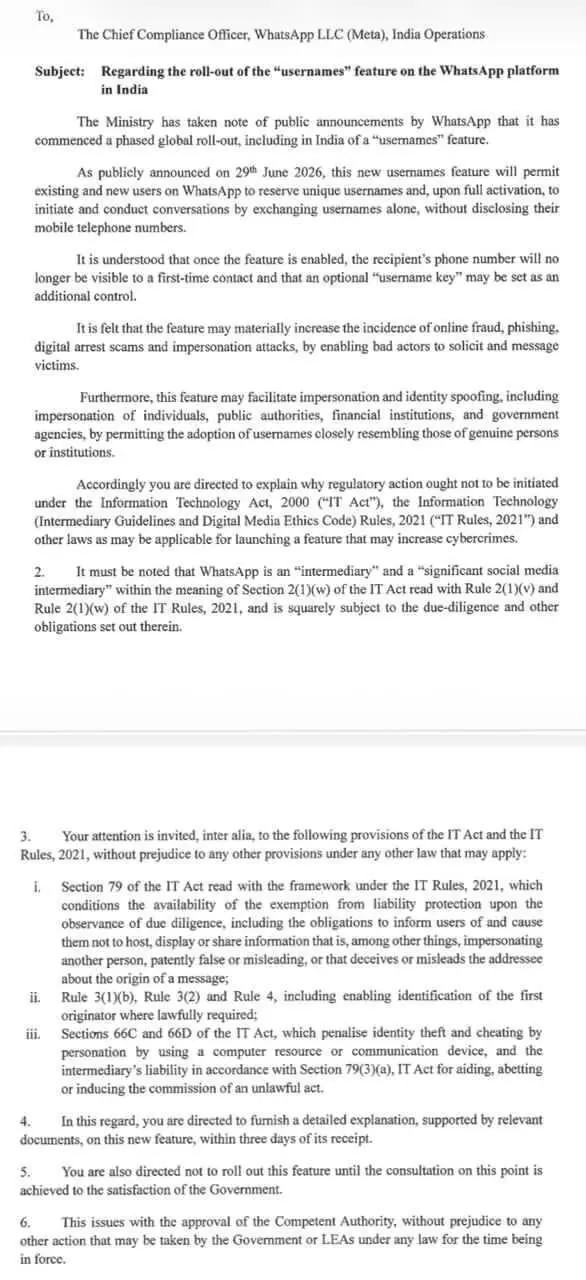
India's Ministry of Electronics and Information Technology has told WhatsApp not to roll out its planned usernames feature in India until government consultations are finished.
The notice says MeitY took account of WhatsApp's phased global rollout plan, including India.
The notice asks why regulatory action should not be started under the Information Technology Act, 2000 and the 2021 intermediary rules.
MeitY's notice brings the product-design question into India's platform-governance process.
WhatsApp wants usernames to let people communicate without exposing mobile phone numbers.
MeitY says the same design could increase online fraud, phishing, digital arrest scams and impersonation.
Notice Gives WhatsApp Three Days To Explain
MeitY asked WhatsApp to submit a detailed explanation with relevant documents within three days.
It also directed the Meta-owned company not to launch the usernames feature until consultations conclude to the government's satisfaction.
The notice cites Section 79 of the IT Act and the 2021 IT Rules.
The notice also names Rules 3(1)(b), 3(2) and 4, which cover user due diligence and first-originator identification when lawfully required.
MeitY also referred to Sections 66C and 66D of the IT Act.
Those provisions cover identity-theft and personation offences involving computer resources or communication devices.
The ministry's notice says usernames that resemble individuals, public authorities, financial institutions or government agencies could enable identity spoofing.
Digital Rights Group Disputes Approval Power
The Internet Freedom Foundation challenged the legal basis of the notice.
The digital rights group said Section 79 governs intermediary liability and does not give MeitY power to decide which features a platform may offer.
IFF also argued that Rules 3 and 4 of the 2021 IT Rules cannot be converted into a licensing scheme.
It said the government should deal with impersonation and fraud by enforcing criminal law against offenders rather than restricting platform features.
MediaNama founder Nikhil Pahwa, writing separately in the Economic Times, said Telegram and Signal have offered username-based access for some time.
He argued that WhatsApp's scale in India is driving the scrutiny and said companies should not need government consultation before shipping a privacy-protecting feature.
Telegram Case Shows The Enforcement Link
The same article points to the government's Telegram arguments before the Delhi High Court.
In that case, the Centre said platform architecture can make unlawful activity harder to remove even after enforcement action.
Solicitor General Tushar Mehta cited Indian Cyber Crime Coordination Centre reports from 2024, 2025 and 2026.
MediaNama reported that Mehta's arguments covered username-based communication, cloud storage, large public channels and the ability for a single account to create 40 bots.
WhatsApp has not disclosed an India launch date for usernames, MeitY has not published the final consultation outcome, and the notice does not identify the exact product changes that would satisfy the ministry.
Summary version for Medium
India Tells WhatsApp To Pause Usernames Rollout During Fraud Review
What the policy signal means for operators and investors
Quick Summary: India's electronics ministry has told WhatsApp not to launch usernames in India until consultations finish. The notice gives the Meta-owned platform three days to explain how the feature would address fraud and impersonation risks.
MeitY Orders WhatsApp To Hold Usernames In India
India's Ministry of Electronics and Information Technology has told WhatsApp not to roll out its planned usernames feature in India until government consultations are finished. The notice says MeitY took account of WhatsApp's phased global rollout plan, including India.
Notice Gives WhatsApp Three Days To Explain
MeitY asked WhatsApp to submit a detailed explanation with relevant documents within three days.
- Point 1: The central topic is capital-policy, with the announcement framed around concrete operating detail.
- Point 2: It also directed the Meta-owned company not to launch the usernames feature until consultations conclude to the government's satisfaction.
The headline matters only if the approval path, compliance burden and operating limits line up.
Digital Rights Group Disputes Approval Power
The Internet Freedom Foundation challenged the legal basis of the notice. The digital rights group said Section 79 governs intermediary liability and does not give MeitY power to decide which features a platform may offer.
Read the Full Deep Dive
Want to explore the complete technical analysis, enterprise trade-offs, and detailed metrics?
Read the full article originally published at SendTech Times