NHK lab showcases provenance technology that records who edited video and when
NHK Science & Technology Research Laboratories is showing a prototype system that records and verifies when, where and by whom news footage was shot and edited. The system is based on the C2PA standard and carries provenance data from filming through editing and distribution, including masking work. NHK is also demonstrating a web browser prototype that verifies provenance information and displays a Content Credential mark to help viewers judge trustworthiness.
NHK Science & Technology Research Laboratories is exhibiting research on “provenance information technology” at its Giken Open 2026 event, held from May 28 to 31.
The technology is designed to record and verify when, where and by whom content such as news video was filmed and edited.
The lab presented the work against a backdrop of impersonation videos and misinformation created with generative AI spreading more easily online.
Its stated goal is to let users judge content credibility for themselves.
Prototype spans filming, editing and distribution
At the center of the exhibit is a prototype system that embeds provenance information across a broadcaster’s full workflow.
It is based on C2PA, the international standard that defines how provenance data for digital content is recorded.
Under the prototype, history from filming to editing and distribution is attached to the content itself.
For example, footage shot on a Sony camera that supports the C2PA standard carries information from the point of capture.
NHK’s later editing history and the trace of masking processing are then added to the same record.
NHK says this makes it possible to follow the full flow from source material to distribution without interruption.
The report also says mechanisms that automatically attach provenance information to content created with generative AI tools from OpenAI and Adobe are beginning to spread.
By checking that information, broadcasters can identify at an early editing stage whether AI-generated material has been mixed into source material.
Browser-based verification and the CR mark
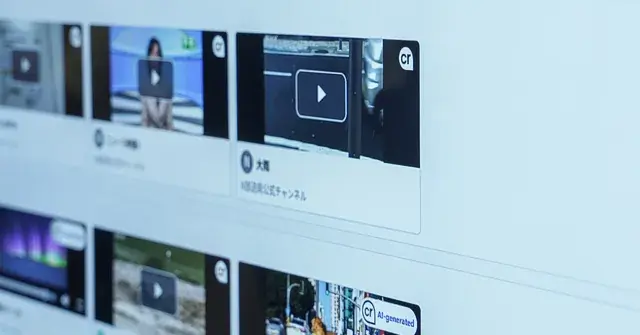
A second exhibit is a prototype web browser with built-in functions to verify and display provenance information.
NHK says putting verification into the browser itself could prevent malicious apps or websites from deceiving viewers with fake verification results.
Viewers would be able to check a “CR mark,” short for Content Credential, indicating whether provenance information is present, giving them a quick way to judge whether a piece of content is trustworthy.
Adoption is starting, but broadcast use is still ahead
According to the report, C2PA-based provenance information has already begun to be implemented in some Sony cameras and Google smartphones.
In broadcasting, however, adoption is still at an earlier stage.
Overseas, public broadcasters including the BBC are described as active in introducing the approach, while the European Broadcasting Union is also pursuing related work.
An explainer at the booth said that if attaching provenance information becomes standard in the future, the absence of such information could itself become a reason to regard content as suspicious.
Summary version for Medium
NHK lab showcases provenance technology that records who edited video and when
What the announcement means beyond the headline
Quick Summary: NHK Science & Technology Research Laboratories is showing a prototype system that records and verifies when, where and by whom news footage was shot and edited. The system is based on the C2PA standard and carries provenance data from filming through editing and distribution, including masking work.
Prototype spans filming, editing and distribution
At the center of the exhibit is a prototype system that embeds provenance information across a broadcaster’s full workflow. It is based on C2PA, the international standard that defines how provenance data for digital content is recorded.
Browser-based verification and the CR mark
A second exhibit is a prototype web browser with built-in functions to verify and display provenance information.
- Point 1: The central topic is science-tech, with the announcement framed around concrete operating detail.
- Point 2: NHK says putting verification into the browser itself could prevent malicious apps or websites from deceiving viewers with fake verification results.
The important shift is not the AI label, but the operating boundary it creates for teams.
Adoption is starting, but broadcast use is still ahead
According to the report, C2PA-based provenance information has already begun to be implemented in some Sony cameras and Google smartphones. In broadcasting, however, adoption is still at an earlier stage.
Read the Full Deep Dive
Want to explore the complete technical analysis, enterprise trade-offs, and detailed metrics?
Read the full article originally published at SendTech Times