Intel Lists Starfire Space AI Chip At 75 TOPS As Radiation Data Stays Pending
Tom's Hardware reported that Intel has listed Starfire, a space-grade system-on-chip for the U.S. government, with up to 75 TOPS and Intel 18A CPU and NPU tiles. The sell sheet says samples are planned for Q3 2026, while radiation qualification data and final specifications remain pending.
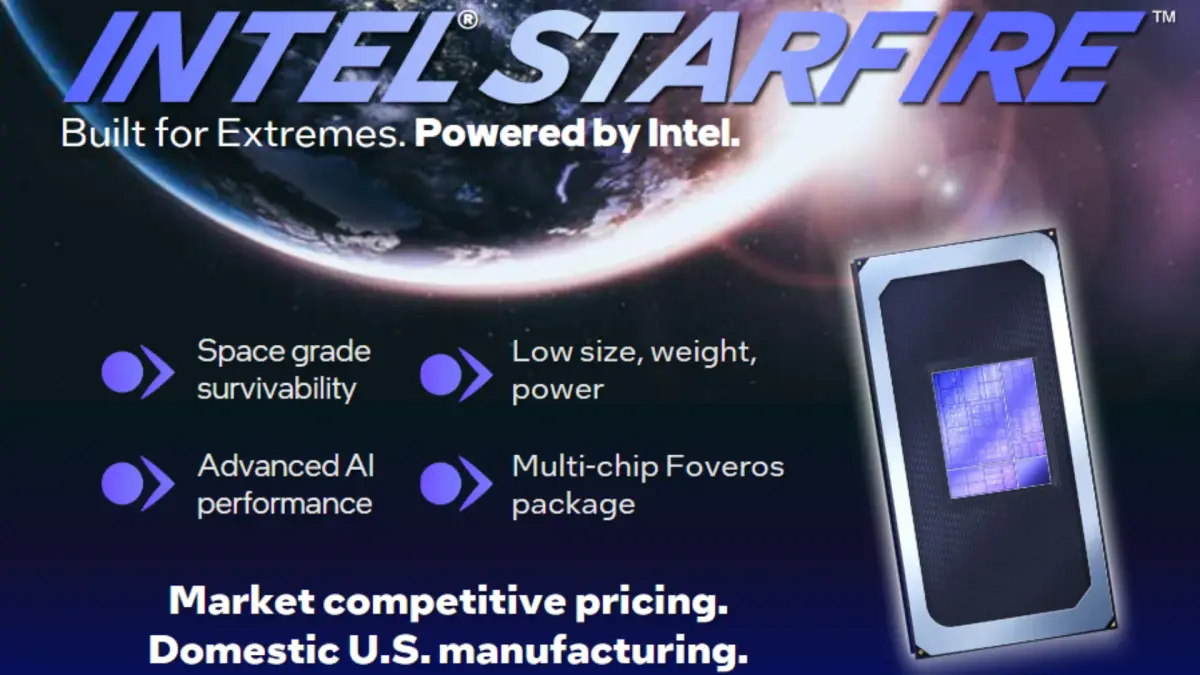
Intel has listed Starfire as a space-grade AI system-on-chip for the U.S. government with up to 75 TOPS, Tom's Hardware reported, but the same sell sheet still leaves radiation qualification data in progress.
The report said Intel Government Technologies is handling Starfire and that samples are planned for Q3 2026.
The chip combines Intel 18A compute and NPU tiles with an Intel 3 graphics tile in a Foveros package.
Intel Starfire Uses 18A CPU And NPU Tiles
Tom's Hardware reported that Starfire has eight CPU cores and a three-tile NPU on Intel 18A, paired with a four-core Xe GPU built on Intel 3.
Intel lists two versions of the chip: a 10 W low-power version rated at 45 TOPS and a 35 W performance version rated at 75 TOPS.
Tom's Hardware reported that the sell sheet gives the part an operating range from -55 to 125 Celsius, lists 12 PCIe Gen4 lanes, supports LPDDR5 or DDR5 memory, and gives both versions a 10-plus year lifetime rating.
The low-power version runs its P-cores at 1.0 GHz, its efficiency cores at 850 MHz and its GPU between 800 MHz and 1.0 GHz, according to Tom's Hardware.
The performance version raises those clocks to 3.1 GHz for the P-cores, 2.1 GHz for the efficiency cores and 2.0 GHz for the GPU.
Starfire Targets On-Orbit AI Inference Rather Than Telemetry
Tom's Hardware compared Starfire with BAE Systems' RAD750, the radiation-hardened PowerPC processor that has been used for two decades.
Public specifications cited by the outlet list RAD750 at 110 MHz to 200 MHz, 10.4 million transistors and 150nm or 250nm lithography.
The report said RAD750 has flown on the Mars rovers, Kepler, Fermi and more than 150 spacecraft.
Tom's Hardware reported that BAE's multi-core RAD5545 and a NASA-backed Microchip processor have also become newer reference points; the NASA-backed processor has a 100-times throughput goal.
Starfire's listed 75 TOPS ceiling and dedicated NPU put Intel's pitch closer to on-orbit AI inference.
Tom's Hardware did not present Starfire as a flight-qualified replacement for those existing processors.
Radiation Characterisation Is Still In Process
Intel lists radiation data for total-dose exposure, latch-up and single-event effects as characterisation still in process, according to Tom's Hardware.
The report said the part is not radiation-qualified yet and that Intel notes the specifications remain subject to change.
Tom's Hardware said Intel's use of Intel 18A for CPU and NPU tiles and Intel 3 for the GPU resembles the node split used in Clearwater Forest.
The article said smaller transistors hold less charge per stored bit, which can make leading-edge silicon more exposed to radiation-induced bit flips.
Intel's domestic-manufacturing pitch sits alongside its Trusted Foundry status and Pentagon programmes.
Tom's Hardware reported that RAMP-C and SHIP include Intel 18A and advanced packaging work, and said 18A yields are not expected to reach industry-standard levels until 2027.
Intel has not disclosed completed radiation qualification, final specifications, production pricing, named mission customers or confirmed flight dates for the two listed Starfire SKUs.
Summary version for Medium
Intel Lists Starfire Space AI Chip At 75 TOPS As Radiation Data Stays Pending
Why this hardware shift matters for AI and compute buyers
Quick Summary: Tom's Hardware reported that Intel has listed Starfire, a space-grade system-on-chip for the U.S. government, with up to 75 TOPS and Intel 18A CPU and NPU tiles.
Intel Starfire Uses 18A CPU And NPU Tiles
Tom's Hardware reported that Starfire has eight CPU cores and a three-tile NPU on Intel 18A, paired with a four-core Xe GPU built on Intel 3. Intel lists two versions of the chip: a 10 W low-power version rated at 45 TOPS and a 35 W performance version rated at 75 TOPS.
Starfire Targets On-Orbit AI Inference Rather Than Telemetry
Tom's Hardware compared Starfire with BAE Systems' RAD750, the radiation-hardened PowerPC processor that has been used for two decades.
- Point 1: The central topic is chips-semiconductors, with the announcement framed around concrete operating detail.
- Point 2: Public specifications cited by the outlet list RAD750 at 110 MHz to 200 MHz, 10.4 million transistors and 150nm or 250nm lithography.
The important shift is not the AI label, but the operating boundary it creates for teams.
Radiation Characterisation Is Still In Process
Intel lists radiation data for total-dose exposure, latch-up and single-event effects as characterisation still in process, according to Tom's Hardware. The report said the part is not radiation-qualified yet and that Intel notes the specifications remain subject to change.
Read the Full Deep Dive
Want to explore the complete technical analysis, enterprise trade-offs, and detailed metrics?
Read the full article originally published at SendTech Times