Taiwan Visit Highlights How AI Demand Is Pulling Chip Power, Capacity and Pricing Into One Orbit
Jensen Huang’s Taiwan visit was centered on partner meetings, a planned discussion with TSMC Chairman C.C. Wei, and Nvidia appearances tied to the Computex cycle. The episode points to a broader market phase in which AI chip demand is increasingly shaped by foundry access, packaging readiness, memory costs and ecosystem coordination. Investors, suppliers and device makers should watch whether Taiwan-related expansion signals translate into concrete capacity, site, and pricing outcomes.
The Market Signal
In a May 2026 retrospective reading of this episode, the visit stands out less as a standalone celebrity arrival and more as a supply-chain signal.
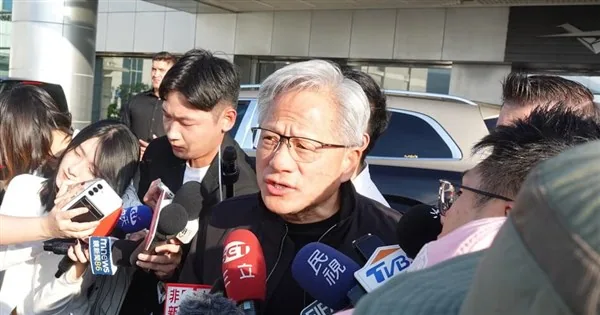
Focus Taiwan reported that Nvidia CEO Jensen Huang arrived in Taiwan on May 23 ahead of AI and technology events, saying he planned to meet clients and TSMC Chairman C.C. Wei during the trip.
After landing at Taipei Songshan Airport, he said he had “a lot to do” and later went to Taipei’s Nangang District for Nvidia’s “Meet-a-Claw” developer event.
He was also scheduled to deliver a keynote at the Taipei Music Center on June 1 to open that year’s Computex Taipei.
During the visit, Huang addressed several commercially important topics.
On Nvidia’s reported planned headquarters site in Taipei’s Beitou Shilin Technology Park, he said that if the company held an event, he would attend and might unveil the building’s design.
On AI business, he said Nvidia works closely with partners and supports them while receiving support in return.
On memory pricing, he said nearly all electronics rely on memory chips and that rising memory prices could significantly affect consumer electronics prices, describing it as an important form of inflation and expressing hope that suppliers could expand output quickly.
Why It Matters
The significance lies in the combination of three signals arriving together: executive attention to Taiwan, direct engagement with TSMC leadership, and public concern about memory pricing.
Those elements matter because advanced AI systems depend not just on chip design leadership but on synchronized access to fabrication, advanced packaging, high-bandwidth memory, board-level integration, and server deployment.
The article also places Huang’s comments alongside AMD’s recently announced plan to invest more than US$10 billion in Taiwan’s industrial ecosystem to expand strategic partnerships and meet demand for AI infrastructure.
That juxtaposition suggests that Taiwan was being treated not only as a manufacturing base but as a competitive coordination hub for the AI compute cycle.
When major chip companies intensify local engagement at the same time, it can indicate that ecosystem control is becoming as strategic as product performance.
Cycle Context
This fits a broader market pattern in which AI demand can tighten multiple parts of the hardware stack at once.
In that kind of cycle, leading compute vendors may benefit from strong order books, but margins, shipment timing, and customer adoption can still depend on bottlenecks outside the GPU itself.
Memory is one obvious choke point.
If memory prices rise sharply, the cost of AI servers and even broader consumer electronics could increase, potentially shifting purchasing behavior across data center and device markets.
More broadly, Taiwan’s role in the AI cycle has likely become more central because foundry capability and related supply-chain specialization remain difficult to replicate quickly.
A meeting between Nvidia’s CEO and TSMC’s chairman may therefore be read as part of the normal competitive choreography of the AI infrastructure race rather than a routine courtesy.
It could reflect ongoing alignment around production planning, technology roadmaps, or supply priorities, though the article does not confirm any specific outcome from the meeting.
Who Is Exposed
The most immediate exposure sits with chip designers, foundries, memory suppliers, server makers, and cloud infrastructure buyers.
For chip designers such as Nvidia and AMD, competitive advantage may depend not only on architecture and software ecosystems but also on how reliably they secure manufacturing and component supply.
For TSMC and its surrounding ecosystem, concentrated demand from AI leaders can strengthen strategic importance while increasing execution pressure.
Memory suppliers are exposed because capacity decisions could affect pricing stability across both AI systems and consumer electronics.
Hardware buyers are exposed because higher component costs may flow into server budgets, PC and device pricing, or deployment timelines.
Developers and enterprise customers are also indirectly exposed: if infrastructure costs remain high, AI deployment economics could become harder to justify for smaller buyers than for hyperscale operators.
What To Watch Next
First, watch whether Taiwan-related Nvidia expansion plans produce confirmed milestones, including any event, building design reveal, or later groundbreaking activity linked to the Beitou Shilin Technology Park site.
Huang only said he would attend if such an event were held.
Second, monitor whether meetings with TSMC translate into visible supply outcomes, such as improved shipment cadence, stronger packaging availability, or commentary on production readiness.
No such outcomes were confirmed in the article.
Third, watch memory pricing.
If suppliers expand capacity fast enough, pricing pressure could ease; if not, inflationary effects may continue to ripple through AI systems and consumer electronics.
Finally, watch the competitive rhythm around Computex-style ecosystem events.
In this market phase, keynote stages and partner meetings can function as early indicators of where design wins, supply commitments, and infrastructure spending may be heading next.
Summary version for Medium
Taiwan Visit Highlights How AI Demand Is Pulling Chip Power, Capacity and Pricing Into One...
Why this hardware shift matters for AI and compute buyers
Quick Summary: Jensen Huang’s Taiwan visit was centered on partner meetings, a planned discussion with TSMC Chairman C.C. Wei, and Nvidia appearances tied to the Computex cycle.
The Market Signal
In a May 2026 retrospective reading of this episode, the visit stands out less as a standalone celebrity arrival and more as a supply-chain signal. Focus Taiwan reported that Nvidia CEO Jensen Huang arrived in Taiwan on May 23 ahead of AI and technology events, saying he planned to meet clients and TSMC Chairman C.C.
Why It Matters
The significance lies in the combination of three signals arriving together: executive attention to Taiwan, direct engagement with TSMC leadership, and public concern about memory pricing.
- Point 1: The central topic is science-tech, with the announcement framed around concrete operating detail.
- Point 2: Those elements matter because advanced AI systems depend not just on chip design leadership but on synchronized access to fabrication, advanced packaging, high-bandwidth memory,...
The important shift is not the AI label, but the operating boundary it creates for teams.
Cycle Context
This fits a broader market pattern in which AI demand can tighten multiple parts of the hardware stack at once. In that kind of cycle, leading compute vendors may benefit from strong order books, but margins, shipment timing, and customer adoption can still depend on bottlenecks outside the GPU itself.
Read the Full Deep Dive
Want to explore the complete technical analysis, enterprise trade-offs, and detailed metrics?
Read the full article originally published at SendTech Times