Unit 42 Finds 13,229 Malicious URLs In AI Phantom-Domain Study
Unit 42 said its phantom-squatting research generated 685,339 prompts across 913 brands and produced 2.1 million unique URLs, including 13,229 malicious URLs and about 250,000 unique phantom domains. The vendor research did not disclose the brand list, affected customer names or named domains tied to data loss.
Unit 42 Maps AI-Hallucinated Domains
Unit 42's research article describes phantom squatting as a security problem created when large language models generate plausible but nonexistent domains.
The vendor research said attackers can register those domains before a user, developer or AI agent follows the model's recommendation.
The article classifies the source as vendor research rather than independent incident reporting.
Unit 42 said its telemetry shows the vector is active in the wild, but the public writeup does not name victim organizations or customers affected by a specific domain.
Unit 42 framed the risk around trusted AI output.
A coding assistant could invent a benefits portal, a research agent could suggest a fake banking portal, or a developer could place an AI-generated API endpoint into code that later sends data to attacker-controlled infrastructure.
The Attack Lifecycle Has Four Phases
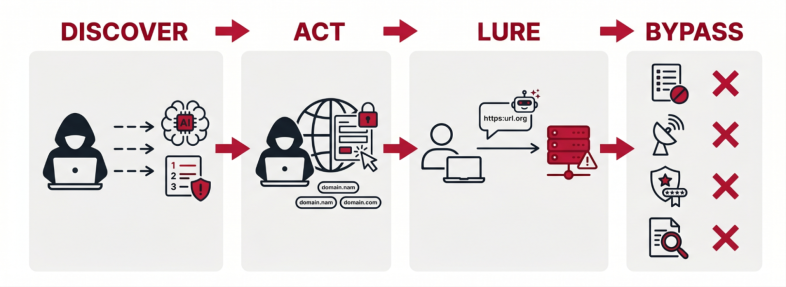
Unit 42 divides the phantom-squatting lifecycle into four phases: discover, act, lure and bypass.
Attackers first probe a target brand's hallucination surface by asking models realistic questions that may produce fictitious URLs.
The act phase begins when attackers register the most useful hallucinated domains.
Unit 42 said generic top-level domains can be registered quickly and cheaply, and observed domains moved from initial registration to malicious content within hours.
The lure phase uses the model itself as the delivery channel.
A user or autonomous AI agent receives a confident recommendation from a sanctioned assistant and visits infrastructure controlled by an attacker, without a traditional phishing email or advertisement.
Zero-Reputation Domains Evade Blocklists
Unit 42 said conventional URL defenses often depend on prior reputation, threat-intelligence history or blocklist entries.
Newly registered hallucinated domains can begin with none of those signals.
The research said some attackers can extend that clean-window advantage through redirect cloaking, benign content for automated crawlers and CAPTCHA-protected infrastructure.
Those techniques make a newly registered domain harder to classify before a user or agent reaches it.
Research Pipeline Tested 913 Brands
Unit 42 said its methodology generated 685,339 prompts across 913 global brands in technology, finance, healthcare, e-commerce, government, gambling and logistics.
The URL-generation phase used two model families, labeled LLM1 and LLM2, across three temperature settings.
The pipeline produced 2.1 million unique URLs.
Unit 42 said threat-intelligence systems flagged 13,229 of those URLs, or 0.61%, as malicious at the time of analysis.
Another 41,313 URLs, or 1.90%, were categorized as high risk.
The company also said 809,455 generated URLs, or 37.28%, resolved to nonexistent domains.
After normalization, those fictitious endpoints collapsed into approximately 250,000 unique phantom domains.
Unit 42 did not disclose the brand list, affected customer names, registered malicious domain names, remediation outcomes or evidence that any named organization lost data through phantom squatting.
Summary version for Medium
Unit 42 Finds 13,229 Malicious URLs In AI Phantom-Domain Study
What the announcement means beyond the headline
Quick Summary: Unit 42 said its phantom-squatting research generated 685,339 prompts across 913 brands and produced 2.1 million unique URLs, including 13,229 malicious URLs and about 250,000 unique phantom domains. The vendor research did not disclose the brand list, affected customer names or named domains tied to data loss.
Unit 42 Maps AI-Hallucinated Domains
Unit 42's research article describes phantom squatting as a security problem created when large language models generate plausible but nonexistent domains. The vendor research said attackers can register those domains before a user, developer or AI agent follows the model's recommendation.
The Attack Lifecycle Has Four Phases
Unit 42 divides the phantom-squatting lifecycle into four phases: discover, act, lure and bypass.
- Point 1: The central topic is cybersecurity, with the announcement framed around concrete operating detail.
- Point 2: Attackers first probe a target brand's hallucination surface by asking models realistic questions that may produce fictitious URLs.
The important shift is not the AI label, but the operating boundary it creates for teams.
Zero-Reputation Domains Evade Blocklists
Unit 42 said conventional URL defenses often depend on prior reputation, threat-intelligence history or blocklist entries. Newly registered hallucinated domains can begin with none of those signals.
Read the Full Deep Dive
Want to explore the complete technical analysis, enterprise trade-offs, and detailed metrics?
Read the full article originally published at SendTech Times