ESMA Warning Pushes Prediction Markets Toward Gambling And Derivatives Rules
ESMA warned that binary event contracts can fall under existing rules for binary options, derivatives or national gambling law. Kalshi, Polymarket and ADI Predictstreet show why prediction markets now face financial, gambling and insider-trading scrutiny.
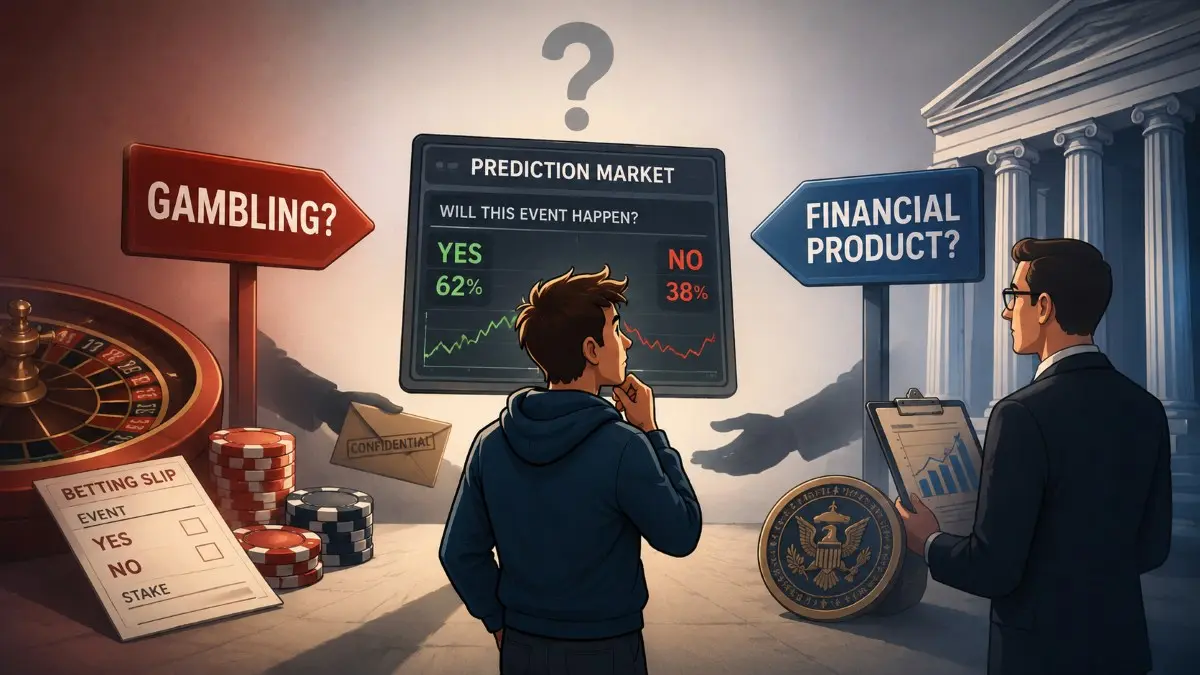
ESMA has warned that some prediction-market products can still fall under rules for binary options, derivatives or national gambling law, putting event-contract platforms under a wider regulatory test than their branding suggests.
The prediction market regulation warning now spans Europe, U.S. court fights and a Gulf-linked sports product.
Kalshi, Polymarket and ADI Predictstreet show how financial, gambling and market-integrity rules can all reach the same type of yes-or-no contract.
ESMA Says Binary Event Contracts Can Trigger Existing Rules
ESMA's warning centred on yes-or-no event contracts that pay a set amount when the chosen outcome occurs and nothing when it does not.
The regulator said products marketed as event contracts or prediction markets may still qualify as binary options, derivatives or bets under national gambling legislation.
That creates a direct compliance problem for platforms that describe themselves as forecasting tools or information markets.
A contract on an interest-rate decision may be treated like a financial derivative, while a contract on a football match may be treated like betting.
A contract on an election or confidential corporate event can raise market-integrity questions.
Legal classification depends on the event, payout structure, user base and jurisdiction.
ESMA did not say every prediction market is gambling, but its warning shows that product labels alone are not enough to keep a platform outside existing regulatory perimeters.
Kalshi Court Fights Keep Federal And State Rules In Conflict
Kalshi has become the clearest U.S. example of the jurisdictional split.
The company argues that its event contracts are federally regulated financial products overseen by the Commodity Futures Trading Commission.
State authorities have challenged that view when the contracts involve sports outcomes.
The Michigan dispute produced a temporary court block on Kalshi sports-event betting for state residents after the attorney general alleged gaming-law violations.
The dispute is broader than one company.
Federal financial oversight and state gambling rules can point to different answers for the same contract, especially when sports outcomes are involved.
Kalshi maintains that CFTC oversight should override state gambling rules, while state challenges continue.
CFTC Charges Put Polymarket Insider Trading Risk On Record
Polymarket shows a separate problem for prediction-market oversight: nonpublic information.
The CFTC has brought separate April and May cases involving Polymarket trading.
The April case involved a U.S. Army service member.
The CFTC alleged that the person used sensitive nonpublic information about a U.S. operation to trade contracts linked to Nicolás Maduro.
The May case involved a Google employee; the agency alleged that information connected to Google's official Year in Search list was used for Polymarket trades.
Those cases move the issue beyond gambling classification.
Prediction markets can create a financial incentive to trade on military, corporate, court, election, regulatory, sports or product information before it becomes public.
Traditional markets already have insider-trading rules because confidential information can distort market fairness; event markets can widen that problem across more types of real-world events.
ADI Predictstreet Uses Gibraltar Betting Licence
ADI Predictstreet uses ADI Chain's institutional blockchain infrastructure and is connected to the Abu Dhabi digital-asset ecosystem through Finstreet and ADI Foundation.
FIFA said ADI Predictstreet is the Official Prediction Market Partner of the FIFA World Cup 2026.
The partnership covers forecasts on match outcomes, tournament statistics, standout players and key moments.
The regulatory home sits outside the UAE.
Predict Street Limited is licensed by the Government of Gibraltar, and industry coverage described the licence as a betting-intermediary licence under Gibraltar's gambling framework.
Gibraltar is also outside MiCA, the EU crypto-asset framework.
The structure has no disclosed UAE classification.
A product can use institutional digital-asset infrastructure and still be licensed elsewhere under a gambling-style framework.
The public material did not identify a UAE financial or crypto licence for ADI Predictstreet, name a UAE regulator classification, or disclose a MENA rulebook for prediction-market activity.
Summary version for Medium
ESMA Warning Pushes Prediction Markets Toward Gambling And Derivatives Rules
What the policy signal means for operators and investors
Quick Summary: ESMA warned that binary event contracts can fall under existing rules for binary options, derivatives or national gambling law. Kalshi, Polymarket and ADI Predictstreet show why prediction markets now face financial, gambling and insider-trading scrutiny.
ESMA Says Binary Event Contracts Can Trigger Existing Rules
ESMA's warning centred on yes-or-no event contracts that pay a set amount when the chosen outcome occurs and nothing when it does not. The regulator said products marketed as event contracts or prediction markets may still qualify as binary options, derivatives or bets under national gambling legislation.
Kalshi Court Fights Keep Federal And State Rules In Conflict
Kalshi has become the clearest U.S.
- Point 1: The central topic is capital-policy, with the announcement framed around concrete operating detail.
- Point 2: example of the jurisdictional split.
The headline matters only if the approval path, compliance burden and operating limits line up.
CFTC Charges Put Polymarket Insider Trading Risk On Record
Polymarket shows a separate problem for prediction-market oversight: nonpublic information. The CFTC has brought separate April and May cases involving Polymarket trading.
Read the Full Deep Dive
Want to explore the complete technical analysis, enterprise trade-offs, and detailed metrics?
Read the full article originally published at SendTech Times