Hunar.AI Tests Voice Agents On India’s Frontline Hiring Gap
Bengaluru-based Hunar.AI says its voice agents now handle more than 5 Lakh calls a day for frontline hiring, onboarding and retention workflows, with customers including Swiggy, Zepto, Croma and Starbucks.
Voice Agents Move Into Frontline Work
Bengaluru-based Hunar.AI is applying conversational AI to a part of enterprise operations that is still handled heavily by phone calls: frontline hiring, onboarding, training and retention.
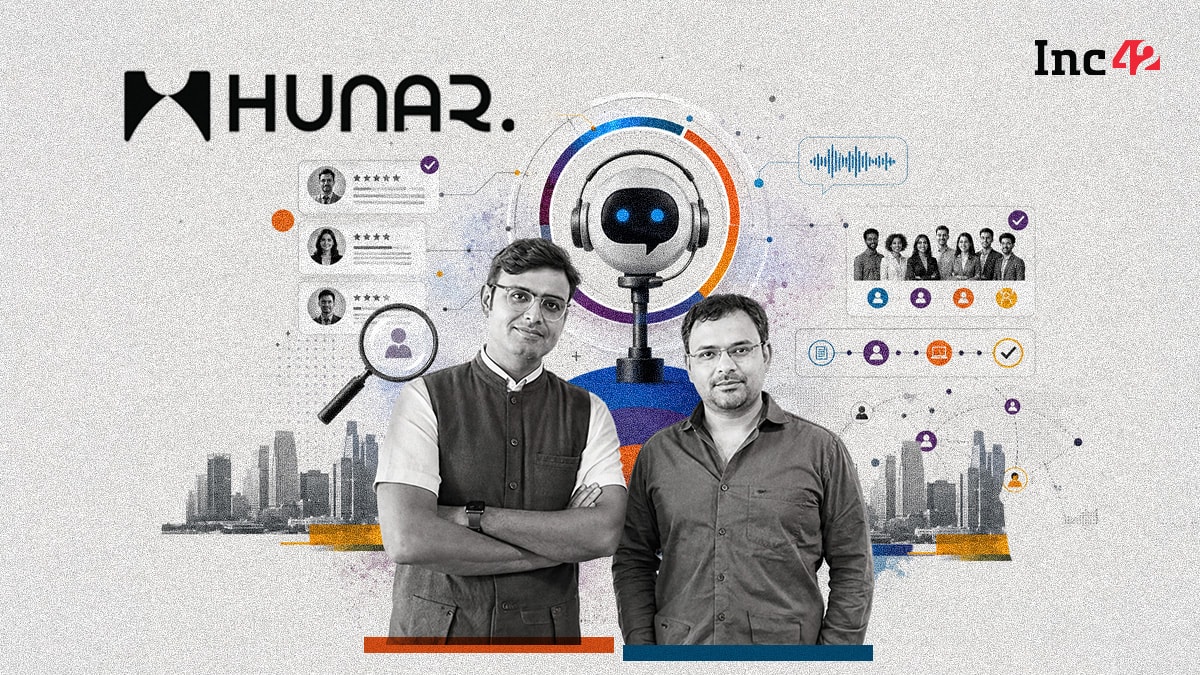
Founded in 2022 by Krishna Khandelwal and Shantanu Bhattacharyya, the company is building voice agents for employers managing gig workers, delivery partners, retail staff, sales executives and construction workers.
The startup says it now powers more than 5 Lakh calls daily.
Swiggy, Zepto, Aditya Birla Capital and Bajaj Finserv are among the customers named by the company.
The same roster also includes Croma, Dr Lal PathLabs, 1mg and Starbucks.
That customer mix makes the story less about a generic chatbot and more about whether AI systems can handle high-volume workforce conversations in India’s multilingual labour market.
Khandelwal framed the problem around the amount of phone work inside human resources.
He said HR calls are often high-fidelity conversations that assess skills, persuade candidates, gather ground-level feedback or train workers.
A Recruitment Agency Became The Data Layer
Before it moved deeper into voice-native infrastructure, Hunar.AI spent nearly two years operating as a recruitment agency.
The founders used that period to study how hiring conversations happened, why attrition stayed high and where employers struggled to listen to dispersed workers.
That operating phase produced nearly 40 Lakh to 50 Lakh minutes of workforce-related conversations across recruitment, onboarding, assessment and retention use cases.
In 2024, Hunar.AI pushed the product further toward voice-native infrastructure as real-time audio models from companies including OpenAI became commercially viable.
The distinction matters because most Indian voice AI deployments cited by the company are short, transactional calls, such as payment reminders.
Hunar.AI says its average call duration exceeds three minutes, with tone, pauses, interruptions and speech patterns carrying useful information for hiring or assessment decisions.
The Stack Is Tuned For Noisy Indian Workplaces
Hunar.AI is not relying only on a standard speech-to-text, language-model and text-to-speech chain.
The company says it first processes raw audio through a proprietary Dynamic Config Generator that removes irrelevant acknowledgements, reads contextual pauses and catches language-specific filler words before the next model step.
The platform also preserves voice properties such as tonality, speed, interruptions and conversational context.
Its Audio Regenerative Model is designed to reconstruct context during interruptions rather than restarting the interaction.
The company says this architecture is meant for calls taking place in small towns, logistics hubs, warehouses and retail stores, where accents and background noise vary heavily.
Multilingual handling is another core constraint.
Hunar.AI switches between providers including ElevenLabs and Cartesia depending on regional language performance, while using models from Google and OpenAI and experimenting with open-source models trained on proprietary workforce conversation data.
Pricing Follows Workflows, Not Raw AI Usage
Hunar.AI positions the product as an autonomous workforce operations platform, not a generic voice API.
Companies can create AI HR agents by defining workflows, job descriptions and knowledge bases, while enterprise deployments can screen candidates, conduct evaluations and schedule interviews with minimal human intervention.
The startup operates across six major sectors.
Quick commerce contributes the largest share of call volumes, but the company says revenue is more balanced across sectors.
Pricing is tied to functions: a screening call usually sits in the ₹15 to ₹20 range, while assessment or onboarding workflows can run from ₹75 to ₹100.
Hunar.AI says it currently operates at an annual recurring revenue of $3 Mn to $4 Mn.
It has raised pre-seed and seed capital from tier-one Indian investors but has not publicly disclosed the details, and it is closing another funding round that it plans to announce later.
The Next Test Is Enterprise Depth
The company’s near-term work is split between deeper enterprise penetration and model development.
Every month, it stores millions of minutes from multilingual workforce interactions, which could help it reduce dependence on third-party inference models if specialized models for Indian frontline communication become reliable enough.
The practical checkpoint is whether Hunar.AI can turn call volume into durable enterprise deployments.
Its proof today is concentrated in named customers, daily call volume, sector spread and workflow pricing; the next disclosed funding round will test how investors value that operating data.