Quant Firms Turn Prediction Markets Into a Crypto Trading Infrastructure Test
DRW, Wintermute and IMC are building or hiring for prediction-market trading desks as Polymarket and Kalshi attract institutional attention. During 2025, Polymarket handled a reported $22 billion to $40 billion across politics, economics and sports, while three sports markets topped $730 million together. The practical question is whether institutional trading models can exploit cross-platform inefficiencies without displacing specialist sports-betting groups.
Prediction markets are drawing a new class of institutional traders as crypto-native venues and traditional event contracts begin to look more like market infrastructure than a niche betting product.
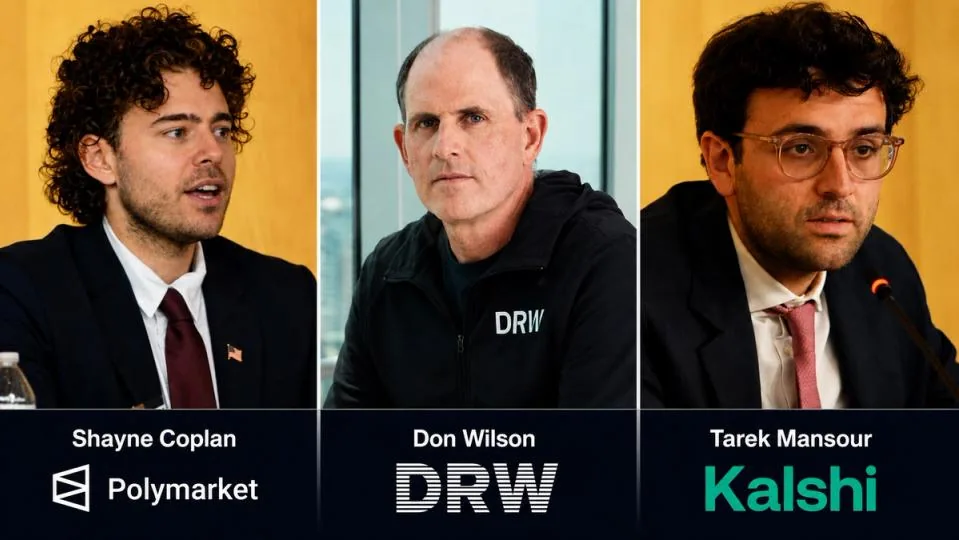
Major quantitative trading firms including DRW, Wintermute and IMC are building or hiring for desks focused on markets such as Polymarket and Kalshi.
The core opportunity is not necessarily better forecasting of sports or political outcomes.
It is the ability to identify price gaps across platforms, move quickly and trade before those gaps close.
Desks Are Following The Volume
In 2025, Polymarket handled a reported $22 billion to $40 billion in activity spanning politics, economics and sports, after being close to negligible three years earlier.
Sports markets have become a visible liquidity pool: the UEFA Champions League Winner market had processed $256 million as of last week, the 2026 NBA Champion market had reached $399 million, and the 2026 NHL Stanley Cup market stood at $79 million.
Together, those sports markets represented more than $730 million in volume.
That scale helps explain why firms accustomed to crypto derivatives, fixed income and high-speed arbitrage are testing prediction markets as tradable venues. the point is less about sports betting as entertainment and more about whether event contracts are becoming liquid enough for professional market structure strategies.
The Edge Is Market Structure, Not Just Forecasting
DRW has posted for candidates who can monitor prices across Polymarket and Kalshi in real time, identify when one venue is mispricing an outcome relative to another, and react before prices converge.
Wintermute is hiring algorithmic traders with prediction-market experience, while IMC is seeking quantitative traders able to operate across binary event contracts.
Harry Crane, a statistics professor at Rutgers University who studies prediction market calibration, said sports-market accuracy still depends heavily on specialist betting groups.
Crane said institutional capital is not yet a meaningful driver of accuracy in sports prediction markets.
The practical edge for large firms may sit in latency, cross-platform arbitrage and fragmented liquidity.
A market on Britain's next prime minister showed how a price gap can open when Betfair moves faster than Polymarket, creating a temporary mismatch for traders able to compare venues and settlement systems.
World Cup Infrastructure Raises The Stakes
HyperLiquid is preparing to launch prediction markets ahead of the 2026 World Cup, an event with 64 games over six weeks and thousands of correlated binary outcomes.
The source described HyperLiquid as an onchain perpetuals exchange that processed more than $10 billion in daily volume at its peak.
Prediction markets still have a different user base from traditional finance.
The next signal is whether firms such as DRW, Wintermute and IMC can turn pricing inefficiencies into repeatable trading revenue while sports-betting specialists continue to influence the underlying probabilities.
Summary version for Medium
Quant Firms Turn Prediction Markets Into a Crypto Trading Infrastructure Test
Why Quant Firms matter now for cloud infrastructure teams
Quick Summary: DRW, Wintermute and IMC are building or hiring for prediction-market trading desks as Polymarket and Kalshi attract institutional attention. During 2025, Polymarket handled a reported $22 billion to $40 billion across politics, economics and sports, while three sports markets topped $730 million together.
Desks Are Following The Volume
In 2025, Polymarket handled a reported $22 billion to $40 billion in activity spanning politics, economics and sports, after being close to negligible three years earlier. Sports markets have become a visible liquidity pool: the UEFA Champions League Winner market had processed $256 million as of last week, the 2026 NBA Champion market had reached $399 million, and the 2026 NHL Stanley Cup market stood at $79 million.
The Edge Is Market Structure, Not Just Forecasting
DRW has posted for candidates who can monitor prices across Polymarket and Kalshi in real time, identify when one venue is mispricing an outcome relative to another, and react before prices converge.
- Point 1: The central topic is crypto, with the announcement framed around concrete operating detail.
- Point 2: Wintermute is hiring algorithmic traders with prediction-market experience, while IMC is seeking quantitative traders able to operate across binary event contracts.
The useful takeaway is the operating constraint behind the announcement, not the announcement alone.
World Cup Infrastructure Raises The Stakes
HyperLiquid is preparing to launch prediction markets ahead of the 2026 World Cup, an event with 64 games over six weeks and thousands of correlated binary outcomes. The source described HyperLiquid as an onchain perpetuals exchange that processed more than $10 billion in daily volume at its peak.
Read the Full Deep Dive
Want to explore the complete technical analysis, enterprise trade-offs, and detailed metrics?
Read the full article originally published at SendTech Times