AI Times Says Infrastructure Captures 82% Of Generative AI Value
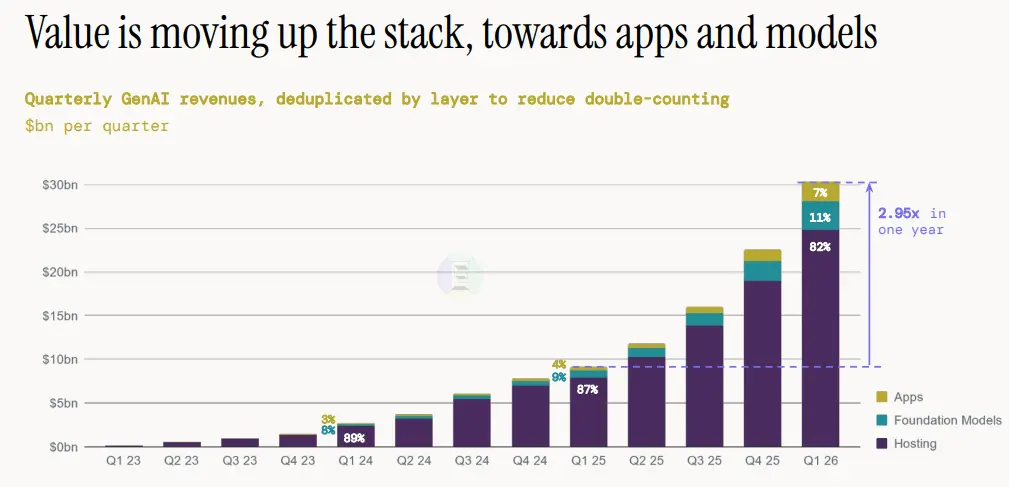
AI Times Korea cited Exponential View data showing 82% of measured AI-economy value going to cloud, GPU and inference infrastructure in Q1 2026, while foundation-model companies accounted for 11% and applications 7%.
Exponential View Reports 82% Of AI Value In Infrastructure
AI Times Korea cited an Exponential View report showing that cloud, GPU and inference infrastructure captured the largest measured share of the generative AI economy, even as model developers remain the most visible companies in the sector.
The Korean technology outlet said Exponential View's State of the AI Economy 2026 report measured where value accrues across the AI stack, including infrastructure, foundation models and applications.
AI Times Korea said Exponential View put 82% of captured AI-economy value in the hosting layer in the first quarter of 2026.
The hosting layer includes cloud services, GPUs and inference infrastructure.
For the most recent 12 months, AI Times Korea said generative AI recorded $110 billion in actual revenue.
It also said the annualised revenue run rate had expanded to $175 billion, framing generative AI as a fast-growing enterprise technology market rather than only a consumer chatbot trend.
Foundation Models Account For 11% In The Report
AI Times Korea said the Exponential View report assigned 11% of measured value to the foundation-model layer, including companies such as OpenAI and Anthropic.
The application layer accounted for the remaining 7%, according to the same article.
AI Times Korea said user payments for ChatGPT-like services still push much of the economic value towards GPUs, data centres and cloud operations needed to serve models at scale.
AI Times Korea also said applications increased from a 4% share a year earlier to 7% in the latest period.
AI Times Korea linked the increase to growth in AI agents, coding tools and enterprise AI services that perform work on top of foundation models.
FT Questions Model-Company Valuations
AI Times Korea also referenced Financial Times commentary on possible OpenAI and Anthropic listings.
The Financial Times commentary cited research, development, GPU investment and cloud spending as costs that could make durable profitability harder to prove.
AI Times Korea wrote that the Exponential View report was analysing value across the whole AI industry, not publishing financial statements for individual companies.
That means the foundation-model layer figure should not be read as a direct company-level share for OpenAI or Anthropic.
AI Times Korea said OpenAI and Anthropic operate services beyond foundation models, including ChatGPT, Claude, enterprise AI services and API platforms.
Their revenue can therefore sit across model, application and platform layers rather than only inside the foundation-model category.
AI Times Korea said narrower performance gaps between advanced models could also shift competition towards enterprise services, AI agents and productivity platforms.
The valuation debate stays tied to disclosed model economics rather than a claim that foundation-model companies have already lost customer demand.
OpenAI Infrastructure Costs Remain A Missing Company-Level Figure
AI Times Korea said OpenAI is pursuing the Stargate project and in-house chip development as ways to lower infrastructure costs and increase supply-chain control.
AI Times Korea described those moves as part of the broader pressure created by compute and hosting costs.
AI Times Korea did not identify OpenAI or Anthropic profit figures, cash-flow figures, named customers, infrastructure-spending totals or IPO schedules.
AI Times Korea also did not disclose the exact spending commitments behind Stargate or any measured cost reduction from in-house chip work.
Summary version for Medium
AI Times Says Infrastructure Captures 82% Of Generative AI Value
Why AI Times Says Infrastructure matter now for cloud infrastructure teams
Quick Summary: AI Times Korea cited Exponential View data showing 82% of measured AI-economy value going to cloud, GPU and inference infrastructure in Q1 2026, while foundation-model companies accounted for 11% and applications 7%.
Exponential View Reports 82% Of AI Value In Infrastructure
AI Times Korea cited an Exponential View report showing that cloud, GPU and inference infrastructure captured the largest measured share of the generative AI economy, even as model developers remain the most visible companies in the sector. The Korean technology outlet said Exponential View's State of the AI Economy 2026 report measured where value accrues across the AI stack, including infrastructure, foundation models and applications.
Foundation Models Account For 11% In The Report
AI Times Korea said the Exponential View report assigned 11% of measured value to the foundation-model layer, including companies such as OpenAI and Anthropic.
- Point 1: The central topic is cloud-data-centers, with the announcement framed around concrete operating detail.
- Point 2: The application layer accounted for the remaining 7%, according to the same article.
The important shift is not the AI label, but the operating boundary it creates for teams.
FT Questions Model-Company Valuations
AI Times Korea also referenced Financial Times commentary on possible OpenAI and Anthropic listings. The Financial Times commentary cited research, development, GPU investment and cloud spending as costs that could make durable profitability harder to prove.
Read the Full Deep Dive
Want to explore the complete technical analysis, enterprise trade-offs, and detailed metrics?
Read the full article originally published at SendTech Times