SendTech Times
Chips & SemiconductorsNews|June 5, 2026 at 12:07 AM
CAPACITY TEST:

AMD Server CPU Share Hits 33.2% as AI Server Demand Lifts the Segment

Article summary

AMD reached 33.2 percent of the server CPU market in the first quarter of 2026 as overall x86 processor shipments fell by more than six percent. Server CPU unit shipments rose by more than 10 percent from a year earlier, while Intel still held roughly two-thirds of the server CPU market. The next signal is whether AI server demand keeps server processors stronger than the wider PC and client CPU cycle.
Market signal

The impact is on AI infrastructure procurement, power budgets and rollout timing. The next signal is whether named customers, operators or regulators confirm deployment, shipment timing or measurable performance results.

AMD Server CPU Share Hits 33.2% as AI Server Demand Lifts the Segment
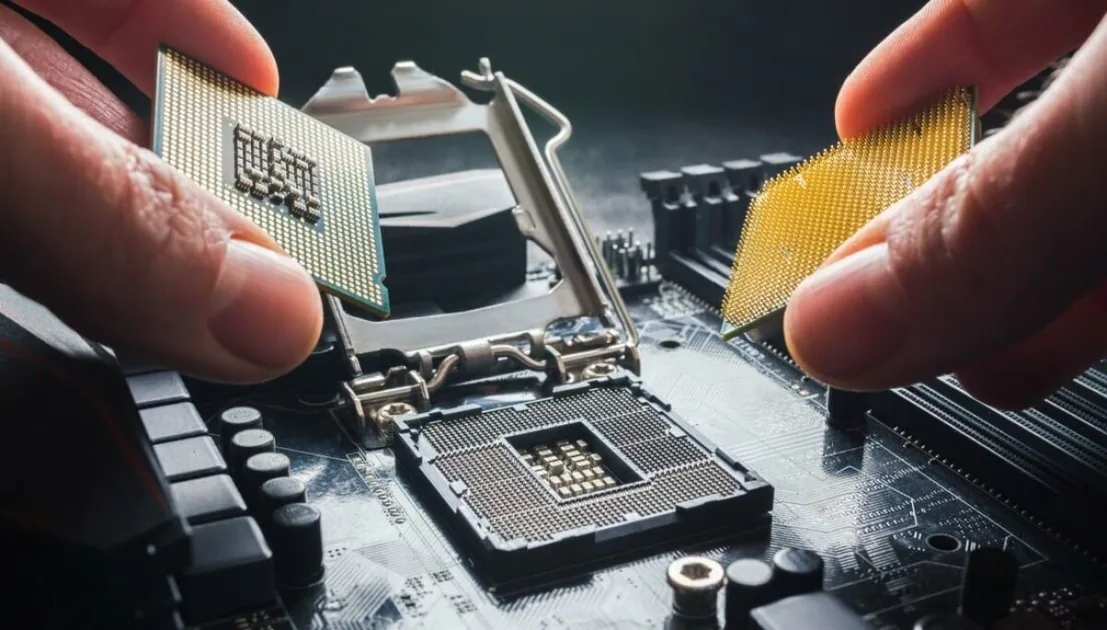
Image source: The Register

AMD Server CPU Share Rises as X86 Shipments Slow

AMD gained ground in server processors during the first quarter of 2026, even as overall x86 processor shipments fell by more than six percent from the previous quarter.

Server CPU unit shipments moved in the opposite direction, rising by more than 10 percent from a year earlier.

Mercury Research's PC Processor report gives the clearest signal in the source data: AMD reached 33.2 percent of the server CPU market during the quarter, up six percentage points from the same period last year.

Intel remained the larger supplier, with roughly two-thirds of the expanding server CPU market.

The category signal is not only about share transfer between two suppliers.

Server processors were the strongest part of an x86 market that otherwise showed seasonal weakness, with the source linking the server increase to demand for AI servers in datacenters.

Server Demand Outruns the PC Cycle

The first-quarter decline in total x86 processor shipments was described as seasonally typical, but worse than average this year.

The source also points to a weaker-than-typical fourth quarter tied to Intel supply constraints after the company shifted manufacturing capacity toward server chips.

Intel's server CPU shipments were relatively flat both sequentially and year-on-year.

AMD's server volumes grew strongly, giving the company its one-third position while Intel continued to hold the majority of shipments.

The client market showed a different pattern.

Desktop CPU shipments fell nearly 20 percent from the same quarter a year earlier, and Intel gained some desktop share from the prior quarter, reaching 66.8 percent of shipments against AMD's 33.2 percent.

In mobile processors, AMD's share rose to 28.3 percent, up from 22.5 percent a year earlier, while the broader mobile market was down by low single digits.

Arm Adds Another Pressure Point

Mercury Research also estimated Arm-based client processors, including Chromebooks and Apple's M-series-based Macs, at 14.4 percent of the total market in the first quarter of 2026, up from a revised 13.9 percent in the fourth quarter of 2025.

Arm-based server chips were estimated at 13.2 percent of total shipments, up from a revised 12.5 percent in the prior quarter.

Mercury Research President Dean McCarron said Arm server CPU shipments were nearly double their year-earlier level, primarily because of growth from Nvidia's Grace CPU in Blackwell NVL72 AI rack platforms.

The next signal is whether server CPU demand continues to offset weaker client-chip shipment patterns while AMD, Intel and Arm-based suppliers compete for AI datacenter processor demand.

Share this article
inXf

Related articles

More
Intel Xeon 6+ Launch Puts CPU Supply on the AI Infrastructure Watchlist
Chips & Semiconductors

Intel Xeon 6+ Launch Puts CPU Supply on the AI Infrastructure Watchlist

Intel launched Xeon 6+ "Clearwater Forest" at Computex 2026 for scale-out data center workloads. The processor tops out at 288 Darkmont E-cores per socket, 576MB of L3 cache and compute tiles built on Intel 18A. The practical test is whether constrained CPU allocation becomes a larger bottleneck for agentic AI data center deployments.

Huawei's Tau scaling puts architecture at the center of China's AI-chip push
Chips & Semiconductors

Huawei's Tau scaling puts architecture at the center of China's AI-chip push

Huawei proposed Tau scaling, a framework focused on shorter signal paths rather than only smaller transistors. LogicFolding is planned for Kirin chips in fall and winter 2026, with Huawei claiming a density jump to 238 million transistors per square millimeter. The test is whether architecture-led gains can be validated in commercial chips amid export-control limits on advanced tools.

Huawei’s Kirin 9050 highlights 3D stacking and Tau Law ahead of the Mate 90 launch
Chips & Semiconductors

Huawei’s Kirin 9050 highlights 3D stacking and Tau Law ahead of the Mate 90 launch

Huawei plans to introduce the Kirin 9050 with the Mate 90 series this fall, with September 2026 indicated for the phone launch window. Reports tied to industry channels and an ISCAS 2026 conference presentation describe the chip as moving past Apple’s A18 while nearing first-generation 3nm-class density. The central issue is whether 3D IC stacking and Tau Law can deliver high-end results without relying on the most advanced EUV lithography tools.

Marvell Teralynx T100 Puts AI Data-Center Switching Into the Chip Race
Chips & Semiconductors

Marvell Teralynx T100 Puts AI Data-Center Switching Into the Chip Race

Marvell announced planned availability of its Teralynx T100 switch chip for AI training and inference infrastructure. The 102.4 Tbps chip is built on a 3nm process, supports up to a 512-port radix and is claimed to use 25 percent lower power than competitive solutions. The practical test is whether data-center customers use lower-power, high-radix switching to ease latency and power constraints in larger AI clusters.

Keep Reading

More Stories

Latest
Iren Plans 800MW Australia AI Data Center Campus as Power Becomes the Capacity GateCloud & Data CentersJun 5, 2026Iren Plans 800MW Australia AI Data Center Campus as Power Becomes the Capacity GateIren signed a transmission connection agreement for a planned 800MW data center campus in Bundey, South Australia. The project is Iren's first Australian foray and is expected to be energized in 2028 as the company shifts more cash flow toward AI cloud infrastructure. The practical test is whether Iren can turn grid-connected power, financing and GPU capacity into energized AI cloud campuses on the announced timelines.Cisco Unified CM Flaw Puts WebDialer Exposure Under Patch PressureCybersecurityJun 4, 2026Cisco Unified CM Flaw Puts WebDialer Exposure Under Patch PressureCisco disclosed fixed-release guidance for a critical Unified Communications Manager flaw that can let attackers gain root privileges when WebDialer is enabled. Cisco PSIRT is aware of public proof-of-concept exploit code for CVE-2026-20230, though it has not found active exploitation or targeting. The immediate test is whether administrators patch Unified CM or disable WebDialer before proof-of-concept code turns into wider exposure.Oman's Energy Security Pitch Puts Ports, Private Capital and AI Demand in FocusEconomyJun 4, 2026Oman's Energy Security Pitch Puts Ports, Private Capital and AI Demand in FocusOman was presented as a stronger energy and infrastructure hub as global markets put more weight on supply security and diversified trade routes. The Global Energy Debate at the 2nd Oman Capital Market Conference included Shell Oman, Oman LNG, OQ, BlackRock and Vision Invest. The next signal is whether private capital and infrastructure planning turn Oman's location, ports and energy assets into financed projects.CISA WebLogic Warning Turns Oracle Patch Lag Into an Exposure TestCybersecurityJun 4, 2026CISA WebLogic Warning Turns Oracle Patch Lag Into an Exposure TestCISA ordered U.S. federal agencies to patch Oracle WebLogic Server systems affected by CVE-2024-21182 after active exploitation was observed. Shodan tracks more than 1,592 exposed WebLogic servers vulnerable to the flaw, including 961 on version 12.2.1.4.0 and 631 on version 14.1.1.0.0. The immediate test is whether public- and private-sector defenders apply Oracle fixes or remove exposed systems where mitigations are unavailable.WeedHack Malware Turns Minecraft Mods Into a 116,000-System Infostealer CampaignCybersecurityJun 4, 2026WeedHack Malware Turns Minecraft Mods Into a 116,000-System Infostealer CampaignWeedHack has infected more than 116,000 systems by targeting Minecraft players through malicious mods, clients, cheats and utilities. McAfee telemetry shows 116,464 affected systems, 2,000 to 3,000 infections a day, more than 240 distribution URLs and 3,820 malicious JAR files. The next signal is whether Minecraft mod communities can move users back toward official download sources before infostealer distribution expands further.EU Tech Sovereignty Push Puts Cloud Providers And AI Chips Under Policy ScrutinyCloud & Data CentersJun 4, 2026EU Tech Sovereignty Push Puts Cloud Providers And AI Chips Under Policy ScrutinyThe European Commission proposed a tech-sovereignty package covering chips, AI and cloud services. The package includes the Cloud and AI Development Act and Chips Act 2.0, and still needs approval from all 27 EU member states. The next signal is whether member states convert the proposals into cloud procurement rules and semiconductor investment priorities.Core42's 42MW Lake Mariner Expansion Turns US Power Capacity Into a Gulf AI Cloud SignalCloud & Data CentersJun 4, 2026Core42's 42MW Lake Mariner Expansion Turns US Power Capacity Into a Gulf AI Cloud SignalCore42 expanded its AI cluster at TeraWulf's Lake Mariner site in Buffalo, raising compute capacity there by 42MW to 60MW. The UAE-headquartered G42 company's AI cloud platform has ten global sites operational, with additional deployments planned for 2026. The practical test is whether Core42 exercises further Lake Mariner capacity and turns the expanded US footprint into durable hyperscale and enterprise workloads.Coralogix's $200 Million Round Puts AI-Agent Monitoring on the Enterprise WatchlistAIJun 4, 2026Coralogix's $200 Million Round Puts AI-Agent Monitoring on the Enterprise WatchlistCoralogix raised $200 million in Series F financing to expand software-monitoring tools for AI-agent operations. The round valued the company at $1.6 billion post-money and brought total capital raised to $550 million. The practical test is whether enterprise use of AI agents turns observability spending into durable growth for Coralogix.O-Green's 58 MW Duqm Wind Pilot Ties Oman Renewables to Industrial Power DemandEconomyJun 4, 2026O-Green's 58 MW Duqm Wind Pilot Ties Oman Renewables to Industrial Power DemandO-Green is developing a 58 MW pilot wind farm in the Duqm Special Economic Zone to support clean-power use in Oman's industrial buildout. The Duqm North and South Wind Project will use six 9.6 MW turbines and is expected to generate around 190 gigawatt-hours of electricity annually. The practical test is whether O-Green can turn its Duqm pilot and wider renewable portfolio into reliable power for manufacturing and industrial demand.Korea’s Weak Won Is Exposing a Policy Credibility ProblemEconomyJun 4, 2026Korea’s Weak Won Is Exposing a Policy Credibility ProblemSouth Korea’s won is trading near crisis-era lows even as AI-driven semiconductor demand has produced a record external surplus and a historic rally in chip stocks. The pressure reflects a capital-flow puzzle: exporters are earning dollars, foreign investors are selling Korean equities, and chipmakers may be keeping more revenue offshore. The political risk is that Seoul treats the currency slide as a temporary market anomaly rather than a warning about policy credibility, asset inflation and dependence on a semiconductor cycle.A Ballot Shortage Is Not a Normal ElectionPoliticsJun 3, 2026A Ballot Shortage Is Not a Normal ElectionBallot shortages disrupted voting at several polling stations in Seoul and other areas during the June 3 election, leaving some voters waiting for hours and raising concerns that others may have left without voting. The National Election Commission blamed higher-than-expected turnout, but ballot supply should be based on the assumption that every eligible voter may cast a vote. The practical test is whether the government and election authorities publicly explain the failure, identify responsibility and prevent any repeat of the same breakdown.Palo Alto Sell-Off Shows AI Cybersecurity Demand Still Has a Timing ProblemCybersecurityJun 3, 2026Palo Alto Sell-Off Shows AI Cybersecurity Demand Still Has a Timing ProblemPalo Alto Networks shares fell more than 4% after stronger quarterly results and current-quarter guidance failed to satisfy investors looking for faster AI-linked earnings upside. CEO Nikesh Arora reiterated a fiscal 2030 target of more than 4,000 platformizations and a USD 20 billion NGS ARR goal. The practical test is whether AI-related security demand turns into NGS ARR progress as data center infrastructure is ordered, installed and brought online.