Instacart’s Grocery AI Rollout Tests Whether Agents Can Build Baskets Without Breaking Trust
Instacart has rolled out an AI shopping assistant to millions of U.S. customers, with U.S. and Canada expansion planned in the coming months. The assistant turns prompts, photos and deal requests into carts using live inventory from nearly 100,000 stores and data from more than 1.6 billion lifetime orders. The tension is whether larger baskets and personalization can scale while customers still review every decision before checkout.
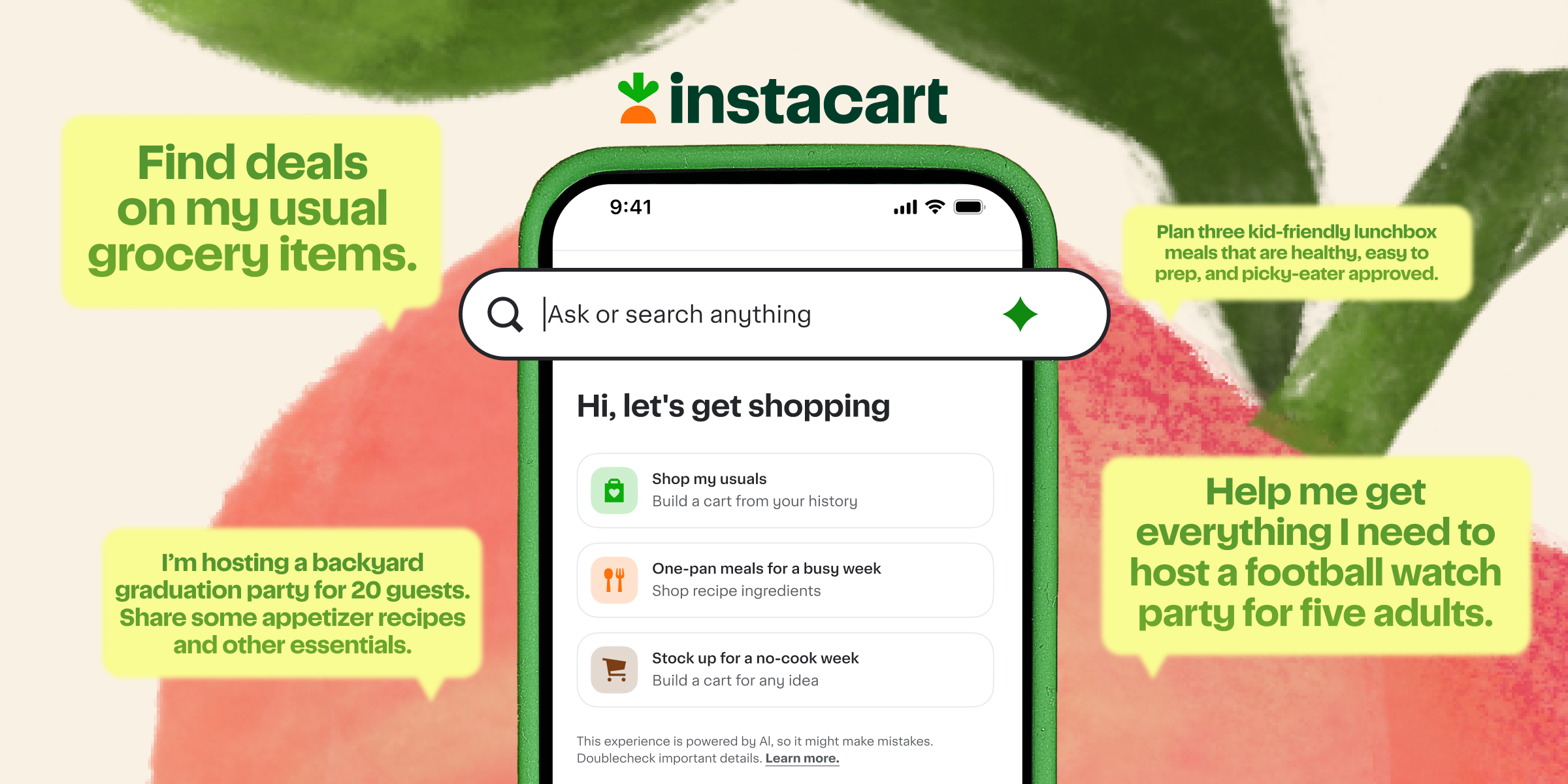
Instacart is moving agentic commerce from a partner-platform promise into its own grocery marketplace, rolling out an AI assistant that can turn a meal idea, shopping prompt or uploaded list into a ready-to-review cart.
Instacart Turns Grocery Search Into Cart Building
The assistant is now available to millions of U.S. customers through Instacart’s app and website.
A full rollout across the U.S. and Canada is planned in the coming months, after months of testing.
The product is built for a specific retail problem: grocery recommendations fail quickly when items are out of stock, household preferences are ignored or substitutions feel random.
Instacart says the assistant uses grocery-specific machine learning, live inventory and customer history to build baskets that reflect what is available at a chosen retailer.
Users can ask for easy weeknight dinners, deals on usual items, a party menu or a cart based on a handwritten list.
The assistant can generate meal ideas with shoppable ingredient lists, translate a list photo into items, surface promotions and adapt suggestions to brand preferences and dietary choices.
The Data Claim Is The Competitive Moat
Instacart’s case rests on the depth of its grocery data.
The company says the assistant draws on more than 1.6 billion lifetime orders and live inventory from nearly 100,000 stores across North America.
It also points to signals from household behavior, millions of consumers and thousands of retail banners.
Those figures matter because agentic shopping is only useful if the agent understands availability, substitutions, recurring purchases and price sensitivity.
A general chatbot can suggest dinner; a grocery agent has to convert that suggestion into an in-stock basket that a household is willing to buy.
Instacart also frames the assistant as part of a wider AI strategy for retailers and advertisers.
The same grocery intelligence is being extended through enterprise tools, Storefront Pro, ads optimization tools and integrations with ChatGPT, Claude and Gemini.
Early Usage Points To A Basket-Size Bet
The company says early testing showed customers using the assistant for more complex tasks such as recipe discovery and meal planning, not only faster search.
Orders placed with the AI assistant are, on average, larger than Instacart’s typical basket, while the platform’s average order value is $113.
Survey data included with the launch explains the demand side of the bet.
An Instacart-commissioned Harris Poll of more than 2,000 U.S. adults found that 83% say deciding what to make for dinner causes stress.
The same survey found more than two in three would be interested in an AI-powered assistant for that task, while just 8% currently use AI for meal planning or grocery shopping.
The commercial question is whether higher-value baskets come from genuine convenience or from nudging customers toward more items.
Instacart says the tool does not finalize anything without explicit action and that every decision is reviewed before checkout.
That review step is important if agentic shopping is to feel like help rather than automated upselling.
Rollout Risk Is About Trust, Not Only Accuracy
Grocery is a difficult test case for consumer AI because mistakes are personal and immediate.
A wrong size, missing ingredient, unsuitable brand or unavailable item can make the whole basket less useful.
That is why Instacart’s strongest claim is not simply that the assistant can generate carts in seconds.
The bigger test is whether it can keep improving from customer accepts, refinements and rejections while preserving user control.
If customers trust the assistant enough to use it for weekly planning, agentic commerce moves closer to a repeat habit.
If they feel the cart needs too much correction, the feature becomes another search layer with a conversational interface.