Japan’s AI Suitcase Turns Assistive Mobility Into a Robotics Test Case
CAAMP, a consortium that includes university research institutes and IBM Japan, has developed the AI Suitcase to guide visually impaired users with sensors, cameras, motors and AI. The suitcase is being tested at locations including Miraikan, New Chitose Airport and Tokyo’s Nihonbashi district, where 39 visually impaired participants completed a monthlong indoor trial without collisions. An updated indoor-and-outdoor model is planned for Expo 2025 in Osaka, with CAAMP aiming to collect feedback from 2,000 to 3,000 people without visual disabilities.
What happened
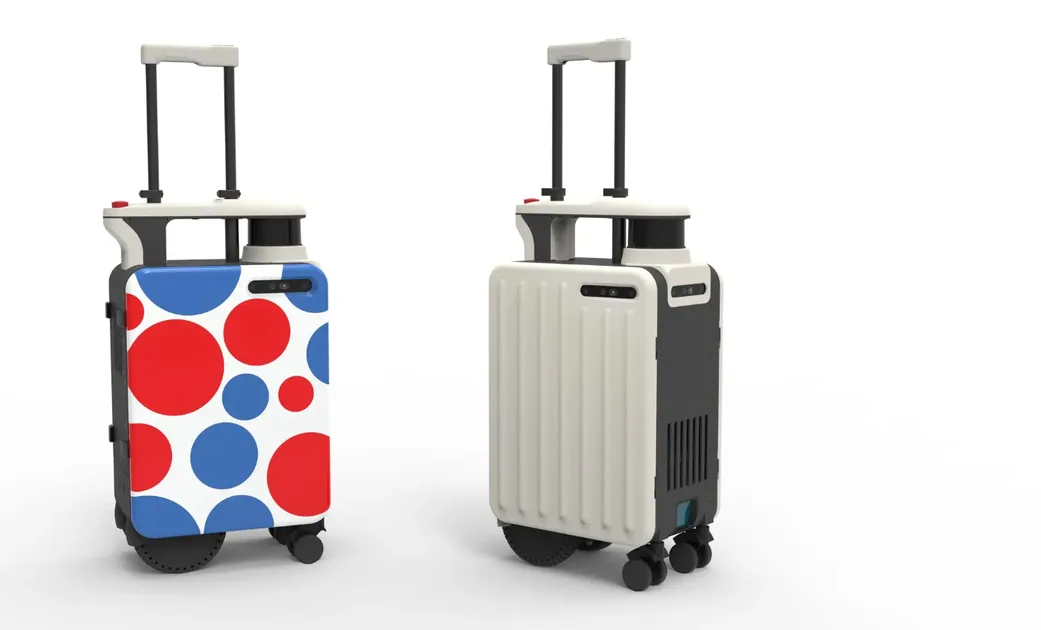
A Japanese assistive-technology consortium has pushed the AI Suitcase from research concept toward public demonstration, positioning a suitcase-shaped robot as a potential mobility aid for people with visual disabilities.
The Consortium for Advanced Assistive Mobility Platform, or CAAMP, includes university research institutes and major companies such as IBM Japan.
The device combines a computer, image-recognition sensors, cameras and motors to guide a user toward a selected destination.
Users choose where they want to go through a smartphone app, grip the handle and receive directional cues through handle vibration.
Releasing the handle stops the suitcase.
The system also uses LiDAR to judge distance from obstacles and real-time kinematics technology based on satellite signals and ground-station data.
The onboard computer processes that information so the robot can estimate its location in more complex outdoor settings.
CAAMP is also exploring functions that use cloud data and image recognition to describe nearby shops, people and products.
Why it matters
The project is a market signal for robotics beyond factory automation.
Japan is testing whether AI navigation, sensor fusion and human-machine interaction can become practical infrastructure for accessibility in public spaces.
If the system proves reliable, it could affect airports, museums, shopping centers and transport hubs that need safer ways to support independent mobility.
The work also shows how assistive robotics may depend less on a single breakthrough than on the integration of several mature technologies: smartphone interfaces, computer vision, LiDAR, localization and edge computing.
The commercial question is whether those parts can operate smoothly in crowded indoor and outdoor environments.
Who is affected
The primary users are people with visual disabilities who may need navigation support in places where guide dogs are restricted or where route guidance requires more precise destination control.
Public-venue operators could also be affected if assistive robots become part of accessibility planning.
The project was initiated by Chieko Asakawa, chief executive director of the National Museum of Emerging Science and Innovation, known as Miraikan, and a fellow at the University of Tokyo’s Research Center for Advanced Science and Technology.
Demonstration testing has taken place at large shopping malls, New Chitose Airport in Hokkaido, Miraikan in Tokyo and the outdoor route between Miraikan and the nearest train station.
In a monthlong Nihonbashi district test in September 2022, 39 visually impaired participants used the AI Suitcase to reach multiple destinations on the same floor of a building.
The test ended with all users arriving safely and without collisions or other reported problems.
What to watch next
The next proving ground is Expo 2025 in Osaka, where the AI Suitcase has been selected for a Robot Experience exhibit.
A special model designed for both indoor and outdoor use is planned, with improvements including wheels intended to handle steps more easily and a sensor designed to detect low obstacles.
Masashi Oikawa of CAAMP said the group wants to improve technical performance for indoor and outdoor use and check non-functional requirements such as social acceptability and legal compliance.
CAAMP hopes 2,000 to 3,000 people without visual disabilities will test or experience the suitcase during the expo.
Readers should watch whether the expo tests show that the system can handle crowds, uneven surfaces and public-space rules.
Those results may determine whether AI mobility assistance remains a demonstration project or moves closer to real deployment.
Summary version for Medium
Japan’s AI Suitcase Turns Assistive Mobility Into a Robotics Test Case
What the announcement means beyond the headline
Quick Summary: CAAMP, a consortium that includes university research institutes and IBM Japan, has developed the AI Suitcase to guide visually impaired users with sensors, cameras, motors and AI. The suitcase is being tested at locations including Miraikan, New Chitose Airport and Tokyo’s Nihonbashi district, where 39 visually impaired participants completed a monthlong...
What happened
A Japanese assistive-technology consortium has pushed the AI Suitcase from research concept toward public demonstration, positioning a suitcase-shaped robot as a potential mobility aid for people with visual disabilities. The Consortium for Advanced Assistive Mobility Platform, or CAAMP, includes university research institutes and major companies such as IBM Japan.
Why it matters
The project is a market signal for robotics beyond factory automation.
- Point 1: The central topic is ai, with the announcement framed around concrete operating detail.
- Point 2: Japan is testing whether AI navigation, sensor fusion and human-machine interaction can become practical infrastructure for accessibility in public spaces.
The important shift is not the AI label, but the operating boundary it creates for teams.
Who is affected
The primary users are people with visual disabilities who may need navigation support in places where guide dogs are restricted or where route guidance requires more precise destination control. Public-venue operators could also be affected if assistive robots become part of accessibility planning.
Read the Full Deep Dive
Want to explore the complete technical analysis, enterprise trade-offs, and detailed metrics?
Read the full article originally published at SendTech Times