Zepto’s IPO Pitch Moves India Quick Commerce Beyond Delivery Speed
Zepto’s draft IPO story is shifting from 10-minute delivery toward cash, dark-store density, advertising revenue and repeat orders, testing whether India’s quick-commerce platforms can turn scale into defensible public-market economics.
Speed Is No Longer The Whole Pitch
Zepto’s public-market case is moving India’s quick-commerce debate away from delivery speed alone.
The company’s Updated Draft Red Herring Prospectus, filed with SEBI on June 8, frames the next phase around order density, advertising yield and customer retention rather than simply adding dark stores or promising faster drops.
That shift matters because quick commerce has spent years training urban consumers to expect groceries and daily-use products in minutes.
The article’s core point is that the 10-minute delivery label is no longer enough for investors.
Zepto now has to show that frequency, pricing discipline and higher utilization can create a business that does not depend only on subsidy-led growth.
The cash comparison explains why.
Zepto had about ₹5,680 Cr in cash at the close of FY26, while Eternal held ₹17,972 Cr and Swiggy had ₹15,053 Cr.
Zepto is seeking ₹8,010 Cr through a fresh issue, which makes the IPO not just a listing event but a funding step in a market where deeper rivals can keep competing aggressively.
The Dark-Store Model Becomes An Efficiency Test
Zepto’s operating argument is built around everyday low prices and dense neighborhood fulfillment.
Smaller average delivery distances can lower the cost of each order and allow riders to complete more deliveries per hour.
If that loop works, lower fees can support more order volume, and more volume can justify additional dark stores in the same locality.
The company is already claiming scale.
Its order volumes are described as having expanded at a 119.4% CAGR across FY24 to FY26.
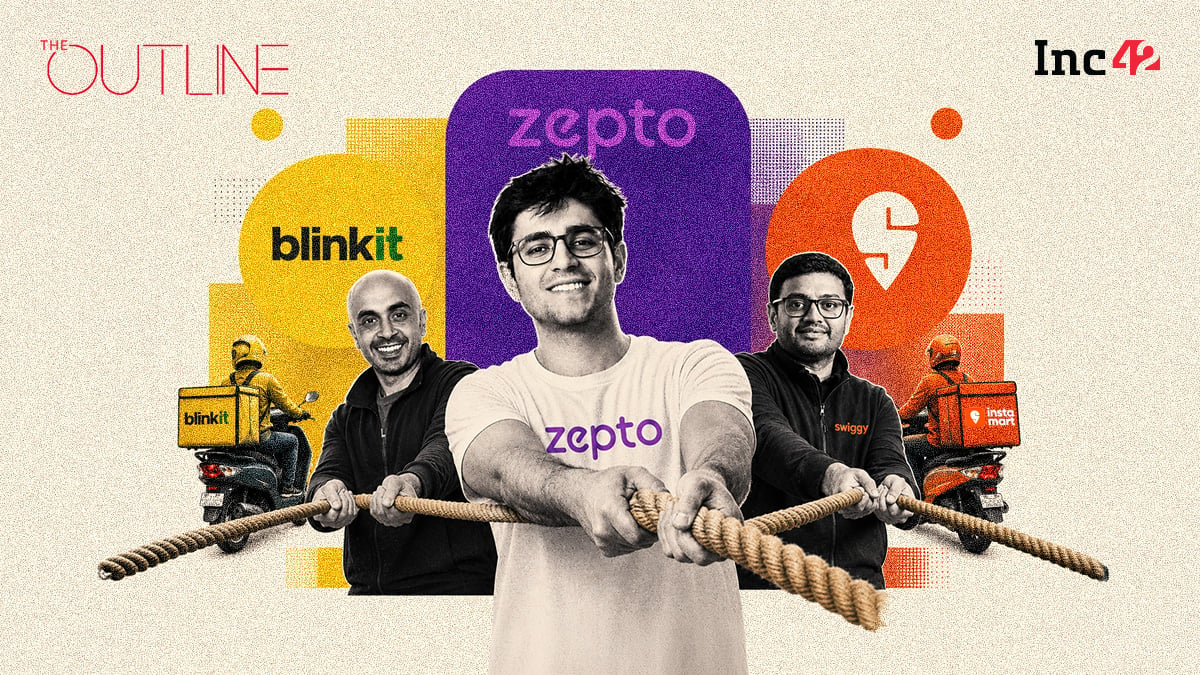
By March 2026, Zepto operated 1,139 dark stores, close to Swiggy Instamart’s 1,143 stores, while Blinkit had 2,243 active stores.
Zepto also reported 23.3 Lakh orders per day, compared with 1.25 Lakh for Swiggy Instamart and 30.4 Lakh for Blinkit.
Revenue scale is part of the same case.
Zepto’s FY26 revenue from operations stood at ₹22,624 Cr, ahead of Swiggy Instamart’s ₹3,859 Cr but behind Blinkit’s ₹37,779 Cr.
The comparison is not perfectly simple because Zepto and Blinkit use an inventory-led model, while Instamart recognizes commissions and platform fees.
Still, the figures show why Zepto wants investors to evaluate operational scale, not only speed.
Advertising Is The Margin Lever To Watch
The more strategic part of Zepto’s pitch is retail media.
Quick-commerce apps sit close to purchase intent, and that makes advertising a possible offset to the cost of fulfillment.
Zepto’s advertising revenue rose from ₹49 Cr in FY24 to ₹651 Cr in FY25 and ₹1,636 Cr in FY26.
In Q4 FY26 alone, advertising revenue reached ₹543 Cr.
That revenue line is important because ads do not carry the same dark-store, cold-chain and delivery-labor burden as physical orders.
If Zepto can expand retail media without weakening customer trust or supplier economics, advertising can improve unit economics while the company keeps competing on everyday prices.
The proof is not complete.
Zepto’s filing material cites 5–8x return on ad spend for brands on the platform, but investors will still need to see whether that performance remains durable as Amazon Now, Flipkart Minutes, Blinkit and Swiggy Instamart compete for the same shoppers and advertisers.
The Risk Is Customer Loyalty
Zepto’s toughest issue is not only capital.
In the March 2026 quarter, annual transacting users fell to 47.97 Mn from 49.54 Mn in the December 2025 quarter.
That decline matters because quick-commerce customers have little switching cost, and delivery partners can work across multiple platforms.
Amazon Now is scaling discounting in Bengaluru and Delhi, while Flipkart Minutes has expanded to nearly 1,000 dark stores.
The next test for Zepto is whether its density-led model and advertising income can hold up when large ecommerce rivals use existing logistics, consumer relationships and discount budgets to attack the same category.
For SendTech Times readers, the signal is broader than one IPO.
India’s quick-commerce market is becoming a test of whether app-based convenience can evolve into infrastructure-like retail economics.
Zepto has scale, cash-raising plans and advertising momentum; it still has to prove that those advantages can outlast a price war.