Amazon India Puts Generative AI Inside Seller Operations
Amazon is rolling out an AI-powered Seller Assistant for Indian merchants, using Bedrock, Nova and Anthropic Claude to cut listing work, support inventory and advertising decisions, and test the tool during Prime Day demand.
Seller Central Gets An AI Operating Layer
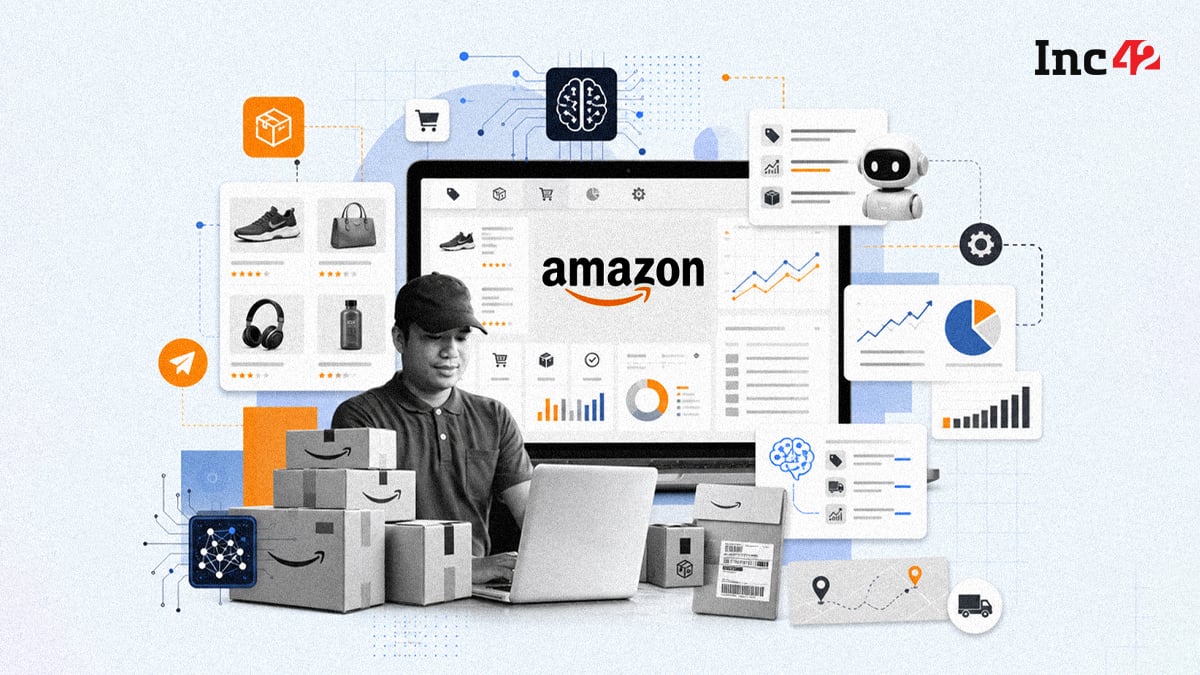
Amazon is moving generative AI deeper into its Indian marketplace by rolling out Seller Assistant inside Seller Central.
The tool is designed as a 24/7 chatbot for merchants and is built on Amazon Bedrock, Amazon Nova foundation models and Anthropic Claude.
The deployment is aimed at sellers who need help with onboarding, catalog creation, advertising, inventory management and cross-border expansion.
Amazon is presenting the assistant as operating support for small businesses rather than a consumer-facing shopping feature, which makes the rollout more relevant to marketplace efficiency than to front-end search alone.
Abhijit Kamra, Amazon's director of seller experience for emerging markets, said the AI features have been provided to 1.7 Mn sellers in India.
He also said the phased rollout began after Smbhav 2025, Amazon's flagship event for MSME startups and entrepreneurs.
Catalog Work Is The First Efficiency Claim
The clearest operational claim is in listing creation.
Amazon says the system can produce product titles, descriptions and attributes.
It can also use a product image or URL to complete up to 70% of the fields needed for a listing, while assisting with image enhancement.
That directly targets a common bottleneck for small merchants moving inventory online.
The company is also applying machine learning to restocking recommendations.
On the advertising side, sellers can use account diagnostics through Amazon's Customized On-Demand Ads Experts programme, known as CODE, for campaign-performance recommendations.
Amazon also pointed to its Vine programme, which allows eligible products to receive reviews from a curated pool of reviewers.
Kamra said operational effort required from sellers has fallen by nearly 70%, while listing errors linked to manual processes have declined by around 10%.
Those figures matter because the assistant is being positioned as a cost and accuracy tool, not only as a chatbot layer.
Prime Day Becomes A Stress Test
The rollout is arriving ahead of Prime Day in July, giving Amazon a high-volume event to test how the newer product-listing and inventory tools perform under pressure.
Kamra said Amazon is watching those tools after positive feedback from sellers in the initial rollout.
International selling is another part of the product scope.
Seller Assistant now gives merchants product recommendations, demand insights and market-level guidance for export opportunities.
It also helps with country-specific compliance requirements, including documentation and regulatory checks, and provides step-by-step tracking of the international expansion process.
That combination gives the product a wider role than basic listing automation.
If the assistant can reduce errors and surface export guidance during busy sales periods, Amazon can use it to make smaller sellers more active across both domestic and cross-border channels.
Training Shows The Adoption Challenge
Amazon India has rolled out Seller Connect programmes in over 20 cities to drive adoption of its AI tools.
More than 5,000 sellers have attended training sessions covering catalog creation, inventory management, fulfillment operations and growth planning.
The training numbers show why marketplace AI is still partly an enablement problem.
A tool built into Seller Central may reduce repetitive work, but small businesses still need to trust the recommendations and understand where automated listing, advertising and compliance guidance should be checked by a human.
Amazon's stated target is broader than one shopping event.
Kamra said the initiative is aimed at impacting 15 Mn businesses by 2030.
The larger Indian market opportunity is also explicit: India's ecommerce market is expected to reach $300 Bn by 2030, with MSMEs identified as a key growth driver.
Merchant AI Is Becoming Platform Infrastructure
Amazon is not alone in moving AI from customer experience into merchant operations.
Flipkart and Snapdeal have introduced AI-powered seller tools, Meesho has added voice AI and AI-powered personalisation in discovery, and software providers for merchants are building AI capabilities for catalog management, marketing and customer engagement.
For SendTech Times readers, the useful signal is that ecommerce AI is becoming infrastructure for marketplace supply.
Amazon's Indian rollout ties foundation models, cloud infrastructure, seller training and export compliance into the merchant workflow.
The next proof point is whether those tools continue to reduce manual work and listing errors when Prime Day volume tests the system.