CapBay And MDEC Open RM200 Million Debt Pool For Malaysian Tech Firms
e27 reported that CapBay and MDEC opened a RM200 million (~US$47.1 million) debt financing pool for Malaysia Digital-status technology companies. The programme offers applications of up to RM3 million and uses AI credit assessment, but participating borrowers and disbursement timing remain undisclosed.
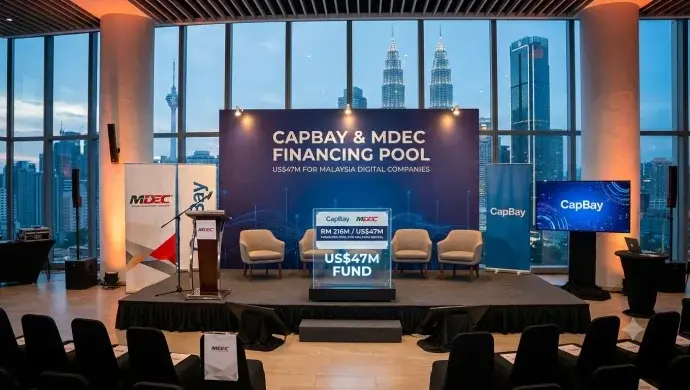
e27 reported that CapBay and the Malaysia Digital Economy Corporation have opened a RM200 million (~US$47.The 1 million) financing pool for Malaysia Digital-status technology companies., according to CapBay. e27 reported that the MD Technology Financing Programme gives eligible firms a debt route separate from equity fundraising, with applicants able to seek up to RM3 million (US$707,000) each.
The programme targets startups and scale-ups that may not fit conventional bank lending models.
The terms include a 60-month maximum repayment period, a six-month grace period and annual interest starting at 6 per cent, according to e27.
CapBay And MDEC Set Financing Terms For Malaysia Digital Firms
CapBay's application route accepts Malaysia Digital-status firms after six months of incorporation, including pre-profit applicants and more mature technology businesses.
Eligible companies apply through the fintech company's digital platform.
MDEC sits under Malaysia's Ministry of Digital and leads the Malaysia Digital initiative. e27 linked the programme to Malaysia's effort to widen access to growth capital while supporting the country's AI Nation 2030 agenda.
e27 cited Google, Temasek and Bain & Company estimates that Southeast Asia's digital economy gross merchandise value reached US$263 billion in 2024.
Startup funding in the region remains under pressure as investors prioritise profitability and unit economics over rapid expansion, according to e27.
e27 placed the facility alongside supply-chain finance and peer-to-peer lending models already used by small businesses in Southeast Asia.
It identified delayed payments, limited collateral and inconsistent bank access as constraints that have supported invoice financing, embedded finance and digital lending models in markets including Indonesia and the Philippines.
The report also listed Singapore, Indonesia and Vietnam as markets where alternative lenders have underwritten companies that banks may see as too young, asset-light or risky.
CapBay Uses AI Credit Assessment Rather Than Collateral Alone
CapBay described its credit assessment model as using artificial intelligence to evaluate applicants through business fundamentals and growth potential rather than hard assets.
Ang Xing Xian, CapBay's co-founder and group CEO, said the programme bases credit decisions on business fundamentals and growth trajectory because technology companies are often not structured around physical collateral.
The six-month incorporation threshold gives young companies access to non-dilutive financing at a stage when equity is often their only option, according to CapBay. e27 noted that debt still has to be repaid, especially for pre-profit companies whose revenue may be uneven or concentrated among a small number of customers.
According to CapBay, its track record since 2016 includes financing for over 2,600 enterprises, with the total amount above RM5.6 billion (~US$1.32 billion).
Its platform covers peer-to-peer financing and supply-chain finance, linking firms with banks and investors.
Malaysia's peer-to-peer financing sector is regulated by the Securities Commission Malaysia, according to e27.
The e27 report named CapBay, Funding Societies Malaysia and other SME-focused lenders as part of the financing stack for small businesses.
Borrower Names And Repayment Evidence Remain Undisclosed
The MDEC-linked programme narrows its target to Malaysia Digital companies, including businesses built around intellectual property, software, talent and proprietary systems rather than physical collateral. e27 identified enterprise software firms, AI service providers, managed services companies, cybersecurity vendors and digital content businesses as examples of MD-status companies that may fit the programme.
The financing structure does not replace repayment risk. e27 said pre-profit borrowers still need revenue growth, predictable collections or contract-backed cash flow if non-dilutive capital is to extend runway without adding repayment stress.
e27 did not identify participating borrowers, expected approval volumes, default assumptions or a first disbursement timetable for the programme.
Summary version for Medium
CapBay And MDEC Open RM200 Million Debt Pool For Malaysian Tech Firms
What the move signals for regulated finance and digital payments
Quick Summary: e27 reported that CapBay and MDEC opened a RM200 million (~US$47.1 million) debt financing pool for Malaysia Digital-status technology companies. The programme offers applications of up to RM3 million and uses AI credit assessment, but participating borrowers and disbursement timing remain undisclosed.
CapBay And MDEC Set Financing Terms For Malaysia Digital Firms
CapBay's application route accepts Malaysia Digital-status firms after six months of incorporation, including pre-profit applicants and more mature technology businesses. Eligible companies apply through the fintech company's digital platform.
CapBay Uses AI Credit Assessment Rather Than Collateral Alone
CapBay described its credit assessment model as using artificial intelligence to evaluate applicants through business fundamentals and growth potential rather than hard assets.
- Point 1: The central topic is fintech-digital-payments, with the announcement framed around concrete operating detail.
- Point 2: Ang Xing Xian, CapBay's co-founder and group CEO, said the programme bases credit decisions on business fundamentals and growth trajectory because technology companies are often...
The important shift is not the AI label, but the operating boundary it creates for teams.
Borrower Names And Repayment Evidence Remain Undisclosed
The MDEC-linked programme narrows its target to Malaysia Digital companies, including businesses built around intellectual property, software, talent and proprietary systems rather than physical collateral. e27 identified enterprise software firms, AI service providers, managed services companies, cybersecurity vendors and digital content businesses as examples of MD-status companies that may fit the programme.
Read the Full Deep Dive
Want to explore the complete technical analysis, enterprise trade-offs, and detailed metrics?
Read the full article originally published at SendTech Times