Grep Adds LLM Agent To Monito As Online Proctoring Shifts Toward Context Review
Grep said its Monito online proctoring product now uses an LLM agent to analyze context around suspected cheating events. The company cited internal tests showing more than 30 percent shorter post-exam review time and nearly 20 percent fewer false alerts. The key issue is whether agent-based proctoring can improve review efficiency while preserving human final judgment and candidate fairness.
Grep Moves Proctoring From Detection To Context
Grep said it has added an agent system to Monito, its online exam proctoring product, in an effort to improve the accuracy of suspected cheating detection.
The product already uses AI-based functions such as gaze tracking, face authentication, prevention of screen duplication and dual-monitor use, as well as three-channel real-time monitoring through webcam, mobile and screen sharing.
The source said Monito has demonstrated operating-cost savings of up to 40 percent compared with offline proctoring.
The new signal is the shift from simple event detection to context analysis.
Grep said earlier systems relied on physical alerts such as a hand moving outside the screen, which limited accuracy.
The company has now introduced an LLM agent that reviews surrounding context rather than judging a single action in isolation.
Why It Matters
For education technology providers, corporate testing teams and certification operators, the announcement points to a practical use case for AI agents: reducing review workload while keeping humans in the final decision loop.
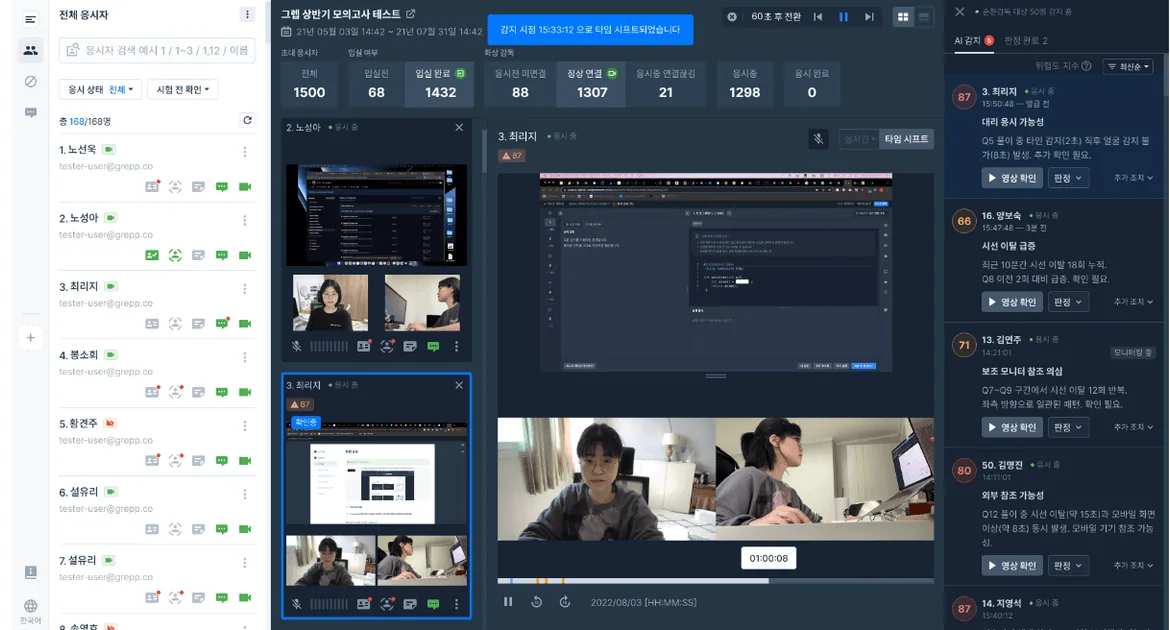
Grep said the main features are situation summaries that add context to AI detection results, a cheating score that lets supervisors check higher-risk candidates first, and fast navigation to the relevant video segment when suspicious activity is found.
The company said the agent can summarize suspected incidents and context in narrative reports, allowing human proctors to review AI-selected cases instead of monitoring all video in real time.
According to internal tests cited by the source, the approach reduced post-exam review time by more than 30 percent compared with checking full video recordings.
The newly added AI agent panel appears on the right side of the supervisor screen and delivers analysis results in real time.
Human Review Remains Central
The source is careful to frame the AI as an assistant, not the final judge.
Grep emphasized that AI does not make the final cheating determination.
It selects and reports suspicious circumstances, while the final decision must be made by a human supervisor under a human-in-the-loop structure.
That difference changes the story because proctoring systems affect exam fairness and candidate trust.
Grep said the system was designed so that good-faith test takers are not disadvantaged even if AI produces a false positive.
Internal tests also showed that false alerts were reduced by nearly 20 percent.
What To Watch Next
Readers should watch whether Grep can turn the agent-based layer into measurable reliability improvements beyond internal tests.
The company said data collection and use for AI model training follow privacy law and related rules, with video data de-identified so that faces and other sensitive personal information cannot be recognized.
The next development area is multimodal AI proctoring.
Grep plans to advance technology that integrates video, audio and environmental logs, and to evolve the agent so it can analyze additional behavioral data such as mouse movement paths and keyboard typing patterns.
Summary version for Medium
Grep Adds LLM Agent To Monito As Online Proctoring Shifts Toward Context Review
What the announcement means beyond the headline
Quick Summary: Grep said its Monito online proctoring product now uses an LLM agent to analyze context around suspected cheating events. The company cited internal tests showing more than 30 percent shorter post-exam review time and nearly 20 percent fewer false alerts.
Grep Moves Proctoring From Detection To Context
Grep said it has added an agent system to Monito, its online exam proctoring product, in an effort to improve the accuracy of suspected cheating detection. The product already uses AI-based functions such as gaze tracking, face authentication, prevention of screen duplication and dual-monitor use, as well as three-channel real-time monitoring through webcam, mobile and screen sharing.
Why It Matters
For education technology providers, corporate testing teams and certification operators, the announcement points to a practical use case for AI agents: reducing review workload while keeping humans in the final decision loop.
- Point 1: The central topic is Grep, with the announcement framed around concrete operating detail.
- Point 2: Grep said the main features are situation summaries that add context to AI detection results, a cheating score that lets supervisors check higher-risk candidates first, and fast...
Stateful isolation is becoming a first-class cloud primitive, not just an implementation detail.
Human Review Remains Central
The source is careful to frame the AI as an assistant, not the final judge. Grep emphasized that AI does not make the final cheating determination.
Read the Full Deep Dive
Want to explore the complete technical analysis, enterprise trade-offs, and detailed metrics?
Read the full article originally published at SendTech Times