OpenAI Rolls Out GPT-Live For ChatGPT Voice Without API Timing
OpenAI said GPT-Live will let ChatGPT Voice listen and speak at the same time, with GPT-5.5 handling harder search and reasoning in the background. The company cited more than 150 million weekly Voice and Dictation users but did not give API timing, video support dates or independent benchmark validation.
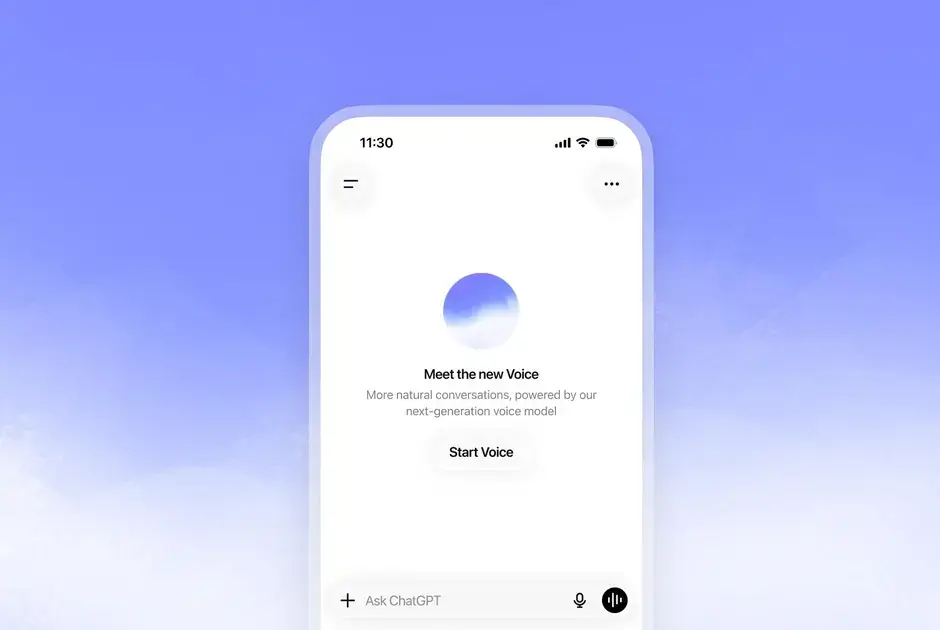
OpenAI is moving ChatGPT Voice to GPT-Live, a full-duplex voice model that the company says can listen and speak at the same time, while delegating harder questions to GPT-5.5 in the background.
The GPT-Live ChatGPT Voice rollout starts globally for ChatGPT users, but OpenAI did not include API launch timing, video support or screen-sharing availability at launch.
The source is OpenAI's own company announcement, so performance, safety and rollout claims remain company-provided and not independently verified.
GPT-Live Rolls Out To ChatGPT Voice Users Globally
OpenAI said it is beginning to roll out two versions of the new system, GPT-Live-1 and GPT-Live-1 mini, to ChatGPT users globally.
The company said GPT-Live-1 will become the default model for ChatGPT Voice on Go, Plus and Pro plans, while GPT-Live-1 mini will become the default for Free users.
The rollout covers ChatGPT on iOS, Android and ChatGPT.com.
OpenAI said it plans to bring GPT-Live to the API soon, but the announcement directed developers and enterprises to a notification form rather than a release date.
The company framed GPT-Live as a change in voice architecture rather than only a new interface.
Earlier cascaded systems chained speech-to-text, language-model response and text-to-speech models.
OpenAI said that approach could lose information across models and produce slow, stilted responses.
Full-Duplex Voice Lets The Model Listen And Speak Together
OpenAI said GPT-Live uses a full-duplex architecture, meaning the model continuously processes input while generating output.
The company said the model can decide many times per second whether to speak, keep listening, pause, interrupt or use a tool.
That design is meant to reduce one of the common limits in voice assistants: rigid turn-taking.
OpenAI said turn-based voice models wait for a user to stop speaking before responding, and silence-based turn detection can mistake a short pause or background noise for the end of a turn.
In the new ChatGPT Voice experience, OpenAI said users can interrupt with a question, pause while thinking or ask ChatGPT to stay quiet and listen.
The company also said the model can acknowledge that it is listening with short phrases such as "mhmm" or "got it", and that it has remastered the nine distinct voices in ChatGPT for GPT-Live.
GPT-5.5 Handles Search And Reasoning Behind Voice Replies
OpenAI said GPT-Live keeps the live audio exchange separate from heavier tasks.
For questions involving search, reasoning or more agent-like work, the company said GPT-Live can hand the request to another model such as GPT-5.5 while the spoken session continues.
At launch, OpenAI said GPT-Live will use GPT-5.5 in the background.
The company also said GPT-Live-1 Instant and GPT-Live-1 mini use GPT-5.5 Instant, while GPT-Live-1 Medium and GPT-Live-1 High use GPT-5.5 Thinking with medium and high reasoning effort.
The company said the voice mode can now show rich visual cards during spoken conversations for topics such as weather, stocks and sports.
It also said Voice continues to support search, memory, images and file uploads.
OpenAI Cites 150 Million Weekly Voice And Dictation Users
OpenAI said more than 150 million people each week talk to ChatGPT using features such as Voice and Dictation.
The company said GPT-Live-1 and GPT-Live-1 mini were strongly preferred over Advanced Voice Mode in matched 5-10 minute human evaluations covering preference, turn-taking, interruptions, conversational flow and naturalness.
Those evaluation claims remain company-provided.
OpenAI said GPT-Live-1 outperforms Advanced Voice Mode on GPQA, BrowseComp and an internal tau3-Voice Telecom variant, but the announcement did not include independent benchmark validation or customer-level enterprise deployment data.
The safety section also stays inside OpenAI's own testing boundary.
The company said GPT-Live adds audio-native evaluations, synthetic audio testing, internal red-teaming, safeguards for higher-risk conversations, teen protections and voice-impersonation limits based on predefined voices.
OpenAI did not disclose API release timing, pricing for developer access, independent benchmark results, enterprise customer deployments, support dates for voice with video or screen sharing, or language-by-language quality data for GPT-Live.
Summary version for Medium
OpenAI Rolls Out GPT-Live For ChatGPT Voice Without API Timing
What the announcement means beyond the headline
Quick Summary: OpenAI said GPT-Live will let ChatGPT Voice listen and speak at the same time, with GPT-5.5 handling harder search and reasoning in the background. The company cited more than 150 million weekly Voice and Dictation users but did not give API timing, video support dates or independent benchmark validation.
GPT-Live Rolls Out To ChatGPT Voice Users Globally
OpenAI said it is beginning to roll out two versions of the new system, GPT-Live-1 and GPT-Live-1 mini, to ChatGPT users globally. The company said GPT-Live-1 will become the default model for ChatGPT Voice on Go, Plus and Pro plans, while GPT-Live-1 mini will become the default for Free users.
Full-Duplex Voice Lets The Model Listen And Speak Together
OpenAI said GPT-Live uses a full-duplex architecture, meaning the model continuously processes input while generating output.
- Point 1: The central topic is ai, with the announcement framed around concrete operating detail.
- Point 2: The company said the model can decide many times per second whether to speak, keep listening, pause, interrupt or use a tool.
The useful takeaway is the operating constraint behind the announcement, not the announcement alone.
GPT-5.5 Handles Search And Reasoning Behind Voice Replies
OpenAI said GPT-Live keeps the live audio exchange separate from heavier tasks. For questions involving search, reasoning or more agent-like work, the company said GPT-Live can hand the request to another model such as GPT-5.5 while the spoken session continues.
Read the Full Deep Dive
Want to explore the complete technical analysis, enterprise trade-offs, and detailed metrics?
Read the full article originally published at SendTech Times