Huawei’s Smart-Car Stack Becomes A Dependency For China’s EV Makers
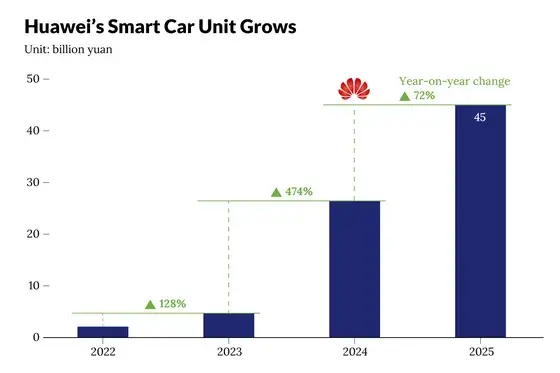
Huawei introduced Qiankun ADS 5, HarmonySpace 6 and Qiankun OS as Chinese automakers deepen reliance on its smart-driving technology. Its intelligent automotive solutions unit generated 45 billion yuan in 2025, up 72%, with 18 billion yuan planned for smart-driving R&D in 2026. The central risk for automakers is whether Huawei’s technology advantage turns into strategic lock-in as the EV market consolidates.
Huawei's smart-car business is becoming a strategic dependency for Chinese automakers.
Caixin reports that carmakers that once feared Huawei as a direct rival now worry they cannot stay competitive without its intelligent-driving and cockpit technology.
The Network Shift
At an April 23 launch event, Huawei's automotive unit introduced Qiankun ADS 5, HarmonySpace 6 and Qiankun OS.
Executives from 18 automakers attended, showing how central Huawei has become to China's smart-EV supply chain.
The company is not only selling components.
It offers partnership models that range from conventional supply to deeper involvement in product definition, R&D and marketing.
That gives Huawei influence over both the technology stack and the way some vehicles are positioned to buyers.
Supplier Power
The financial signal is large.
Huawei's intelligent automotive solutions unit generated 45 billion yuan in revenue in 2025, up 72% year on year.
The company also plans to invest 18 billion yuan, or about $2.6 billion, in smart-driving research in 2026.
That spending helps explain why state-owned and legacy automakers are leaning on Huawei as competition intensifies.
Dongfeng and GAC showed new EV models co-developed with Huawei at the Beijing auto show in April, while the Aito brand with Seres remains a key proof point for Huawei's deeper collaboration model.
Lock-In Risk
The same strength creates unease.
Automakers need Huawei's systems to match rivals in smart driving, but they risk losing control over product strategy, software differentiation and sales positioning if dependence becomes too deep.
Some companies are looking for alternatives.
Caixin says Li Auto and XPeng are working toward Level 4 autonomy, while joint ventures of global manufacturers often work with Momenta because of its more flexible collaboration model.
What To Watch
Huawei expects 93 models to adopt its Qiankun driving system by the end of 2026 and is accelerating Level 3 autonomous-driving deployment.
The question is whether automakers can use Huawei's stack without surrendering too much bargaining power as China's EV market consolidates.
Summary version for Medium
Huawei’s Smart-Car Stack Becomes A Dependency For China’s EV Makers
What the announcement means beyond the headline
Quick Summary: Huawei introduced Qiankun ADS 5, HarmonySpace 6 and Qiankun OS as Chinese automakers deepen reliance on its smart-driving technology. Its intelligent automotive solutions unit generated 45 billion yuan in 2025, up 72%, with 18 billion yuan planned for smart-driving R&D in 2026.
The Network Shift
At an April 23 launch event, Huawei's automotive unit introduced Qiankun ADS 5, HarmonySpace 6 and Qiankun OS. Executives from 18 automakers attended, according to the source, showing how central Huawei has become to China's smart-EV supply chain.
Supplier Power
The financial signal is large.
- Point 1: The central topic is Huawei, with the announcement framed around concrete operating detail.
- Point 2: Huawei's intelligent automotive solutions unit generated 45 billion yuan in revenue in 2025, up 72% year on year.
The important shift is not the AI label, but the operating boundary it creates for teams.
Lock-In Risk
The same strength creates unease. Automakers need Huawei's systems to match rivals in smart driving, but they risk losing control over product strategy, software differentiation and sales positioning if dependence becomes too deep.
Read the Full Deep Dive
Want to explore the complete technical analysis, enterprise trade-offs, and detailed metrics?
Read the full article originally published at SendTech Times