JUPITER Turns Europe’s Exascale Supercomputer Into A Scientific AI Test Bed
JUPITER is running projects in brain mapping, climate simulation, wireless AI and quantum-computer simulation, showing how exascale systems are becoming shared infrastructure for scientific AI.
Exascale Compute Moves From Ranking To Research Work
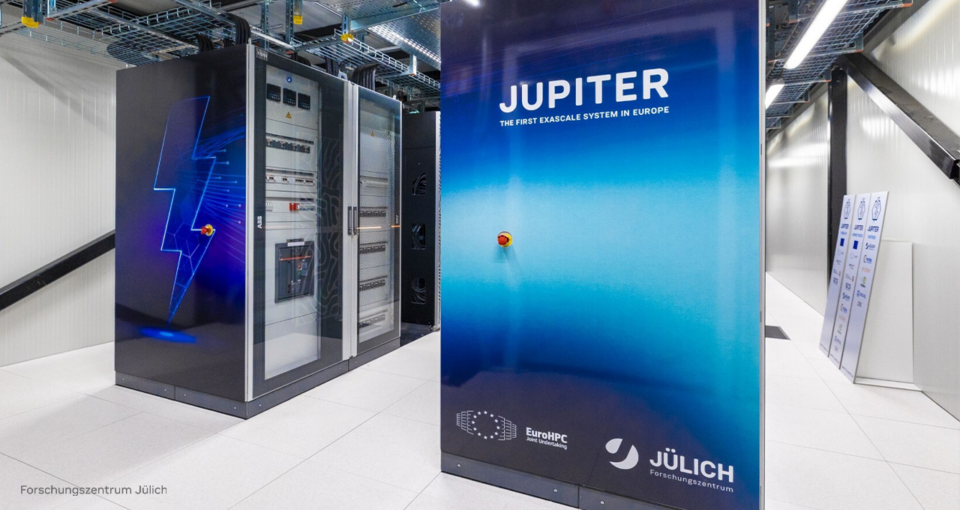
JUPITER, Europe’s first exascale supercomputer, is being used for scientific projects that show how high-performance computing is merging with AI workloads rather than serving only as a benchmark race.
At Forschungszentrum Jülich in Germany, the machine combines NVIDIA Grace Hopper Superchips with Quantum-X800 InfiniBand networking.
At ISC in Hamburg, NVIDIA highlighted four projects on the machine: cellular-scale brain mapping, Earth climate simulation at 1-kilometer resolution, AI for future wireless networks and simulation of a universal 50-qubit quantum computer.
The projects make the system more than a national computing trophy.
They show a European research facility trying to turn scarce accelerator capacity into shared scientific infrastructure for disciplines that need both simulation and AI training.
Thomas Lippert of the Jülich Supercomputing Centre said JUPITER gives Europe exascale capacity across science and AI.
The important operating point is shared access: one machine is being used across neuroscience, climate, telecom research and quantum simulation.
Brain And Climate Work Show The Data Burden
For CytoNet training, NVIDIA lists 6.5 petabytes of data drawn from 21 post-mortem brains and processed on 4,096 NVIDIA Grace Hopper Superchips.
The work finished in under five days, according to the company.
The scale matters because the human brain is described as having 86 billion neurons and about 100 trillion connections.
Katrin Amunts, who leads INM-1 at Forschungszentrum Jülich, said the next step is an AI agent that can help researchers question brain data directly.
That planned agent would add language interfaces, multimodal reasoning and Q&A capabilities to the brain-data workflow.
The claim is still a research direction, not a deployed clinical product, but it shows why the machine’s storage and software environment matter alongside accelerator performance.
Climate researchers are also using JUPITER to run a new ICON configuration that NVIDIA says can simulate the full Earth system at 1-kilometer resolution.
That level of detail puts pressure on networking, storage and workflow software as much as raw accelerator count.
NVIDIA also ties the climate work to a Gordon Bell Prize for Climate Modeling, giving the project a measurable research milestone.
NVIDIA does not claim that JUPITER has solved climate forecasting; it says the system can run models at a level of detail that was previously much harder to reach.
Scientific AI Still Depends On Access And Workflows
JUPITER’s project list gives Europe a visible AI infrastructure story that is different from consumer chatbots or commercial inference clusters.
It is a public research platform where scientific institutions can test whether exascale systems can support data-heavy discovery.
The wireless and quantum projects include AI systems for next-generation wireless networks and a universal 50-qubit quantum-computer simulation.
Those projects widen the machine’s role from one discipline to a broader scientific infrastructure layer.
For governments and research institutions funding exascale systems, that breadth is the policy case.
A supercomputer has to support multiple national and scientific priorities if it is to justify the power, procurement and staffing demands that come with this class of infrastructure.
JUPITER’s unresolved burden is operational rather than promotional.
Researchers need sustained access, usable software, storage capacity and institutional workflows that can turn exascale runs into repeatable scientific results rather than isolated demonstrations.