NVIDIA AI Science Tools Move Research Data Into GPU Pipelines
NVIDIA introduced DAQIRI, ALCHEMI NIM microservices and cuPhoton reference code for scientific AI workloads, targeting chemistry, materials discovery, dark matter research and large observational datasets.
NVIDIA Targets Scientific Data Pipelines
NVIDIA is introducing new AI-for-science software aimed at moving research workflows from slower CPU-bound processing into GPU-accelerated pipelines.
The company named the DAQIRI library, ALCHEMI NIM microservices and cuPhoton reference code as the core additions.
The tools are positioned for chemistry, materials discovery, dark matter research, astrophysics, astronomy, X-ray experiments and laser experiments.
The launch is a scientific-computing story rather than a general AI software update.
The central issue is whether research teams can handle instrument and simulation data quickly enough to turn large experiments into usable results.
NVIDIA said the software belongs to CUDA-X, its collection of tools and libraries for AI and high-performance computing.
The company framed the tools as a way to shift work that previously took hours or days on CPUs into real-time GPU-accelerated workflows.
cuPhoton Focuses On Large Observational Datasets
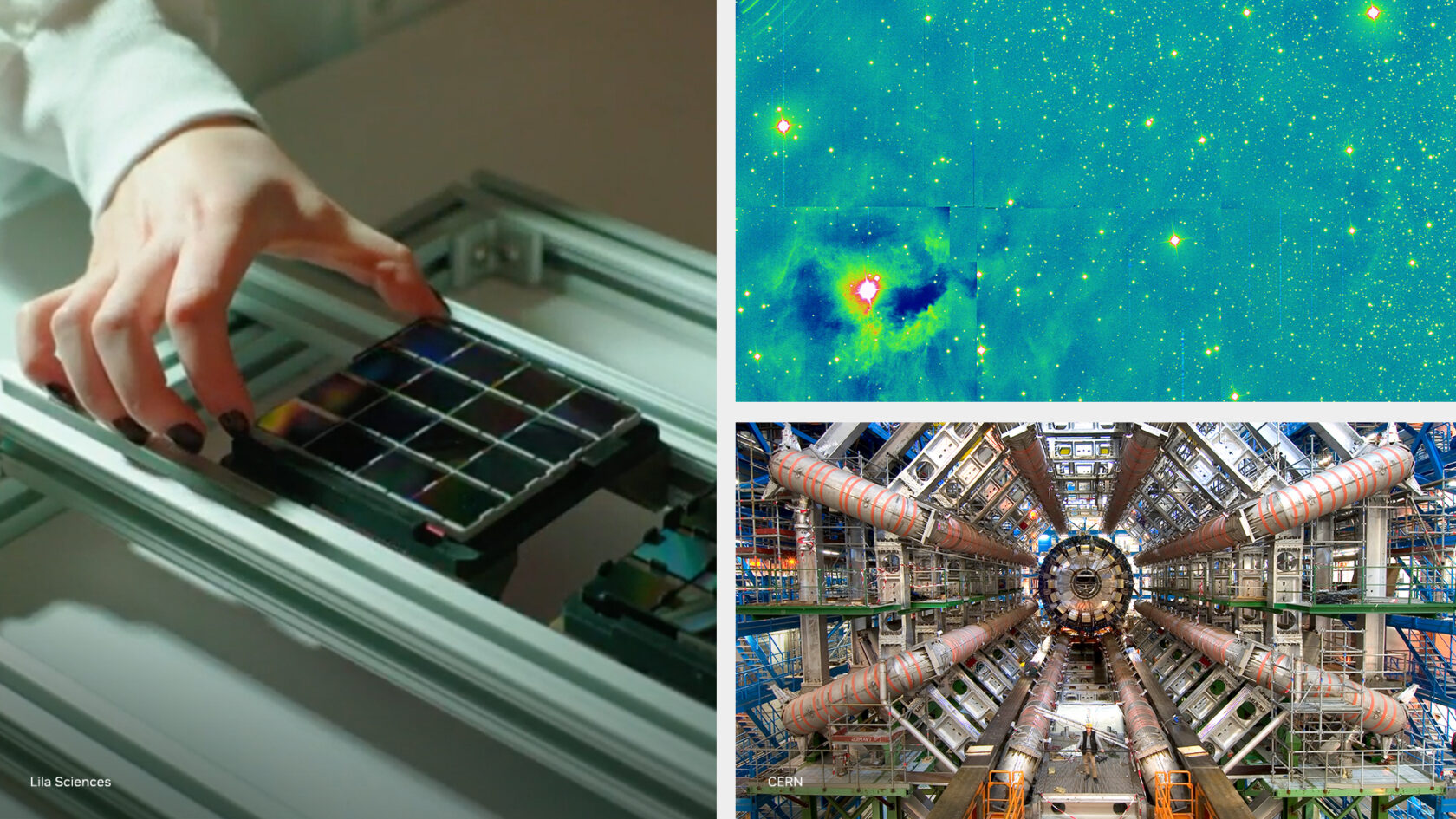
cuPhoton is a reference code for scientists working with multidimensional data from telescopes, X-rays and laser experiments.
NVIDIA presented it as a petabyte-scale tool for moving raw instrument output through loading, processing, analysis and visualization alongside other CUDA-X technologies.
Researchers at Princeton University collaborated with NVIDIA on cuPhoton.
NVIDIA said Princeton and Harvard University will use it for processing and analysis of large observational datasets.
The LSST camera is one of the clearest examples in the announcement.
NVIDIA described it as the largest digital camera ever built and said it captures images of billions of distant galaxies as well as closer faint objects that reflect little light.
That makes data movement and analysis a practical scientific bottleneck, not only a compute benchmark.
Materials And Dark Matter Workloads Set The Proof
The DAQIRI library and ALCHEMI NIM microservices add a second track for chemistry and materials work.
NVIDIA described the broader package as software that helps researchers accelerate discovery across scientific domains rather than only train general AI models.
Research infrastructure budgets often turn on the path from instrument output to usable analysis.
If the pipeline remains slow, labs can collect more data than they can examine.
NVIDIA is arguing that GPU acceleration should be part of the scientific workflow itself, covering data movement, simulation support and visualization rather than sitting only at the model-training stage.
For laboratories and universities, the useful evidence will come from workload results: how the tools perform on telescope data, molecular simulations, dark matter searches and experimental pipelines once research groups put them into routine use.
NVIDIA has named the software components and academic collaborators, but commercial or laboratory adoption remains workload-specific.
The next concrete evidence will be published results, deployment details inside research groups and whether GPU pipelines reduce the delay between scientific instruments and analysis.