Oxmiq Raises $35 Million For GPU IP And AI Factory Design
EE Times reported that Oxmiq Labs raised $35 million in Series A funding, taking total funding to $60 million, and is expanding from GPU IP toward data-centre-scale hardware, orchestration software and AI factory design. Raja Koduri described customer-funded custom silicon and a 2-GW AM Intelligence Labs deployment, but Oxmiq did not name the other large customers or production contracts.
Oxmiq Adds $35 Million For GPU And Data Centre Design
EE Times reported that Oxmiq Labs raised $35 million in Series A funding, bringing total funding to $60 million as the startup expands its work from GPU hardware IP toward AI data centre design, orchestration software and custom silicon.
Raja Koduri founded the company and serves as chief executive.
The new board additions are Tenstorrent CEO Jim Keller and Intel veteran Valluri Rao.
The evidence is company-led because the most detailed claims come from Koduri.
The article therefore treats Oxmiq's cost, customer and architecture claims as company claims rather than independently measured market proof.
OxFactory Targets 10,000-GPU Operations
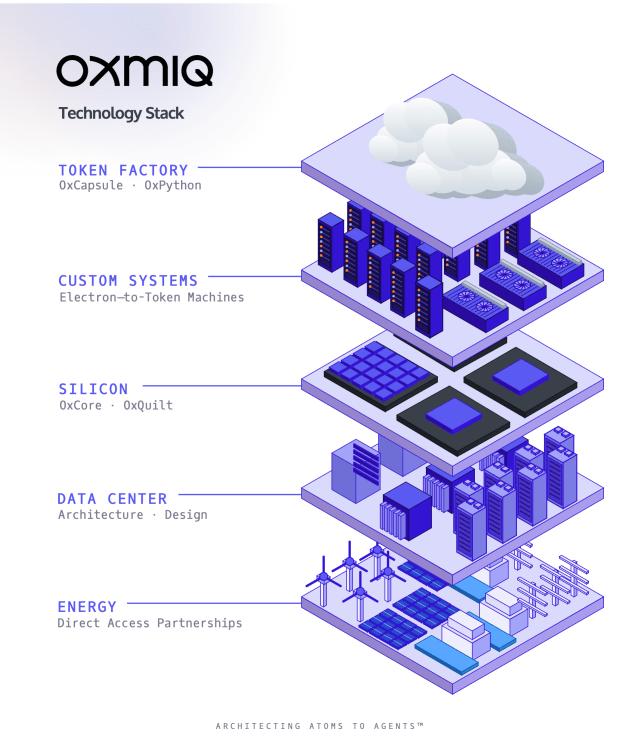
Koduri said Oxmiq wants to build across the stack from energy generation to data centre infrastructure design for AI factories.
The stack includes GPU hardware IP, appliance design and AI data centre pod design.
Oxmiq calls the data centre-scale software layer OxFactory.
Koduri described it as a version of OxCapsule built for software that operates 10,000 GPUs and remains resilient across hardware failures and network failures.
OxCapsule is the company's GPU container software.
Oxmiq says it is partially based on software licensed from Intel and is designed to abstract heterogeneous hardware so workloads can be assigned according to desired speed and cost of execution.
Koduri said the software challenge is larger than CUDA compatibility because many data centre stack layers work only with Nvidia or have only been tested on Nvidia hardware.
He said OxPython is designed to help port workloads from Nvidia GPUs to other hardware.
Custom Silicon Depends On Customer Prepayment
Oxmiq's Electron-to-token machines are planned as bespoke appliances for individual customers.
Koduri said the offering can include custom silicon based on OxCore, the company's GPU IP.
Koduri said the model became possible in the last 12 months because infrastructure companies can pre-pay for tapeouts, masks, wafers and production.
He compared that with a startup spending hundreds of millions of dollars on a chip before finding buyers.
The company claim is tied to AI data centre economics.
Koduri said a 100-MW data centre fitted with state-of-the-art GPUs costs closer to $5 billion, while buying wafers directly from foundries and constructing a product could deliver the same compute and token rate for $1 billion instead of $5 billion.
Oxmiq said OxCore is running on FPGA with the company's software stack.
The IP combines CUDA-compatible GPU cores, tensor cores and orchestration engines, and OxQuilt is meant to combine compute, memory and I/O chiplets in different ratios.
AM Intelligence Labs Names A 2-GW Deployment
Koduri said Oxmiq has a couple of large customers at the table.
The named customer is AM Intelligence Labs, part of India's AM Group.
Oxmiq is the architecture and engineering partner for a 2-GW AM Intelligence Labs AI deployment.
Oxmiq will design the systems architecture, hardware roadmap and supply chain strategy for the facility.
Phase one is a 1-GW cluster in Noida, Uttar Pradesh, India, and is expected to come online in late 2027.
Koduri said Oxmiq will help AM Intelligence Labs architect data centres and procure compute for that cluster.
EE Times reported that Oxmiq currently has 45 employees.
Koduri said he plans to grow the team to 60 or 70 and wants to keep headcount in two digits, even as the company works with partners and licenses elements of the software layer where needed.
Oxmiq did not name the other large customers, disclose production contracts for OxCore-based chips, identify foundry partners, or provide independent benchmarks for the claimed $1 billion versus $5 billion cost comparison.
Summary version for Medium
Oxmiq Raises $35 Million For GPU IP And AI Factory Design
Why this hardware shift matters for AI and compute buyers
Quick Summary: EE Times reported that Oxmiq Labs raised $35 million in Series A funding, taking total funding to $60 million, and is expanding from GPU IP toward data-centre-scale hardware, orchestration software and AI factory design. Raja Koduri described customer-funded custom silicon and a 2-GW AM Intelligence Labs deployment, but Oxmiq did not name the other large...
Oxmiq Adds $35 Million For GPU And Data Centre Design
EE Times reported that Oxmiq Labs raised $35 million in Series A funding, bringing total funding to $60 million as the startup expands its work from GPU hardware IP toward AI data centre design, orchestration software and custom silicon. Raja Koduri founded the company and serves as chief executive.
OxFactory Targets 10,000-GPU Operations
Koduri said Oxmiq wants to build across the stack from energy generation to data centre infrastructure design for AI factories.
- Point 1: The central topic is chips-semiconductors, with the announcement framed around concrete operating detail.
- Point 2: The stack includes GPU hardware IP, appliance design and AI data centre pod design.
The important shift is not the AI label, but the operating boundary it creates for teams.
Custom Silicon Depends On Customer Prepayment
Oxmiq's Electron-to-token machines are planned as bespoke appliances for individual customers. Koduri said the offering can include custom silicon based on OxCore, the company's GPU IP.
Read the Full Deep Dive
Want to explore the complete technical analysis, enterprise trade-offs, and detailed metrics?
Read the full article originally published at SendTech Times