GM Battery Pilot Line Puts Lower-Cost EV Chemistry on a 2028 Clock
General Motors is using a new Battery Cell Development Center near Detroit to move lower-cost EV battery chemistry from research into production planning. The 500,000-square-foot facility supports GM’s $900 million EV battery push and is tied to a plan to cut EV costs by nearly 10%. The practical question is whether LMR battery cells can scale through the pilot line before GM targets vehicles on the road by 2028.
GM Moves the EV Cost Test Into Battery Manufacturing
General Motors is putting a new Battery Cell Development Center at the center of its next EV cost push, using the Warren Tech Center facility outside Detroit to bridge battery research and factory-scale production.
The facility spans two buildings and 500,000 square feet.
GM links it to a $900 million electric-vehicle bet and a plan to lower EV costs by nearly 10%.
The company also said the center should accelerate its lower-cost battery roadmap by about a year.
The timing matters for GM because its EV rollout has been uneven.
The company reconfigured EV production capacity last year, laid off thousands of workers, and temporarily paused a refresh of full-size EV trucks and SUVs.
The new facility is meant to shorten the path between laboratory work and commercial production rather than leave battery chemistry stuck in research.
LMR Becomes GM’s Main Chemistry Test
Kurt Kelty, vice president of battery and sustainability at GM, is focusing the strategy on lithium-manganese-rich (LMR) battery chemistry.
“That is really going to be our bread and butter,” Kelty said.
“That is going to be our main product line.”
GM has relied on Ultium, the branded battery platform used in its current EVs, but the company is narrowing the role of nickel-manganese-cobalt (NMC) chemistry to high-end vehicles.
GM says LMR is almost as energy dense as NMC while reaching a cost level comparable to lithium-iron-phosphate (LFP), the cheaper chemistry used in lower-end models such as the Chevrolet Bolt.
For a truck such as the Chevrolet Silverado EV, GM has said LMR should preserve most of the vehicle’s more than 400-mile range while cutting costs by at least $6,000.
GM wants LMR vehicles on the road by 2028, making the battery center a schedule risk as much as a technology asset.
The Pilot Line Between Lab and Gigafactory
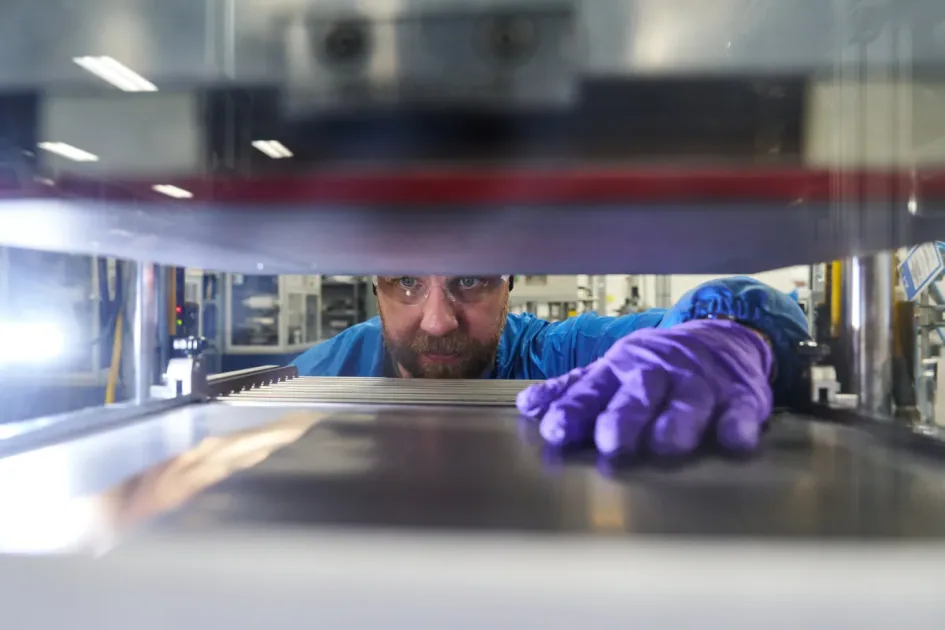
The Battery Cell Development Center is designed to sit between small-batch battery research and full gigafactory production.
At full operation, GM expects output of about 2,500 cells per day, equal to roughly half a gigawatt-hour per year.
That scale is far above the 30 to 50 batteries per day developed next door at the Wallace Battery Cell Research Center, but well below the 2.8 million-square-foot Ultium battery factory in Tennessee.
GM says the Tennessee plant produces about 300,000 cells per year, or 45 gigawatt-hours’ worth.
A test run at the new center costs about $200,000, far less than a comparable run at the full-size Ultium plant.
Mo Gallegos, head of BCDC at GM, described the center as a bridge between the research process and production handoff.
AI Models Add a Second Speed Lever
GM is also using simulations and AI models to reduce battery development time.
Radu Theyyunni, director of global virtual electrification and powertrain at GM, said the company has logged more than 150 million CPU hours on LMR work.
The company has also built a digital twin of the Battery Cell Development Center, including equipment control boards, wiring, and mixing-tank blades.
GM says simulations have helped check equipment clearance, control-system behavior, safety, and ramp-up timing, saving millions of dollars.
The next signal is whether the first LMR batches expected later this year show that GM can move the chemistry from pilot production toward vehicles planned for 2028.
Summary version for Medium
GM Battery Pilot Line Puts Lower-Cost EV Chemistry on a 2028 Clock
What the announcement means beyond the headline
Quick Summary: General Motors is using a new Battery Cell Development Center near Detroit to move lower-cost EV battery chemistry from research into production planning. The 500,000-square-foot facility supports GM’s $900 million EV battery push and is tied to a plan to cut EV costs by nearly 10%.
GM Moves the EV Cost Test Into Battery Manufacturing
General Motors is putting a new Battery Cell Development Center at the center of its next EV cost push, using the Warren Tech Center facility outside Detroit to bridge battery research and factory-scale production. The facility spans two buildings and 500,000 square feet.
LMR Becomes GM’s Main Chemistry Test
Kurt Kelty, vice president of battery and sustainability at GM, is focusing the strategy on lithium-manganese-rich (LMR) battery chemistry.
- Point 1: The central topic is devices consumer tech, with the announcement framed around concrete operating detail.
- Point 2: “That is really going to be our bread and butter,” Kelty said.
AI deployments now depend on where models, data, approvals and operating teams meet.
The Pilot Line Between Lab and Gigafactory
The Battery Cell Development Center is designed to sit between small-batch battery research and full gigafactory production. At full operation, GM expects output of about 2,500 cells per day, equal to roughly half a gigawatt-hour per year.
Read the Full Deep Dive
Want to explore the complete technical analysis, enterprise trade-offs, and detailed metrics?
Read the full article originally published at SendTech Times