Hong Kong Indoor 5G Gap Shows Building-Level Network Divide
A Speedtest Intelligence study says Hong Kong’s indoor 5G experience varies sharply by building, putting the focus on shared in-building systems rather than outdoor coverage alone.
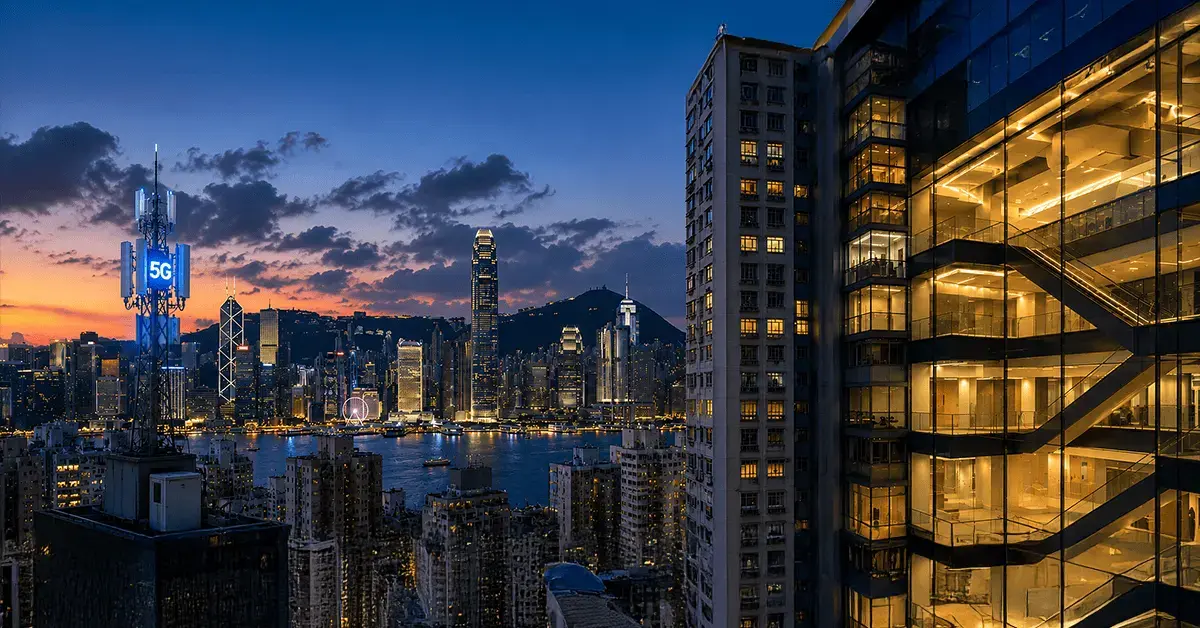
A new Speedtest Intelligence study of indoor 5G in Hong Kong shows that outdoor coverage figures do not settle the question of mobile quality inside towers, malls, transport hubs and offices.
The Office of the Communications Authority's Trading Fund Report 2024/25 says 5G population coverage exceeded 99% by the end of March 2025.
The building-level study uses that figure as the starting point for a different question: how well 5G works once users move inside dense vertical buildings.
Building Data Shows The Indoor Gap
The Speedtest Intelligence indoor sample covers more than 760 buildings across shopping malls, residential estates, offices, transit hubs and hotels.
It separates performance by building, region and operator, rather than treating the territory as one coverage map.
The dataset lists an all-operator median 5G download speed of 167.37 Mbps and an all-operator median upload speed of 27.98 Mbps.
Those medians hide the building-level spread.
The slowest 10% of measured buildings recorded 43.02 Mbps for median 5G download speed, while the fastest 10% reached 479.97 Mbps.
Regional medians varied less than the building-level results.
Ookla attributed the indoor differences to signal penetration, in-building systems and available capacity.
Signal And Infrastructure Drive The Result
The signal data points to the same conclusion.
According to the Speedtest Intelligence signal analysis, average 5G SS-RSRP across the four major operators was -89.5 dBm, a level between good and fair coverage.
Reinforced concrete, tinted low-emissivity glass and high-rise layouts can weaken mid-band and high-band 5G signals from outdoor macro cells.
Dedicated in-building systems, including distributed antenna systems and small cells, become the main way to improve indoor capacity.
Shared Systems Narrow The Venue Gap
Ookla's selected-venue review covered 16 prominent buildings with enough operator-level samples for stable readings.
Public venues with shared infrastructure, including Hong Kong International Airport Terminal 1 and the Hong Kong Convention and Exhibition Centre New Wing, showed more consistent multi-operator performance.
Private estates and towers showed a sharper split.
The self-reported selected-venue review states that gaps reached 80-fold between the best and worst operator result in some buildings.
The selected-venue result links indoor 5G experience to property access, deployment choices and whether infrastructure is shared across carriers.
The regulatory framework is changing.
The Telecommunications (Amendment) Ordinance 2024 grants mobile operators statutory access to designated infrastructure space in newly approved buildings from April 2025 without access fees.
The study does not provide upgrade costs, ownership terms for shared systems or operator participation plans for older buildings.
That leaves the timetable for improving indoor 5G in existing properties outside the published evidence.
Summary version for Medium
Hong Kong Indoor 5G Gap Shows Building-Level Network Divide
What the announcement means beyond the headline
Quick Summary: A Speedtest Intelligence study says Hong Kong’s indoor 5G experience varies sharply by building, putting the focus on shared in-building systems rather than outdoor coverage alone.
Building Data Shows The Indoor Gap
The Speedtest Intelligence indoor sample covers more than 760 buildings across shopping malls, residential estates, offices, transit hubs and hotels. It separates performance by building, region and operator, rather than treating the territory as one coverage map.
Signal And Infrastructure Drive The Result
The signal data points to the same conclusion.
- Point 1: The central topic is telco-connectivity, with the announcement framed around concrete operating detail.
- Point 2: According to the Speedtest Intelligence signal analysis, average 5G SS-RSRP across the four major operators was -89.5 dBm, a level between good and fair coverage.
AI deployments now depend on where models, data, approvals and operating teams meet.
Shared Systems Narrow The Venue Gap
Ookla's selected-venue review covered 16 prominent buildings with enough operator-level samples for stable readings. Public venues with shared infrastructure, including Hong Kong International Airport Terminal 1 and the Hong Kong Convention and Exhibition Centre New Wing, showed more consistent multi-operator performance.
Read the Full Deep Dive
Want to explore the complete technical analysis, enterprise trade-offs, and detailed metrics?
Read the full article originally published at SendTech Times