Korean NPU Makers Target Inference Niches as Nvidia Dominance Deepens
Executives from Rebellions, FuriosaAI and Mobilint said Korean NPU vendors see openings in inference, power efficiency and total cost despite Nvidia technical advantages. The panel highlighted Nvidia’s Groq deal, software ecosystems, interconnects and packaging as the main competitive barriers for domestic AI chip firms. Rebellions and FuriosaAI are focused on data-center inference, while Mobilint is positioning around edge and on-device AI where power and cost limits are tighter.
The Inference Market Signal
Korean NPU companies are treating Nvidia dominance as a market constraint rather than a reason to exit.
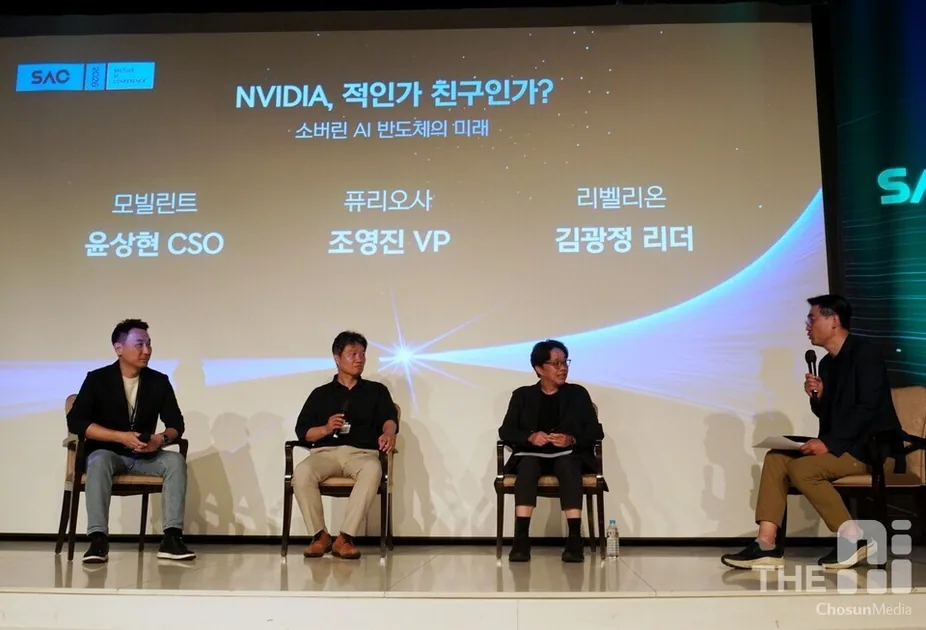
At an SAC 2026 panel, executives from Rebellions, FuriosaAI and Mobilint acknowledged a real technology gap with Nvidia, but argued that inference workloads, power limits and total cost of ownership are opening niches for domestic AI accelerators.
The discussion came as AI chip purchasing criteria are shifting.
The source says early benchmarks focused on raw operations and throughput, then token generation speed, while buyers now increasingly look at power efficiency and total cost.
That shift matters because large GPUs can push data centers toward expensive power and cooling upgrades, while edge devices often cannot accommodate high-power accelerators at all.
Nvidia Raises the Bar
The panelists also pointed to Nvidia strategy in inference.
The source says Nvidia struck a roughly 29 trillion won technology and talent licensing deal with Groq in December 2025, a move described as close to an acquisition because it absorbed key people and intellectual property.
Rebellions executive Kim Kwang-jung said the deal proved the inference market is real, but also raised the software benchmark for Korean NPU companies.
Kim said Rebellions is focusing on open-source AI frameworks, a wider software stack and chiplet-based networking and interconnect solutions.
He also cited an NPU deployment in an SK Telecom call reservation service as a sign that Korean accelerators are moving beyond proof of concept.
Different Paths for Korean NPUs
FuriosaAI vice president Cho Young-jin framed the technology challenge around architecture.
He expects attention and feed-forward layers in AI inference to become more separated, potentially creating a role for specialized hardware and different memory structures.
He said Nvidia is more than three years ahead in interconnect, packaging and system-level capabilities, but argued FuriosaAI has built a more mature software stack and will pursue positioning rather than direct frontal competition.
Mobilint is taking a different route.
Chief strategy officer Yoon Sang-hyun said the company is focused on edge and on-device markets, where performance, power and cost must be balanced together.
Mobilint began volume production of its Aries NPU in the second half of last year and is preparing commercialization of an AI SoC in the first half of this year.
What to Watch
The Korean NPU opportunity depends less on beating Nvidia everywhere and more on proving specific deployment economics.
Data-center players such as Rebellions and FuriosaAI need production customers, software compatibility and interconnect progress.
Edge-focused firms such as Mobilint need lightweight algorithms that let constrained hardware run transformer-era models without unacceptable accuracy losses.
Government support may help early commercialization, but the harder test is international adoption.
If Korean NPU vendors can convert domestic deployments into repeatable inference services, they will have a clearer path to compete in parts of the AI accelerator market where efficiency and localization matter more than GPU scale.
Summary version for Medium
Korean NPU Makers Target Inference Niches as Nvidia Dominance Deepens
Why this hardware shift matters for AI and compute buyers
Quick Summary: Executives from Rebellions, FuriosaAI and Mobilint said Korean NPU vendors see openings in inference, power efficiency and total cost despite Nvidia technical advantages. The panel highlighted Nvidia’s Groq deal, software ecosystems, interconnects and packaging as the main competitive barriers for domestic AI chip firms.
The Inference Market Signal
Korean NPU companies are treating Nvidia dominance as a market constraint rather than a reason to exit. At an SAC 2026 panel, executives from Rebellions, FuriosaAI and Mobilint acknowledged a real technology gap with Nvidia, but argued that inference workloads, power limits and total cost of ownership are opening niches for domestic AI accelerators.
Nvidia Raises the Bar
The panelists also pointed to Nvidia strategy in inference.
- Point 1: The central topic is Korean NPU, with the announcement framed around concrete operating detail.
- Point 2: The source says Nvidia struck a roughly 29 trillion won technology and talent licensing deal with Groq in December 2025, a move described as close to an acquisition because it...
The important shift is not the AI label, but the operating boundary it creates for teams.
Different Paths for Korean NPUs
FuriosaAI vice president Cho Young-jin framed the technology challenge around architecture. He expects attention and feed-forward layers in AI inference to become more separated, potentially creating a role for specialized hardware and different memory structures.
Read the Full Deep Dive
Want to explore the complete technical analysis, enterprise trade-offs, and detailed metrics?
Read the full article originally published at SendTech Times