SendTech Times
Chips & SemiconductorsNews|June 1, 2026 at 11:23 AM
CAPACITY TEST:

FuriosaAI and Broadcom Target the Next Layer of AI Inference Infrastructure

Article summary

FuriosaAI said it will work with Broadcom on a next-generation AI inference platform built around its TCP architecture and Broadcom networking and packaging technologies. The planned third-generation accelerator will use a 2-nanometer compute die, HBM4/HBM4E memory and multi-die packaging, with sampling planned for the first half of 2028. The deal points to AI infrastructure competition shifting from single-chip performance toward memory, networking, power efficiency and rack-level system design.

FuriosaAI and Broadcom Target the Next Layer of AI Inference Infrastructure
Image source: 인공지능신문

What happened

FuriosaAI said it has formed a strategic partnership with Broadcom to co-develop a next-generation AI inference platform.

The Korean AI chip company said the project will move its Tensor Contraction Processor architecture into a multi-die chiplet system for hyperscale AI environments where token-processing demand is rising.

The planned platform combines FuriosaAI architecture with Broadcom AI networking, high-bandwidth Ethernet switching and advanced packaging.

The source says the goal is an integrated AI computing, networking and software platform for large inference clusters, not only a standalone accelerator.

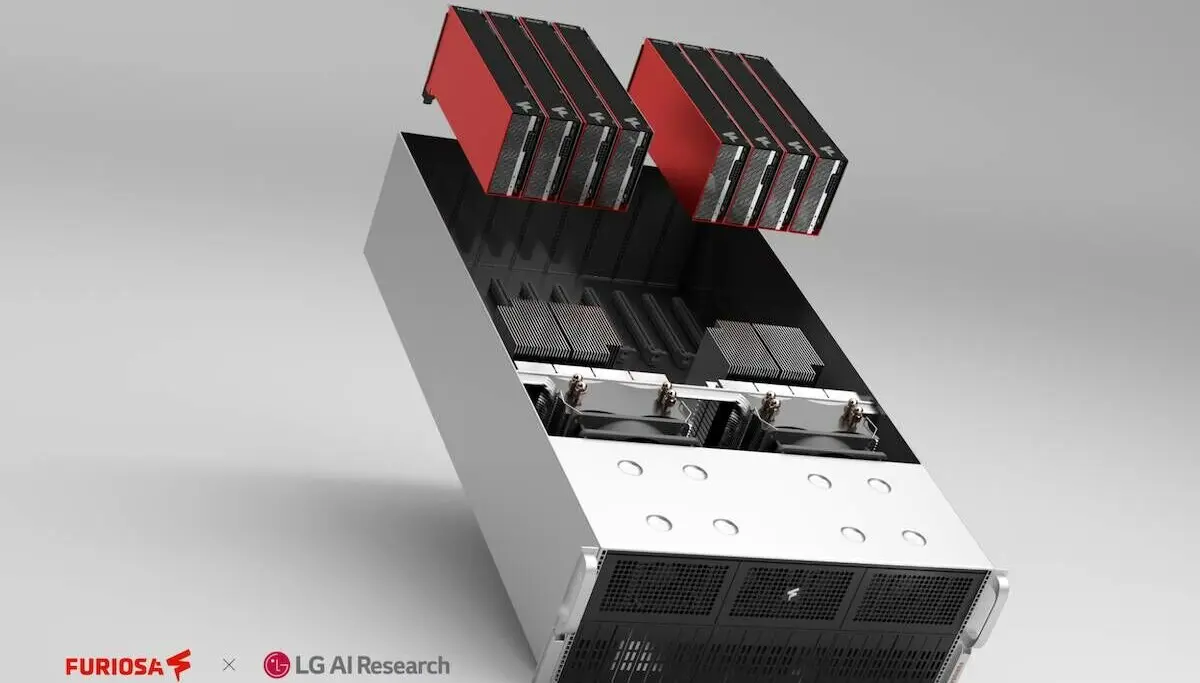
The work builds on FuriosaAI RNGD, or Renegade, accelerator.

The source describes RNGD as a 180W PCIe AI accelerator in mass production using TSMC 5-nanometer process and SK hynix HBM3, optimized for large language model and agentic AI workloads.

FuriosaAI said it has been validated in customer environments including Samsung SDS and LG AI Research.

Why it matters

The announcement points to AI infrastructure competition moving beyond single-chip performance.

If inference demand keeps expanding, buyers may place more weight on memory bandwidth, interconnect, rack-level networking and power efficiency.

That matters for Korean AI semiconductor companies because it puts system design and global infrastructure partnerships at the center of the market.

FuriosaAI is positioning its TCP architecture alongside Broadcom networking and packaging assets to address bottlenecks in large agentic AI deployments.

Who is affected

The most direct audience is hyperscale AI infrastructure buyers, cloud providers and enterprises planning larger inference workloads.

It also matters for AI chip startups trying to compete in markets shaped by GPU-based infrastructure.

For Korean technology readers, the signal is that a domestic AI semiconductor company is working with a global chip and networking supplier on a platform aimed at frontier model and agentic AI inference.

What to watch next

FuriosaAI said the third-generation accelerator will use a 2-nanometer compute die, HBM4 and HBM4E memory, and Broadcom packaging to combine multiple silicon dies into one high-performance chip.

The companies plan to begin sampling in the first half of 2028.

Readers should watch whether the partnership moves from architecture plans to working silicon, whether customer adoption follows current RNGD deployments, and whether rack-scale networking becomes a clearer differentiator in AI inference infrastructure.

Share this article
inXf

Related articles

More
Korean NPU Makers Target Inference Niches as Nvidia Dominance Deepens
Chips & Semiconductors

Korean NPU Makers Target Inference Niches as Nvidia Dominance Deepens

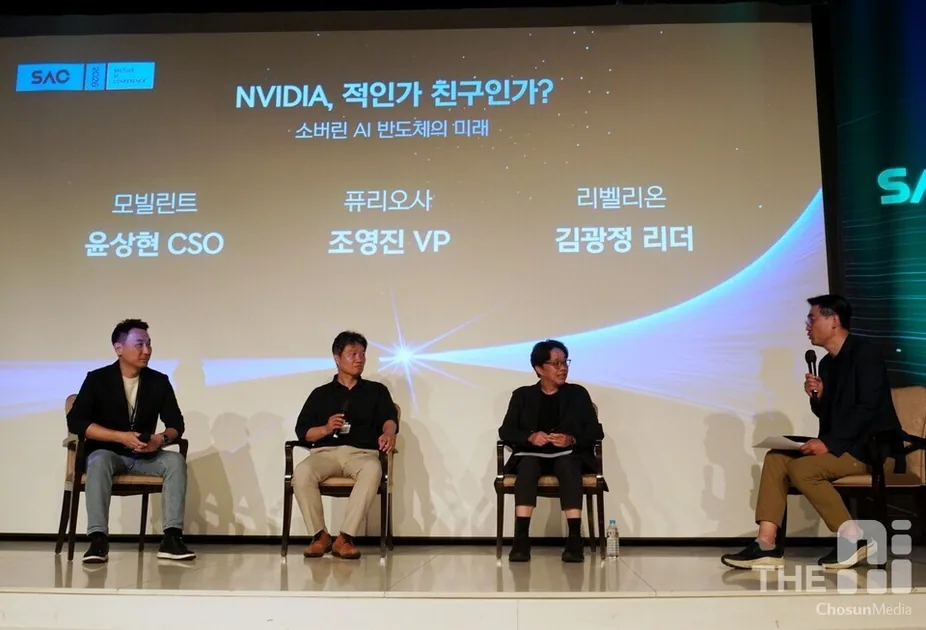
Executives from Rebellions, FuriosaAI and Mobilint said Korean NPU vendors see openings in inference, power efficiency and total cost despite Nvidia technical advantages. The panel highlighted Nvidia’s Groq deal, software ecosystems, interconnects and packaging as the main competitive barriers for domestic AI chip firms. Rebellions and FuriosaAI are focused on data-center inference, while Mobilint is positioning around edge and on-device AI where power and cost limits are tighter.

Tencent’s Canghai V2 Chip Pushes Video Encoding Into Its Cloud Infrastructure Stack
Chips & Semiconductors

Tencent’s Canghai V2 Chip Pushes Video Encoding Into Its Cloud Infrastructure Stack

Tencent Cloud says its self-developed Canghai V2 video encoding chip has entered mass production after leading MSU hardware encoding benchmarks. The company is positioning the chip as a way to cut bandwidth and compute costs for AI video, live streaming and cloud media workloads. The next test is whether benchmark leadership turns into wider deployment across Tencent Cloud services and external customers.

Huawei's Tau scaling puts architecture at the center of China's AI-chip push
Chips & Semiconductors

Huawei's Tau scaling puts architecture at the center of China's AI-chip push

Huawei proposed Tau scaling, a framework focused on shorter signal paths rather than only smaller transistors. LogicFolding is planned for Kirin chips in fall and winter 2026, with Huawei claiming a density jump to 238 million transistors per square millimeter. The test is whether architecture-led gains can be validated in commercial chips amid export-control limits on advanced tools.

Huawei’s Kirin 9050 highlights 3D stacking and Tau Law ahead of the Mate 90 launch
Chips & Semiconductors

Huawei’s Kirin 9050 highlights 3D stacking and Tau Law ahead of the Mate 90 launch

Huawei plans to introduce the Kirin 9050 with the Mate 90 series this fall, with September 2026 indicated for the phone launch window. Reports tied to industry channels and an ISCAS 2026 conference presentation describe the chip as moving past Apple’s A18 while nearing first-generation 3nm-class density. The central issue is whether 3D IC stacking and Tau Law can deliver high-end results without relying on the most advanced EUV lithography tools.

Keep Reading

More Stories

Latest
MiniMax M3 turns long-context AI into an agent platform testAIJun 1, 2026MiniMax M3 turns long-context AI into an agent platform testMiniMax launched M3 on June 1, 2026, combining long-context, agentic, coding and native multimodal capabilities in one model line. The API supports up to 1 million tokens of context, with a guaranteed minimum of 512K tokens, and includes M3 and M3-highspeed versions. MiniMax plans to open-source M3 on HuggingFace and GitHub, while early pricing offers a 50% discount for the first seven days.Japan’s AI Suitcase Turns Assistive Mobility Into a Robotics Test CaseAIJun 1, 2026Japan’s AI Suitcase Turns Assistive Mobility Into a Robotics Test CaseCAAMP, a consortium that includes university research institutes and IBM Japan, has developed the AI Suitcase to guide visually impaired users with sensors, cameras, motors and AI. The suitcase is being tested at locations including Miraikan, New Chitose Airport and Tokyo’s Nihonbashi district, where 39 visually impaired participants completed a monthlong indoor trial without collisions. An updated indoor-and-outdoor model is planned for Expo 2025 in Osaka, with CAAMP aiming to collect feedback from 2,000 to 3,000 people without visual disabilities.Anthropic’s Conway Points Claude Toward Always-On AI AgentsAIJun 1, 2026Anthropic’s Conway Points Claude Toward Always-On AI AgentsAnthropic is preparing a Claude expansion that includes Conway, Orbit, Operon, memory upgrades and multilingual voice mode. The move signals a shift from chat-based AI toward persistent assistants that can connect with external services and manage workspaces. Enterprises, developers and research teams could be affected if Claude becomes a broader agent platform.SoftBank’s €75 Billion France Plan Signals Europe’s AI Infrastructure RaceCloud & Data CentersJun 1, 2026SoftBank’s €75 Billion France Plan Signals Europe’s AI Infrastructure RaceSoftBank plans to invest up to €75 billion in AI data centres in France, with initial sites expected to come online in five years. The first phase includes €45 billion for 3.1 GW of capacity in Hauts-de-France by 2031, including locations in Dunkirk’s Loon-Plage, Bosquel and Bouchain. The plan could strengthen Europe’s AI infrastructure base, but questions remain over financing, regulatory approvals and what technological sovereignty means when a Japanese group leads the buildout.AIVEX Brings Physical AI Into Korean Battery-Plant Packaging WorkAIJun 1, 2026AIVEX Brings Physical AI Into Korean Battery-Plant Packaging WorkAIVEX said its AIbot platform automated a crucible packaging-removal process at a leading Korean battery-materials company. The system combines AI vision, 3D optics, 6D pose estimation and automatic path planning to handle irregular ropes and wrapping film. The deployment points to physical AI moving into factory tasks that are repetitive but too variable for simple fixed automation.Dubai RTA Digital Revenue Shows Smart Mobility Moving Into Daily UseEconomyJun 1, 2026Dubai RTA Digital Revenue Shows Smart Mobility Moving Into Daily UseRTA said digital-channel revenue reached AED5.3 billion in 2025, up 20.6 percent from 2024. The authority reported more than 628 million digital transactions and 96 percent digital adoption. The next test is whether AI, WhatsApp and government-platform integrations make mobility services simpler.Grep Adds LLM Agent To Monito As Online Proctoring Shifts Toward Context ReviewAIJun 1, 2026Grep Adds LLM Agent To Monito As Online Proctoring Shifts Toward Context ReviewGrep said its Monito online proctoring product now uses an LLM agent to analyze context around suspected cheating events. The company cited internal tests showing more than 30 percent shorter post-exam review time and nearly 20 percent fewer false alerts. The key issue is whether agent-based proctoring can improve review efficiency while preserving human final judgment and candidate fairness.Nvidia Pushes AI PC Strategy With RTX Spark Superchip for Windows DevicesChips & SemiconductorsJun 1, 2026Nvidia Pushes AI PC Strategy With RTX Spark Superchip for Windows DevicesNvidia is entering the Windows PC market with the RTX Spark Superchip for laptops and desktops expected this autumn. The chip combines a microprocessor and graphics processor, was built with help from MediaTek, and will run Microsoft Windows for Arm. The key test is whether AI-ready PCs can deliver useful local model, creative software and gaming features without software or battery-life trade-offs.Om AI Bets on Edge Multimodal Models as China AI Startups Move Toward DeploymentAIJun 1, 2026Om AI Bets on Edge Multimodal Models as China AI Startups Move Toward DeploymentOm AI Technology is focusing on compact edge-side multimodal vision models for PCs, cameras, robots and other devices rather than very large cloud models. At BEYOND Expo 2026, the company showed OttoBox AI Studio, a local-AI content tool for video analysis, asset matching, script generation and fast production. The next test is whether its VLX edge multimodal model can improve video understanding and decision-making while keeping operating costs lower.AT&T and Comcast Frame AI as the Next Telecom Network TestTelco & ConnectivityJun 1, 2026AT&T and Comcast Frame AI as the Next Telecom Network TestAT&T and Comcast described AI as a network workload that changes traffic direction, operations and edge infrastructure. AT&T says AI handles about 700000 daily network changes, while Comcast points to 200 edge compute centers and automated fault handling. The commercial test is whether carriers can turn AI-enabled network capabilities into services households and small businesses understand.ByteDance Puts Doubao At The Center Of Its 2026 AI PushAIJun 1, 2026ByteDance Puts Doubao At The Center Of Its 2026 AI PushCEO Liang Rubo told staff that ByteDance is making Doubao/Dola AI a central focus of its 2026 strategy. Liang said ByteDance has leading China foundation models and strong image and video-generation models, but still sees a gap with global AI leaders. The company plans to keep investing in talent and incentives as it tries to turn AI into its next major platform opportunity.Dtonic And LIG D&A Push Agentic AI Into Korea’s Sovereign Defense StackAIJun 1, 2026Dtonic And LIG D&A Push Agentic AI Into Korea’s Sovereign Defense StackDtonic signed an agreement with LIG D&A to develop L-NODE, a defense-focused AI platform led by LIG D&A. The plan connects Dtonic’s D.Hub platform with agentic AI, hybrid RAG, ontology-based tactical intelligence and air-gapped operations. The main test is whether the partnership can move from platform development into validated naval combat-system deployment.