News
CAPACITY TEST:

OpenAI And Broadcom Name Jalapeño AI Accelerator

Newsroom brief

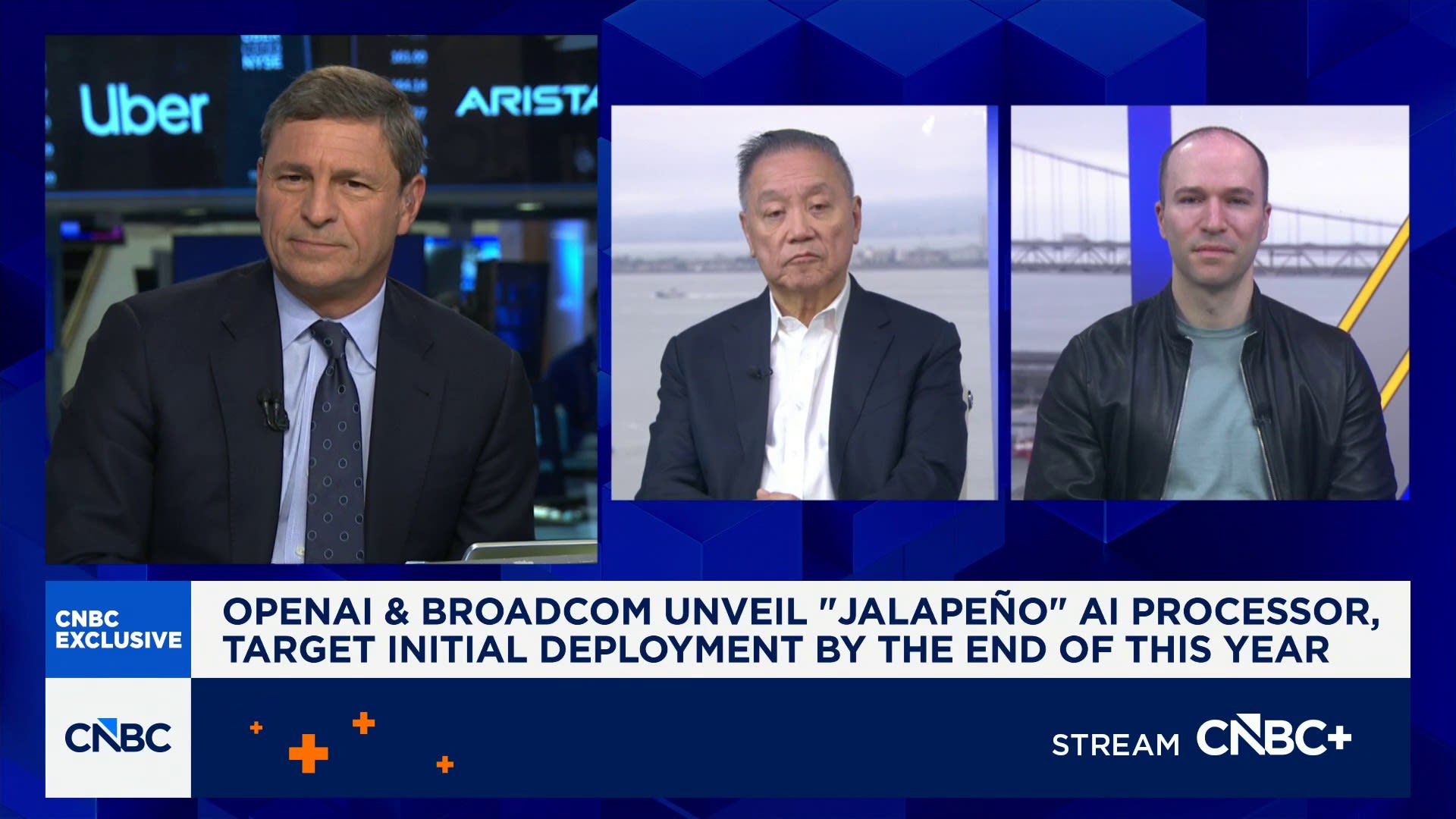
OpenAI and Broadcom unveiled Jalapeño, their first custom AI accelerator, with initial deployment targeted by the end of 2026 and a ramp expected in the following years.
Verified against source materialEdited by SendTech Times Chips & Compute Desk
OpenAI And Broadcom Name Jalapeño AI Accelerator
Image source: CNBC

OpenAI Moves From Chip Buyer To Chip Designer

OpenAI and Broadcom have unveiled Jalapeño, the first custom AI accelerator from their partnership and OpenAI's clearest move into silicon built for its own workloads.

The companies describe the chip as an Intelligence Processor and as the first accelerator in a platform intended to make advanced AI faster and more reliable.

The project changes OpenAI's infrastructure position.

The company has been one of the largest buyers of Nvidia GPUs since the generative AI boom began in 2022, but its demand for inference capacity keeps forcing it to seek other sources of silicon.

Jalapeño is designed for inference, the process of serving models to users in ChatGPT and other applications.

OpenAI President Greg Brockman said the company completed the design cycle in nine months while using its own AI models to speed the work.

The claim gives the announcement a product-development angle as well as an infrastructure angle: OpenAI is using AI tools to accelerate the design of hardware that will then run AI services.

Broadcom Puts Custom Silicon Behind The Stack

Broadcom will make the chips, giving OpenAI a manufacturing and custom-silicon partner rather than a fully internal chip supply chain.

The companies had already announced in October that they planned to develop and deploy racks of OpenAI-designed chips after 18 months of joint work.

The earlier plan pointed to deployment starting late this year and to a long-term buildout large enough to require 10 gigawatts of power.

The new disclosure narrows the story to a named chip and a physical sample scheduled for delivery to OpenAI on Wednesday.

Hock Tan said there would be small prototype development in late 2026 before a broader ramp.

He said the work should scale in '27 and go full tilt in the first half of '28.

Those timing markers matter because they separate a chip reveal from actual infrastructure delivery.

Compute Demand Still Sets The Limit

OpenAI has not abandoned outside accelerator suppliers.

The company has deals involving Amazon Web Services Trainium chips, Nvidia rival AMD and Cerebras, alongside its dependence on Nvidia GPUs.

Jalapeño therefore looks less like a replacement for the existing AI chip market and more like another supply path for a company that says it cannot get compute quickly enough.

Broadcom's role also reflects a wider shift among hyperscalers and frontier labs.

Custom ASICs can be less flexible than GPUs, but they can be designed around specific AI tasks and cost targets.

OpenAI said it also designed large parts of the computer system where Jalapeño will be used, extending the project beyond a single chip.

The economics remain tied to inference growth rather than a public sales forecast for Jalapeño.

OpenAI and Broadcom named the accelerator, the use case and the deployment path, but they did not publish chip volume, system pricing, power efficiency data or customer access beyond OpenAI's own workloads.

Those gaps keep the announcement at the infrastructure-buildout stage rather than proving cost relief for ChatGPT-scale demand.

The launch gives OpenAI a named accelerator, a Broadcom manufacturing partner, a late 2026 prototype target and a '27-to-'28 scaling window.

The unresolved operating burden is whether prototype silicon can become enough deployed inference capacity to ease OpenAI's compute shortage without adding another power bottleneck to its AI infrastructure plans.

Share this article
inXf

Related articles

More
FuriosaAI and Broadcom Target the Next Layer of AI Inference Infrastructure
Chips & Semiconductors

FuriosaAI and Broadcom Target the Next Layer of AI Inference Infrastructure

FuriosaAI said it will work with Broadcom on a next-generation AI inference platform built around its TCP architecture and Broadcom networking and packaging technologies. The planned third-generation accelerator will use a 2-nanometer compute die, HBM4/HBM4E memory and multi-die packaging, with sampling planned for the first half of 2028. The deal points to AI infrastructure competition shifting from single-chip performance toward memory, networking, power efficiency and rack-level system design.

AMD Server CPU Share Hits 33.2% as AI Server Demand Lifts the Segment
Chips & Semiconductors

AMD Server CPU Share Hits 33.2% as AI Server Demand Lifts the Segment

AMD reached 33.2 percent of the server CPU market in the first quarter of 2026 as overall x86 processor shipments fell by more than six percent. Server CPU unit shipments rose by more than 10 percent from a year earlier, while Intel still held roughly two-thirds of the server CPU market. The next signal is whether AI server demand keeps server processors stronger than the wider PC and client CPU cycle.

Huawei’s Kirin 9050 highlights 3D stacking and Tau Law ahead of the Mate 90 launch
Chips & Semiconductors

Huawei’s Kirin 9050 highlights 3D stacking and Tau Law ahead of the Mate 90 launch

Huawei plans to introduce the Kirin 9050 with the Mate 90 series this fall, with September 2026 indicated for the phone launch window. Reports tied to industry channels and an ISCAS 2026 conference presentation describe the chip as moving past Apple’s A18 while nearing first-generation 3nm-class density. The central issue is whether 3D IC stacking and Tau Law can deliver high-end results without relying on the most advanced EUV lithography tools.

AMD Ramps Venice EPYC CPUs On TSMC 2nm Process
Chips & Semiconductors

AMD Ramps Venice EPYC CPUs On TSMC 2nm Process

AMD says its 6th Gen EPYC processor, codenamed Venice, has entered production ramp on TSMC 2nm technology, with future plans for TSMC Arizona production.

Keep Reading

More Stories

Latest
Mistral OCR 4 Adds Audit Trail For Enterprise DocumentsAIJun 25, 2026Mistral OCR 4 Adds Audit Trail For Enterprise DocumentsMistral AI released OCR 4 with bounding boxes, block classification and confidence scores, pricing the document model from $4 per 1,000 pages for enterprise workflows.Japan Clears Ripple RLUSD For Regulated Stablecoin UseFintech & Digital PaymentsJun 25, 2026Japan Clears Ripple RLUSD For Regulated Stablecoin UseJapan’s Financial Services Agency approved Ripple’s RLUSD as an electronic payment instrument, allowing SBI VC Trade to offer the dollar-backed stablecoin to retail and institutional users.AD Ports Lifts GFS Stake To 81% In $300 Million DealEconomyJun 25, 2026AD Ports Lifts GFS Stake To 81% In $300 Million DealAD Ports raised its ownership of Global Feeder Shipping to 81% through a Dh1.1 billion, or $300 million, transaction as Gulf and Red Sea trade routes remain under pressure.Fed Stress Test Keeps Large Bank Capital Rules Unchanged Until 2027Real EstateJun 25, 2026Fed Stress Test Keeps Large Bank Capital Rules Unchanged Until 2027The Federal Reserve said all 32 banks in its annual stress test stayed above minimum common equity tier 1 requirements, even after projected losses of more than $708 billion.Nvidia Says Smuggled AI Data Centers Are A Dead EndChips & SemiconductorsJun 25, 2026Nvidia Says Smuggled AI Data Centers Are A Dead EndJensen Huang told Nvidia shareholders that national security comes first and said export-restricted AI data centers built from smuggled parts would lack the support needed to operate.Nvidia Tops 400 Systems On TOP500 Supercomputer ListChips & SemiconductorsJun 25, 2026Nvidia Tops 400 Systems On TOP500 Supercomputer ListNvidia says its technology now powers more than 400 of the world’s 500 fastest supercomputers, with Grace CPUs, GPUs and networking expanding across AI and science systems.Anthropic Hiring Points To Australia And Japan AI Data Center PushCloud & Data CentersJun 25, 2026Anthropic Hiring Points To Australia And Japan AI Data Center PushAnthropic is hiring compute and data center staff in Australia and Japan as its AI growth strains infrastructure and pushes the company toward new international capacity.Nvidia And AWS Add Blackwell G7 GPUs To Production AI StackCloud & Data CentersJun 25, 2026Nvidia And AWS Add Blackwell G7 GPUs To Production AI StackAWS is adding EC2 G7 instances with Nvidia RTX PRO 4500 Blackwell GPUs, cuVS-backed OpenSearch vector indexing and GB300 Exemplar Cloud status for AI training workloads.Anthropic Alleges Alibaba Used 25,000 Accounts In AI Distillation CampaignAIJun 25, 2026Anthropic Alleges Alibaba Used 25,000 Accounts In AI Distillation CampaignAnthropic told U.S. Senate banking leaders that operators affiliated with Alibaba carried out 28.8 million model exchanges using roughly 25,000 fraudulent accounts between April 22 and June 12.SK Hynix Plans Nasdaq ADR As AI Memory Demand Lifts FundraisingChips & SemiconductorsJun 25, 2026SK Hynix Plans Nasdaq ADR As AI Memory Demand Lifts FundraisingSK Hynix plans a Nasdaq ADR listing that could raise 45.45 trillion won, giving global investors a new route into AI memory demand while capacity plans remain tied to Korea and Indiana.Micron Locks AI Memory Buyers Into Long-Term Supply DealsChips & SemiconductorsJun 25, 2026Micron Locks AI Memory Buyers Into Long-Term Supply DealsMicron said fiscal third-quarter revenue reached $41.46 billion and outlined 16 long-term customer agreements as AI data center demand keeps memory supply tight into 2028.Chile Cable Dispute Turns AI Data Routes Into A Sovereignty FightCloud & Data CentersJun 25, 2026Chile Cable Dispute Turns AI Data Routes Into A Sovereignty FightChile’s review of a $500-million China Mobile subsea cable proposal collided with U.S. pressure, while Google’s 14,800-kilometer Humboldt route remains the country’s approved Asia-Pacific link.